

She says she forgives you. She just doesn’t look at you the same way anymore. You’ve apologized more times than you can count, and somehow it hasn’t moved the needle at all.
Here’s the direct answer: trust and respect aren’t the same thing, and you can’t buy either one with an apology. Trust is about whether she can rely on you. Respect is about who your choices tell her you actually are. You don’t earn it back by convincing her you’ve changed. You earn it by becoming consistent, staying emotionally strong instead of collapsing into your own guilt, and building the kind of integrity that holds up even when she’s not watching.
If you’re looking for the broader process of rebuilding trust after infidelity, that’s a related but different piece of work. This one is about your side of it specifically: what has to change in you before respect has any reason to come back.
The 3 Non-Negotiable Rules to Earn Respect Back After Infidelity | Marriage Intervention | 003
34:27 ·
Respect and Trust Are Not the Same Thing
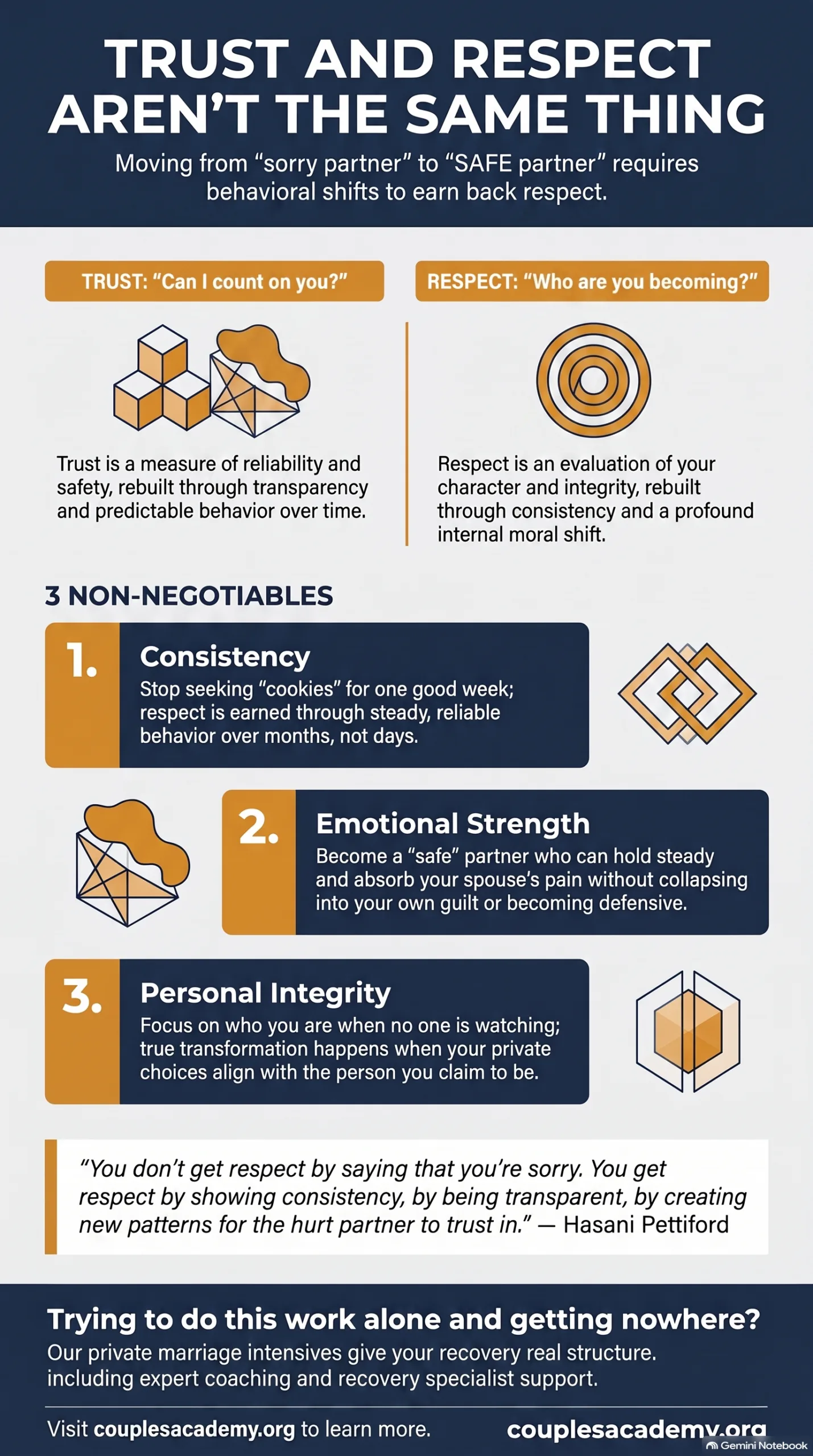
Trust asks a simple question: can I count on you? Will you be where you say you’ll be, tell me the truth, keep the boundaries we agreed on? Respect asks something different: who are you becoming? What do your choices say about your character when nothing forces your hand?
Before the affair, trust was probably something you never had to think about. It was assumed. Now it has to be rebuilt on purpose, through effort, over time. Respect works the same way, except it’s not really about compliance. You can share your passwords, come home on time, and answer every question honestly, and still not be respected, because respect isn’t measuring whether you follow the rules. It’s measuring who you are.
| Area | Rebuilding Trust Is About | Rebuilding Respect Is About | What She Can Actually Observe |
|---|---|---|---|
| Honesty | Whether she can increasingly rely on what you tell her and trust that important information is not being hidden. | Whether truthfulness is becoming something you choose even when honesty is uncomfortable or makes you look bad. | Your story remains consistent, reasonable questions receive honest answers, and significant information is offered rather than discovered later. |
| Keeping promises | Whether you do what you said you would do and become more predictable in everyday life. | Whether commitments still matter when keeping them is inconvenient and no praise is attached. | You follow through on small commitments as consistently as the major promises connected to recovery. |
| Transparency | Whether there is enough openness for secrecy and uncertainty to begin decreasing. | Whether openness is being offered voluntarily instead of treated as punishment or something she has to force from you. | Relevant schedule changes, contact, or other important information is communicated before she has to investigate or repeatedly ask. |
| Boundaries | Whether the agreements designed to protect the relationship are actually being followed. | Whether you are developing the judgment and discipline to protect those boundaries without needing to be supervised. | Appropriate boundaries with the affair partner and other outside relationships remain in place, and meaningful exceptions or unavoidable contact are disclosed. |
| When no one is watching | Whether the reliable behavior continues even when she cannot directly verify it. | Whether your private choices are beginning to match the values and commitments you describe publicly. | The same boundaries and standards remain in place when there is little chance of being caught or receiving credit. |
| Difficult conversations | Whether she can ask important questions and receive answers that remain honest and consistent. | Whether you can stay emotionally present without making your discomfort more important than the impact of what happened. | You listen, answer reasonably, acknowledge the impact, and manage your own emotions without requiring her to comfort you. |
| Consistency under stress | Whether reliability survives ordinary stress, conflict, disappointment, and changes in routine. | Whether doing the right thing has become less dependent on being praised, monitored, or afraid of losing the marriage. | The behavior remains steady after the immediate crisis passes and when life becomes difficult again. |
| Taking responsibility for personal change | Whether you are following through on the changes necessary to stop secrecy and reduce the risk of repeating the same pattern. | Whether you are taking ownership of who you become instead of waiting for her to manage your recovery for you. | You initiate needed changes, examine your own choices, maintain the work without reminders, and avoid making the marriage or your spouse responsible for the affair. |
The same behavior can help rebuild both—but respect has less to do with completing the recovery checklist and more to do with whether honesty, consistency, emotional strength, and integrity are becoming part of how you live.
This is where a lot of people get stuck. They put all their energy into proving they can be trusted again, checking every box on the transparency list, and can’t understand why she still seems distant. Usually it’s because trust and respect are being rebuilt on two different tracks, and only one of them is getting any attention.
“You don’t get respect by saying that you’re sorry. You get respect by showing consistency, by being transparent, by creating new patterns for the hurt partner to trust in.”
— Hasani Pettiford, Marriage Intervention
The Three Non-Negotiables
Hasani’s framework for rebuilding respect comes down to three things, and none of them are about what you say.
1. Consistency
Stop trying to convince her and start being reliable instead. Respect doesn’t come from one good week, one grand gesture, or a moment where you finally said the right thing. It comes from doing the right thing so consistently that it stops being remarkable and starts being who you are.
2. Emotional Strength
Showing remorse matters. But if you fall apart every time she’s triggered, she ends up managing your emotions on top of her own pain, and that’s backward. She needs to see that you can hold steady while she’s hurting, not collapse and make her comfort you.
3. Personal Integrity
Integrity is who you are and how you show up when no one’s watching. Plenty of people are well regarded at work, in their friend group, in their community, and still lose all credibility at home. That gap only closes through real, internal change, not through managing your image better.
| When This Happens | Non-Negotiable | What Undermines Respect | A Stronger Response | What She Can Actually Observe |
|---|---|---|---|---|
| The pain of the affair comes up again | EMOTIONAL STRENGTH | Becoming defensive, collapsing into guilt, or becoming so distressed that she has to stop dealing with her own pain to reassure you. | Stay present, acknowledge what she is feeling, and manage your own emotions without making her responsible for them. | You can hear difficult emotions without immediately defending yourself, shutting down, or requiring comfort. |
| She asks another difficult question about the affair | EMOTIONAL STRENGTH | “We’ve already talked about this,” becoming evasive, or treating the question itself as the problem. | Answer honestly, stay patient, and acknowledge that questions may return as she makes sense of what happened. | Your answers remain consistent, and difficult conversations do not automatically turn into defensiveness or avoidance. |
| Respect or forgiveness is returning more slowly than you hoped | EMOTIONAL STRENGTH | “Nothing I do is good enough,” pressuring her to forgive, or giving up because you’re not receiving credit yet. | Accept that you cannot control her timeline and continue doing the work because it is the right thing to do. | Your behavior remains steady without demanding forgiveness, praise, or immediate restoration of respect. |
| A small promise or everyday commitment is tested | CONSISTENCY | Being reliable only when the marriage feels at risk or expecting praise for doing what you agreed to do. | Keep the promise because reliability is becoming your normal behavior, not a temporary recovery strategy. | The small commitments are kept consistently, not just the ones directly connected to the affair. |
| The immediate crisis has passed | CONSISTENCY | Returning to old habits once the pressure decreases or becoming less open because she appears calmer. | Continue communicating clearly, following through, and being open without waiting for another crisis to force the behavior. | The new pattern continues after the urgency fades and when nobody is reminding you to maintain it. |
| Boundaries with other people are tested | CONSISTENCY | Becoming secretive, making exceptions, or assuming that good intentions should be enough. | Maintain the boundaries you agreed to and disclose situations that could reasonably affect trust. | You protect the relationship consistently instead of requiring her to investigate whether the boundaries are still being honored. |
| Unexpected contact from the affair partner occurs | PERSONAL INTEGRITY | Hiding the contact, deleting evidence of it, or waiting to disclose it only if you think she may discover it. | Follow the boundaries already established and disclose meaningful contact proactively rather than protecting yourself from an uncomfortable conversation. | Important information is volunteered rather than discovered later, and the story remains consistent. |
| You are confronted with the damage your choices caused | PERSONAL INTEGRITY | Blame-shifting, excuses, or adding “yes, but” every time responsibility becomes uncomfortable. | Own the choices you made while still being willing to examine what in you needs to change so those choices are not repeated. | You take responsibility without making marital problems, stress, or another person responsible for the affair. |
| No one would know if you crossed a boundary | PERSONAL INTEGRITY | Treating integrity as something that matters only when there is a risk of getting caught. | Make the same choice privately that you would make if your spouse were standing beside you. | Your standards remain consistent across private conversations, social situations, finances, devices, and other areas where secrecy could return. |
Consistency is doing it again tomorrow. Emotional strength is staying present when the consequences are uncomfortable. Personal integrity is making the right choice even when no one would know the difference.
Why Apologizing Doesn’t Earn Respect Back
An apology can acknowledge what happened. It can’t undo it, and it definitely can’t stand in for the months of behavior that actually rebuild respect. Saying sorry is the first breath of accountability, not the whole job.
Over-apologizing tends to backfire in a specific way: it shifts the emotional labor back onto her. Instead of processing her own pain, she’s reassuring you that you’re still a good person. That’s the opposite of what rebuilds respect. What she actually needs isn’t more words about how sorry you are. It’s evidence, repeated often enough, that you’ve become someone different.
A useful gut check: are you apologizing because it helps her heal, or because saying it out loud makes you feel less guilty? Those are different motivations, and she can usually tell the difference even when you can’t.
How Long This Actually Takes
There’s no fixed timeline, and anyone who gives you an exact number of months is guessing. What’s more useful than a countdown is understanding the shape of it: an early period focused on stabilizing and stopping further harm, a middle stretch focused on understanding what happened and why, and a longer period of actually rebuilding new patterns and habits together.
If you’re several months in and still frustrated that respect hasn’t fully returned, that’s not necessarily a sign that anything is broken. Trust is lost in buckets and gained in drops. Respect works the same way. Rushing it or demanding it on a schedule tends to reset the clock rather than speed it up.
What She Needs to See, Not Hear
Words carry very little weight right now, and that’s fair. What actually moves things forward is behavior she can observe over time:
Telling her about something before she has to ask. Keeping the small promises, not just the big ones. Staying full and complete contact-free with the affair partner, without needing reminders. Sitting with her pain when it resurfaces instead of getting defensive or acting like it should be over by now. Letting your actions match your words often enough that the two stop needing to be compared.
| What You May Be Saying | Why the Words Aren’t Enough Yet | What to Do Instead | What She Can Actually Observe |
|---|---|---|---|
| “I’m sorry.” | An apology can acknowledge the harm, but it cannot by itself show who you are becoming or what you will do differently. | Keep the apology sincere and simple, then let patience, reliability, and changed behavior carry more of the message. | You stay present when the affair comes up again instead of treating the apology as the end of the conversation. |
| “I’ve changed.” | Character change cannot be established simply by declaring it, especially while the relationship is still in crisis. | Stop trying to convince her. Continue the new behavior when there is no praise, pressure, or immediate consequence. | The same standards remain in place when no one is monitoring you and life has returned to ordinary stress. |
| “You can trust me.” | Trust is not something you can require her to feel. It is a conclusion she has to reach from the evidence she sees. | Focus on becoming reliably truthful, predictable, and consistent instead of asking her to believe the statement. | Your story remains consistent, promises are kept, and your actions repeatedly match what you say. |
| “It will never happen again.” | A promise about the future cannot show how you will handle temptation, secrecy, loneliness, conflict, or opportunity differently. | Identify the boundaries, habits, and decisions that are changing so the promise is supported by something concrete. | Those boundaries continue to be honored even when no one is checking whether you’re following them. |
| “I’m doing everything you asked.” | Completing a checklist can show cooperation, but respect is not something you earn by completing enough assigned tasks. | Begin taking responsibility for the work yourself instead of waiting for her to tell you every next step. | You initiate difficult conversations, maintain agreements, and follow through without needing repeated reminders. |
| “I’m being transparent.” | Transparency means more than answering questions after she becomes suspicious or discovers something herself. | Offer relevant information proactively and disclose meaningful contact or uncomfortable facts before they have to be uncovered. | Important information is volunteered rather than extracted, and secrecy does not simply move to another place. |
| “I love you. The affair is over.” | Love and ending the affair matter, but neither one automatically repairs the damage caused by secrecy or restores respect. | Protect the relationship through honesty, appropriate boundaries, responsibility, and choices that match what you say you value. | The affair remains ended, boundaries remain clear, and you own your choices without attaching them to what she did wrong. |
| “I don’t know what else you want me to do.” | Frustration is understandable, but making the conversation about how difficult recovery is for you can put the emotional burden back on her. | Stay present and ask a better question: “What still feels unresolved, and what part of that is mine to address?” | You can tolerate frustration without becoming defensive, giving up, or requiring her to reassure you that your efforts are enough. |
Let consistency, emotional strength, and personal integrity create the evidence. Respect has a reason to return when who you say you are and how you actually live begin matching again.
One shift changes more than almost anything else: leading with impact instead of explanation. When something comes up, the instinct is often to explain yourself. What she needs first is acknowledgment of how it landed on her, before any explanation at all.
Doing This Work With Structure
Most people trying to rebuild respect on their own end up circling the same argument, the same defensiveness, the same cycle of apology and disappointment, because willpower alone rarely holds up under the weight of this kind of repair. Having a structured process, and someone guiding it who isn’t emotionally inside the situation, tends to make the difference between good intentions and actual change.
This is exactly what our private marriage intensives are built for, especially when you’re genuinely trying but the same conversations keep going nowhere. If you’re earlier in the process and still figuring out what recovery actually requires from both of you, our affair recovery coaching is a good place to start.
Loading Viewer...
FAQ
How is respect different from trust after an affair?
Trust is about reliability: can she count on what you say and do. Respect is about character: what your choices reveal about who you are. You can rebuild a working level of trust through consistent transparency and still not have earned respect back, because respect requires her to see real change in you, not just compliance with new rules.
Can a marriage recover if there’s no respect left?
It’s possible, but it takes real work, not just time passing. Respect can be rebuilt when the unfaithful partner shows sustained consistency, emotional strength, and integrity, rather than relying on apologies alone. If none of that changes, the relationship tends to stay stuck exactly where it is.
How long does it take to earn respect back?
There’s no set timeline, and it’s usually longer than the person who cheated expects. What matters more than the calendar is whether the behavior is consistent, whether it holds up under normal stress, and whether it continues even without acknowledgment.
What should the unfaithful partner do first?
Stop trying to convince her with words and start proving it through consistent behavior. That means full transparency without being asked, complete distance from the affair partner, and staying emotionally steady when she’s triggered instead of needing to be comforted yourself.
