

You don’t want to think about her. But she’s there, in quiet moments, in the shower, at 2 a.m., in the middle of a normal Tuesday. You fantasize about confronting her. You compare yourself to her. And then you feel a little crazy for how much space she’s taking up in your head.
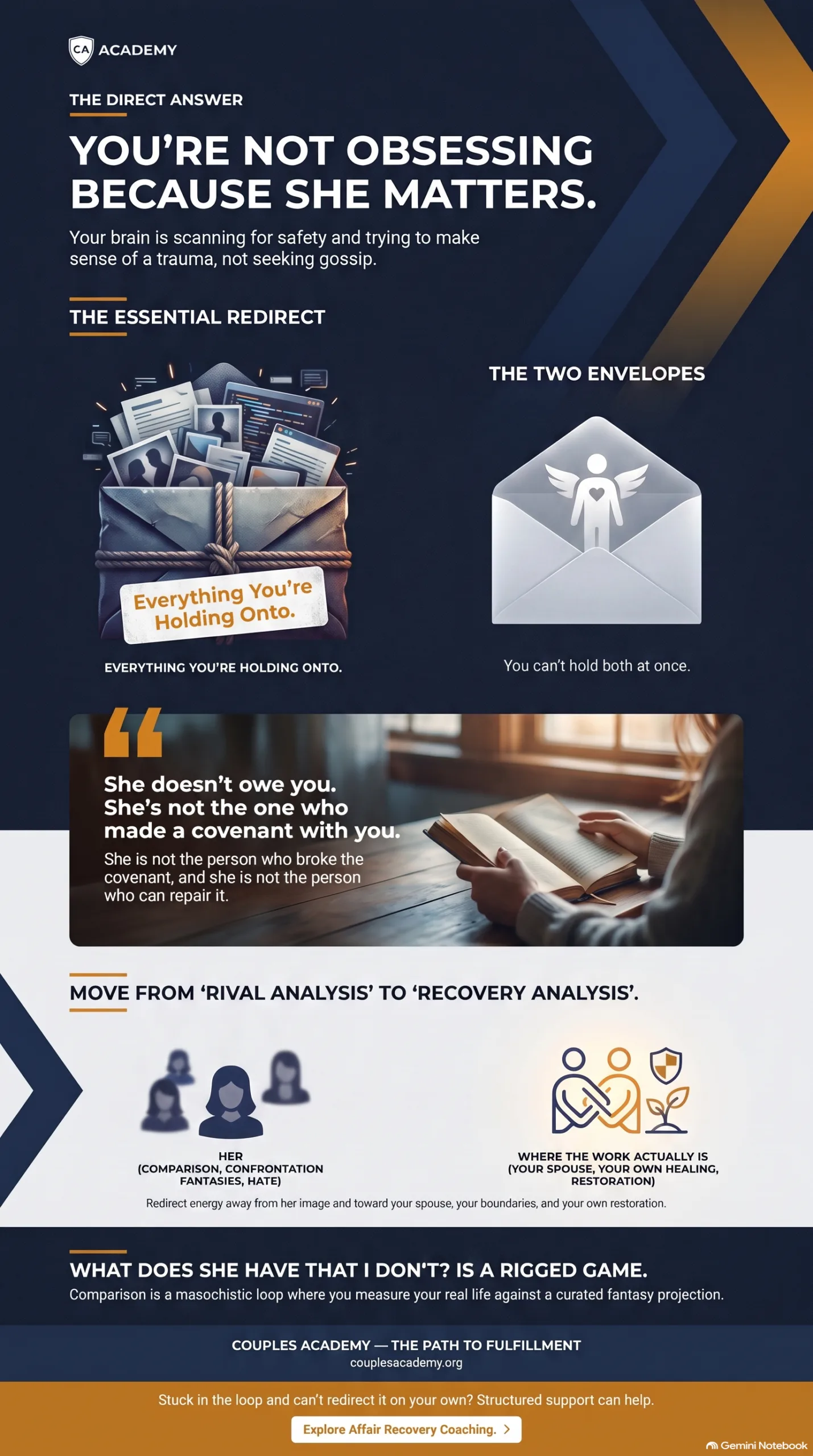
Here’s the direct answer: you’re not obsessing because she matters. You’re obsessing because your brain is trying to regain control after being blindsided, and she’s the most concrete thing to focus that on. The relief isn’t in confronting her, punishing her, or out-competing her. It’s in redirecting that energy toward the person who actually broke the covenant with you.
If part of what’s fueling this is a specific trigger, like seeing her name, a place, or a certain time of day, this guide on infidelity triggers can help you work through those moments directly. Here, we’re focused on the bigger pattern: why she’s occupying so much space, and how to actually loosen her grip.
| What You Find Yourself Doing | What You May Be Trying to Regain | Why It Keeps You Stuck | Where to Redirect the Energy |
|---|---|---|---|
| Replaying imagined confrontations | Power, agency, and a sense of justice | Every mental argument keeps your attention tied to her instead of moving toward the questions and decisions that actually affect your recovery. | Ask what you genuinely need to say, know, or establish—and direct the accountability conversation toward your spouse. |
| Searching for more information about her | Certainty, safety, and an explanation | More details can create more questions, comparisons, and mental images without necessarily giving you the certainty you’re looking for. | Focus on information that actually changes a decision, boundary, or understanding of what happened. |
| Checking her social media | Control and predictability | Each visit gives her another opportunity to enter your thoughts, trigger comparison, and become part of your daily life. | Add friction: mute, unfollow, block, or otherwise reduce unnecessary exposure so checking requires a deliberate choice. |
| Comparing your appearance to hers | Reassurance that you are attractive and enough | It turns the affair into a competition and makes her the measuring stick for your value. | Separate your worth from your spouse’s choices. If you want to improve something about yourself, make the goal yours—not a contest with her. |
| Wondering what she had that you didn’t | An explanation for why this happened | It frames the betrayal as evidence that you lost to someone else rather than examining the choices your spouse made. | Shift the question from “What did she have?” to “What choices were made, what boundaries failed, and what is changing now?” |
| Refusing to say her name or dehumanizing her | Distance, power, and protection from pain | She can remain psychologically central even when every thought about her is negative. | You do not have to like, forgive, or understand her. The goal is simply to stop allowing her to occupy the center of your recovery. |
| Imagining getting even | Justice and a restored sense of power | Revenge fantasies can keep you mentally engaged with the same person you’re trying to remove from your life. | Name what feels unfair, write what you wish you could say without sending it, and put your energy into choices that restore your own agency. |
| Asking why your spouse chose her | Logic, truth, and a coherent story | It assumes she contains the explanation when the more important answers concern your spouse’s choices, boundaries, secrecy, and behavior. | Ask what your spouse now understands about their choices and what concrete changes they are making to become trustworthy. |
| Trying to outperform or out-improve her | Validation, security, and proof that you are better | Your progress remains tied to her as long as the goal is beating her rather than becoming who you want to become. | Improve your health, confidence, work, relationships, or life because those things matter to you—not because she is watching. |
Stop Obsessing Over the Other Woman | Why She’s Blocking Your Healing | Marriage Intervention | 007
16:48 · youtube.com/watch?v=QsC5o4Nqq6c
Why You Can’t Stop Thinking About Her
Think of it as two envelopes. One is heavy: full of details, evidence, receipts, every fact you’ve collected about her. It feels important to hold onto, but it’s the thing keeping you stuck in the trigger, in the pain, in everything you’re actually trying to let go of. The other envelope is smaller and lighter. That one is your healing. And here’s the hard part: you can’t hold both at once.
Fantasizing about confronting her is a completely normal response, not a sign that something’s wrong with you. You were blindsided by someone close to you, and your brain is trying to regain a sense of agency it lost in that moment. It’s the same reflex as replaying an argument hours later, rehearsing everything you should have said. You’re trying to take back some of the control that was ripped away from you.
What She Represents (It’s Rarely Actually About Her)
The hate you feel toward her is rarely just about her as a person. She’s become a stand-in for everything the betrayal represents: the home wrecker, the one who was chosen, the embodiment of every insecurity you already carried about your age, your body, your worth. Every time you think about her, you get a hit of anger, because she’s become the trigger itself.
This is why it’s so common to dehumanize her, to refuse to say her name, to reach for the worst possible words to describe her. But staying that psychologically tied to her keeps the rage active and keeps you exactly where you are. The harder, more useful truth is this: she wasn’t the one who made a covenant with you. She wasn’t the one who broke it. Your spouse was.
“She doesn’t owe you. She’s not the one who made a covenant with you. She’s not the one who broke the covenant with you.”
— Marriage Intervention
Will Confronting Her Actually Help?
Probably not the way you’re imagining. Fantasies about confrontation rarely play out the way we rehearse them. What tends to happen instead is that every time you replay it, every time you have a mental argument with her, you lose a little more of the power you’re actually trying to get back.
| What You Feel Like Doing | What You Hope It Will Give You | What It May Keep Alive | A More Recovery-Focused Alternative |
|---|---|---|---|
| Confronting her in person or by message | Answers, closure, power, or the chance to finally say what you’ve been rehearsing. | It can keep your attention on someone who cannot do the repair work your marriage actually requires. | Identify exactly what you want answered or acknowledged, then decide whether that need belongs in a conversation with your spouse instead. |
| Checking her social media | Information, predictability, and reassurance that there isn’t another surprise waiting. | Each check can create another comparison, question, image, or reason to check again. | Mute, unfollow, or block unnecessary access. When the urge appears, remind yourself: “This is an urge. I don’t have to act on it.” |
| Comparing your age, appearance, or success to hers | Proof that you are still desirable, valuable, and “enough.” | It turns the affair into a contest and makes another person the measuring stick for your worth. | Separate your value from your spouse’s choices. If you want to improve something in your life, make the goal meaningful to you—not a way to beat her. |
| Collecting more details about her life | A complete story, a sense of safety, or an explanation that finally makes the affair make sense. | More details can give your mind more material to replay without changing what you actually need to decide. | Focus on information that affects your health, safety, boundaries, understanding of the affair, or decisions about the relationship. |
| Trying to force yourself to stop thinking about her | Immediate relief and proof that you’re finally “over it.” | Fighting every thought can make the thought itself feel even more important whenever it returns. | Notice the thought without turning it into an assignment: “She’s on my mind again. I don’t have to follow this thought anywhere.” |
| Directing all your anger toward her | A simpler explanation and someone concrete to blame. | It can pull attention away from the commitments, choices, secrecy, and accountability inside your own relationship. | Bring the focus back to the person who made the commitment to you and what they are doing now to repair the damage. |
| Monitoring your spouse—or asking others to monitor her | Safety, certainty, and a guarantee that you won’t be blindsided again. | It can leave you responsible for preventing another betrayal instead of watching whether your spouse is becoming trustworthy on their own. | Look for voluntary transparency, clear boundaries, consistency, and whether your spouse protects the relationship without needing to be policed. |
| Replaying affair images or details during intimacy | Understanding, control, or a way to mentally solve what happened. | The past can take over the present moment and make closeness feel connected to the betrayal instead of what is happening now. | Pause if you need to. Reorient to the room, your breathing, what you’re feeling now, and whether you actually want to continue. |
Instead of asking, “What can I do about her?” ask, “What am I hoping this will give me—and is there a better place to get it?”
The more useful reframe isn’t “how do I confront her,” it’s “how do I actually move forward from this.” That means detaching from the mental images and expectations you’re carrying about her, one piece at a time, and pointing that same energy toward the person who does owe you something: your spouse, and the work of repairing what’s actually yours to repair.
“Just Take the High Road” Isn’t the Whole Story
If people keep telling you to ignore her and take the high road, and it feels like being asked to just get over it, your frustration makes sense. Telling someone who’s had their entire sense of reality upended to simply let it go is some of the laziest advice out there. It’s not the person who was betrayed giving that advice. It usually comes from people who are uncomfortable watching you sit in something hard.
Here’s the distinction worth holding onto: taking the high road was never really about her. It’s about who you’re becoming as a result of what happened to you. It’s not letting her off the hook, and it’s not about being the bigger person for her benefit. It’s about not staying stuck in resentment that isn’t actually serving where you’re trying to go.
If there’s something you genuinely need to say, that doesn’t have to disappear. Some couples work through a structured closing conversation as part of ending the affair for good, one that gives you a chance to say what needs to be said without it turning into an unstructured confrontation that goes sideways.
When “Getting Better” Is Really About Her
Dressing better, working out, pushing harder at work after discovering an affair isn’t inherently a problem. But if you’re honest with yourself and all of it is aimed at proving something to her, that’s worth paying attention to, because it’s still focused entirely on the outside.
Here’s what tends to surprise people: most affairs aren’t actually about physical attraction. What draws someone in is usually something else entirely, a shared connection, a certain kind of attention, a familiar dynamic from somewhere in their own history. If you’re changing your body or your wardrobe to compete with her, you may be chasing something that was never actually the reason in the first place.
| The Comparison Thought | Where It Keeps Your Attention | A More Useful Reframe | What Moving Forward Can Look Like |
|---|---|---|---|
| “Was she prettier, younger, or more attractive?” | On appearance as if the affair were a ranking of who was more desirable or valuable. | Your spouse’s decision to cheat is not an objective score of your attractiveness or worth. | Care for your body, appearance, and confidence because they matter to you—not because you’re trying to beat someone else. |
| “What did she have that I didn’t?” | On searching her characteristics for the explanation that will finally make the betrayal make sense. | Different does not mean better. Her traits do not explain away your spouse’s choices or determine your value. | Replace “What did she have?” with questions about what happened, what boundaries were crossed, and what your spouse understands now. |
| “Why was she chosen over me?” | On turning betrayal into a win-or-lose competition between two people. | You were not competing for a prize. Your spouse had a commitment to you and made choices that violated it. | Evaluate your spouse’s accountability, honesty, boundaries, and willingness to do the work required for repair. |
| “Is she more successful, interesting, or confident?” | On comparing your full life to the limited version of her that you see or imagine. | You do not know her whole life, and you do not need to understand or outperform it to know your own worth. | Reduce unnecessary exposure to her life and put that attention back into your own relationships, interests, goals, and confidence. |
| “Was she better in bed?” | On turning intimacy into another category where you believe you need to prove you were “better.” | You do not have to outperform another person to deserve fidelity, respect, or emotional safety. | Ask only for details that actually help you understand the affair, make informed decisions, or establish what you need going forward. |
| “Why wasn’t I enough?” | On making another person’s behavior evidence about your adequacy. | Someone else’s betrayal does not establish that you lacked something required to deserve faithfulness. | When the thought appears, notice it without treating it as a fact. Bring your attention back to what you know about your own character, values, and worth. |
| “Is he still attracted to her or does he care about her more?” | On trying to read feelings you cannot directly control or verify. | The more useful recovery question is not whether every feeling disappeared overnight, but whether the affair has ended and appropriate boundaries are being maintained. | Watch current behavior: honesty, appropriate no-contact boundaries, transparency, accountability, and consistent investment in the marriage. |
| “What does she think about me?” | On allowing another person’s opinion to influence how you see yourself. | Her opinion does not get a vote in your identity, your marriage decisions, or your worth. | Reduce voluntary exposure to her life and opinions. Put your attention back on the people, values, and evidence that actually deserve influence over how you see yourself. |
Don’t ask, “How do I become better than her?” Ask, “Who do I want to become after this—and what would I be working toward if she weren’t part of the equation?”
It’s also worth asking: where was this motivation before? Sometimes a crisis becomes the thing that finally gets us moving. That’s not shameful, that’s human. The shift worth making is doing this for yourself, becoming a stronger version of you, rather than using her as the measuring stick. There’s no better competition than the one between you and who you were yesterday.
Where to Redirect the Focus
Every ounce of energy spent fantasizing about her, hating her, comparing yourself to her, or trying to out-do her is energy that isn’t going toward the actual repair work: your relationship with your spouse, and your relationship with yourself.
If you find yourself stuck in this loop and can’t seem to redirect it on your own, that’s exactly the kind of pattern structured affair recovery coaching is built to help untangle. And if you and your spouse keep circling the same conversations without making real progress, a private marriage intensive can give you focused, guided time to actually work through it together.
Loading Viewer...
FAQ
Is it normal to obsess over the other woman after infidelity?
Yes. Fantasizing about her, replaying things in your head, and fixating on details are common responses to being blindsided. It’s your brain trying to regain a sense of control after losing it in the moment of discovery, not a sign that something is wrong with you.
How do I stop comparing myself to the affair partner?
Start by questioning the premise. Most affairs aren’t actually about one person being more attractive than another. If you’re changing how you look specifically to prove something to her, try redirecting that energy toward becoming a stronger version of yourself for your own sake, not as a competition with her.
Why do I want to know everything about her?
Wanting details often comes from wanting your power and agency back after being blindsided, more than genuine curiosity about her as a person. The trouble is that more information about her rarely delivers the relief it seems to promise, and it can keep you psychologically tied to the very thing you’re trying to move past.
Will the obsession ever stop?
It tends to loosen as you shift your focus off her and onto the person who actually owes you repair: your spouse. Staying psychologically tied to the affair partner keeps the rage and pain active. Redirecting that energy toward your own healing and the real work in your relationship is what actually moves things forward.
