

He confessed. You thought the worst was over. Then a week later something didn’t add up, you pushed, and a new detail came out. Then another. Then something he said in month one directly contradicted something he said in month three. And now you don’t know what’s actually true — or whether you ever will.
Here’s the direct answer: what you’re describing has a name. It’s called trickle truth — a pattern where the full account of an affair is released in pieces, each one usually extracted under pressure rather than offered voluntarily. It isn’t random forgetfulness. It’s almost always driven by self-protection, shame management, or a calculated attempt to limit consequences. And it is one of the most damaging things that can happen to a couple trying to rebuild, because you cannot build safety on a foundation that keeps shifting.
If what you’re also hearing is “it was just a mistake” or “you’re making it bigger than it was,” those phrases are related but distinct — that’s minimizing language, and this piece on why minimizing the affair destroys trust covers that pattern directly. Here, we’re focused on the ongoing deception that continues even after the affair is known.
Why Does My Spouse Keep Lying About the Affair? | Marriage Intervention | 011
What Trickle Truth Is and Why It Happens
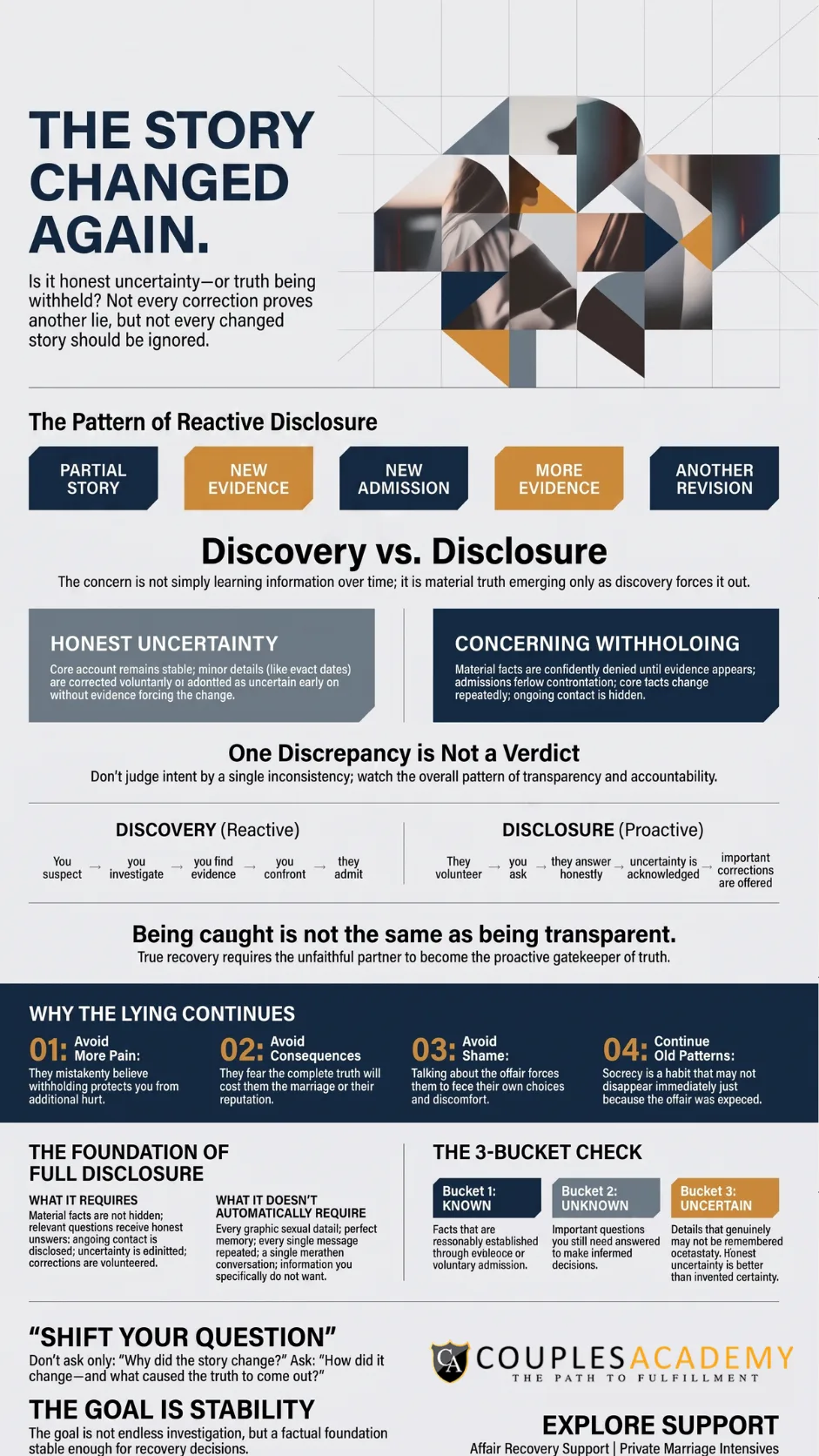
Trickle truth is the pattern of releasing the full account of an affair in small, reluctant pieces — usually only when the betrayed partner discovers a new piece of evidence or pushes hard enough that staying silent becomes harder than admitting the next thing. It’s a disclosure pattern, and it looks like this: a partial confession, then a correction, then “I forgot to mention,” then a contradiction of something said earlier, then another correction when you catch it.
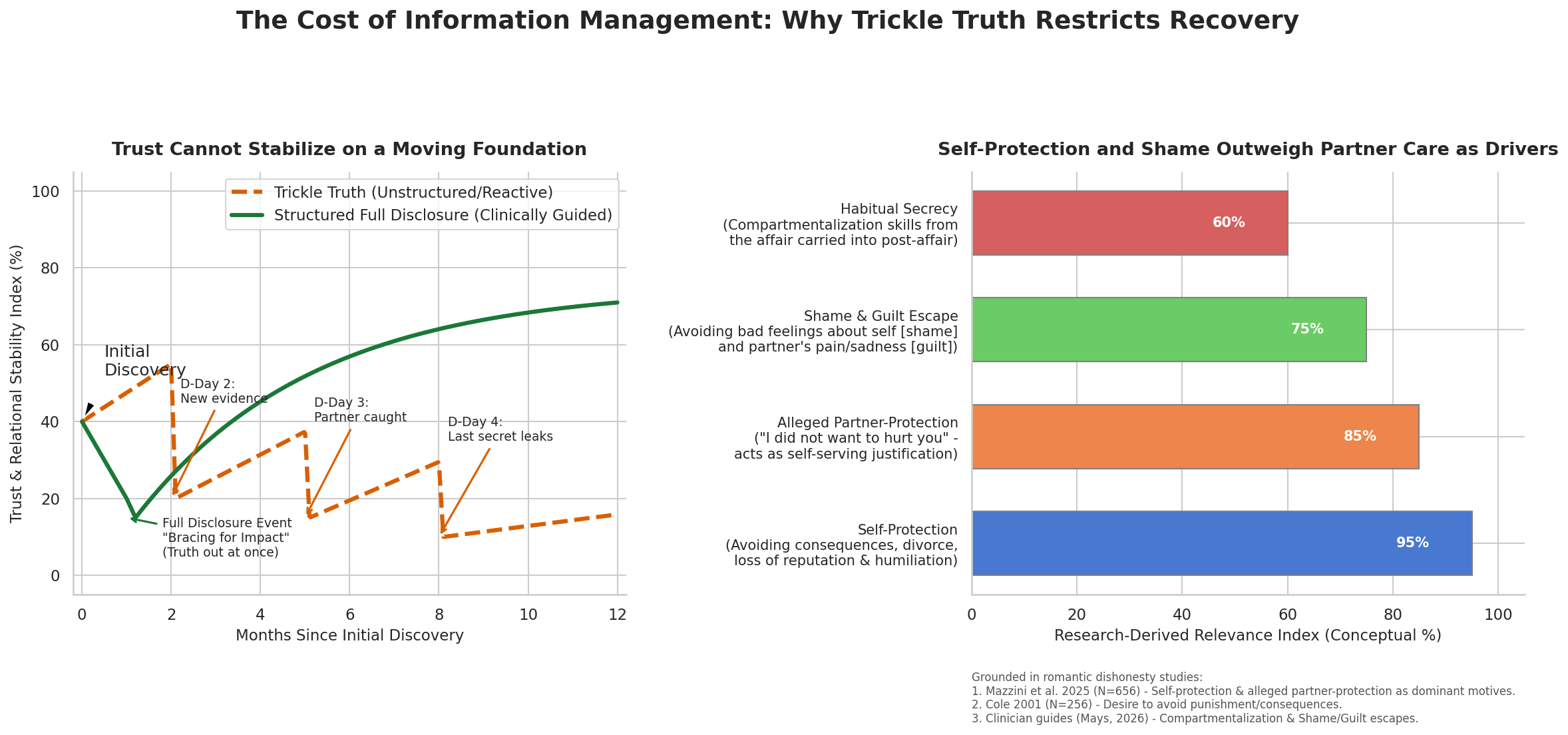
It tends to happen for four main reasons, and they’re rarely about protecting you. The most common driver is self-protection — each new detail carries additional consequences, and withholding buys time. Close behind that is shame management: the full picture feels too ugly to say out loud, so it comes out in pieces because pieces are easier to survive emotionally. Third is habitual compartmentalization, the same skill that made it possible to run an affair while appearing normal at home, carried directly into the post-discovery period. And fourth is the “I didn’t want to hurt you more” justification — which sounds considerate and is almost always self-serving.
None of these reasons mean the affair is continuing. But all of them mean the deception is.
Why Your Spouse Keeps Changing the Story
The story keeps changing because it was never complete to begin with. Each version was the minimum that felt survivable in the moment — enough to stop the immediate pressure, not enough to actually settle the account. So when new evidence surfaces, or when you push past the last boundary of what was disclosed, the story has to update again.
What makes this so destabilizing is that each new disclosure creates a new discovery event. You don’t experience one D-Day. You experience a series of them, and each one resets the clock on whatever fragile stability had started to build. The chart below illustrates what this looks like over time compared to structured full disclosure — trust cannot stabilize on a foundation that keeps moving.
“You cannot heal what hasn’t been fully revealed. Every piece of the truth that’s still being managed is a piece of the foundation that isn’t there yet.”
— Hasani Pettiford, Marriage Intervention
The Difference Between Forgetting and Withholding
This distinction matters, and it’s worth pressing on when you’re trying to figure out what you’re actually dealing with. Genuine memory gaps exist. Trauma affects recall on both sides, and the unfaithful partner may genuinely not remember specific dates, specific conversations, or peripheral details with the precision you need.
But there’s a reliable way to tell the difference between honest forgetting and deliberate withholding. Forgotten things tend to stay forgotten — or surface unprompted when something triggers the memory. Withheld things have a specific quality: they appear exactly when the evidence makes continuing to hide them impossible, and they’re accompanied by some version of “I didn’t think it was important” or “I didn’t want to hurt you more.”
| Looks Like Forgetting | Looks Like Withholding |
|---|---|
| Peripheral details (exact dates, what was ordered at dinner) | Core facts (how long, how many times, who else knew) |
| New information surfaces unprompted when something triggers it | New information appears only when confronted with evidence |
| Corrections don’t change the fundamental shape of the story | Each “correction” significantly changes what happened or for how long |
| Person seems genuinely uncertain, not evasive | Person seems certain about some things but strategically vague about others |
What Trickle Truth Does to the Recovery Process
Recovery requires your nervous system to slowly learn that safety is possible again. That learning happens through consistent, verifiable truth over time — through checking and finding nothing new, through disclosures that stop changing, through a story that finally holds still long enough to stand on.
Trickle truth makes that impossible. Every new piece of information, regardless of how small, is a new betrayal event. It re-triggers the original discovery response, resets whatever fragile trust had started to accumulate, and tells your nervous system that the threat isn’t actually over — which is why you can’t stop hypervigilantly scanning even when things seem quiet. The scanner isn’t broken. It has been right every single time something new came out.
It also changes how you relate to the information you do have. Once a story has changed multiple times, you lose the ability to trust any version of it, including the current one. That’s not irrationality. That’s a completely calibrated response to the pattern you’ve actually experienced.
How to Stop the Cycle of Partial Disclosure
You can’t force someone to tell you the full truth. What you can do is name the pattern clearly, raise the cost of continuing it, and make the path to full disclosure as low-friction as possible.
Naming it matters because trickle truth operates best when it’s unnamed. “I keep finding out new things” is easier to explain away than “this is a specific pattern called trickle truth, and every piece you release only when caught makes recovery structurally impossible.” When you put language on it, you change what it is to sit in the room with it.
The framing that tends to work better than “tell me everything right now” is something closer to: “I need one complete, honest account. I’m not going to be more angry about what’s in it than I am about the pattern of it coming out in pieces. The pieces are what’s destroying this.” That shifts the frame from interrogation to a genuine offer — which is the only version of this conversation that might actually land.
What Full Disclosure Actually Requires
Full disclosure isn’t a confession of every sensory detail. Some information genuinely doesn’t help recovery and may make it harder — the specific physical content of what happened between them, for example, tends to create intrusive images that stick rather than providing resolution. What you need and what you need to know in granular detail are two different questions.
What full disclosure does require is a complete and honest answer to the questions that affect your safety and your ability to make an informed decision about the relationship. That typically includes:
1
How long the affair lasted and when it actually started
2
Whether anyone else knew — friends, family, coworkers — and whether any of those people are still in your life
3
Whether any contact with the affair partner has continued since the confession
4
Whether there are any health implications that affect you directly
5
Whether this is the only affair, or whether there is a broader pattern you don’t know about
When Trickle Truth Becomes a Dealbreaker
A single trickle — something that comes out shortly after the initial confession as the full picture solidifies — is common and doesn’t necessarily indicate a deliberate pattern. What changes the calculation is duration, frequency, and what keeps the withholding in place.
When new information keeps surfacing months in, when each disclosure only happens after you catch something, when the story keeps being corrected in ways that change its fundamental shape, and when he shows no urgency about getting the full truth out — that’s a different situation. At some point it becomes reasonable to name directly: continued partial disclosure, at this stage, is its own breach. It’s not a symptom of the affair. It is its own ongoing choice to deceive.
You’re allowed to draw a line around that. Not as a threat or an ultimatum, but as an honest statement of what’s true: you cannot rebuild trust with someone who is still managing how much of the truth you’re allowed to have. That’s not healing. That’s a continuation of the affair by different means.
Getting Support That Can Actually Break the Pattern
Trickle truth is one of the hardest patterns to break without structure, because the conversation that’s needed — a complete, calm, one-time full account — almost never happens spontaneously between two people who are both still in the acute phase of betrayal. The person who cheated is trying to manage consequences. The person who was betrayed is trying to survive them. Neither of those conditions are right for the disclosure conversation to actually work.
A structured process — with someone guiding both of you and holding the container for that conversation — makes a genuine difference here. This is exactly what our affair recovery coaching is designed for. And if you’re past the conversation stage and trying to decide whether continued partial honesty has made real recovery impossible from here, a private marriage intensive gives you focused, guided time to work through it with both of you in the room at the same time.
Loading Viewer...
FAQ
Why does my spouse keep lying even after confessing?
Usually because each new piece of information carries additional consequences, and withholding feels safer than releasing it. This is driven more by self-protection and shame management than by any intent to hurt you further — but the impact is the same. Continued deception after confession is its own ongoing choice, regardless of the motivation behind it.
What is trickle truth after an affair?
Trickle truth is when the full account of an affair comes out in small, reluctant pieces rather than in one honest disclosure — usually because each piece is only released when the betrayed partner discovers new evidence or applies enough pressure that withholding becomes harder than admitting. It creates repeated re-discovery events that make trust stabilization almost impossible.
How do I get my spouse to tell me the full truth?
You can’t force it, but you can name the pattern, raise the cost of continuing it, and reduce the friction around full disclosure by framing it as a one-time offer rather than an interrogation. “I need one complete honest account — I won’t be more angry about what’s in it than I am about the pattern of it coming out in pieces” is more likely to land than demanding everything right now. Guided support helps significantly when the conversation needs to happen but keeps collapsing.
Can a marriage recover from ongoing dishonesty after an affair?
It depends on when the full truth actually comes out and what changes once it does. Recovery is possible after trickle truth, but it typically requires a clear reset point — a moment where the full account is finally given and both people acknowledge that the pattern of partial disclosure was its own problem. Ongoing deception with no clear endpoint is a different situation, and it’s reasonable to name that directly.