

His phone buzzes in the next room and your stomach drops. You drive past a restaurant and suddenly you can’t breathe. A song comes on and you’re right back in the worst moment of your life. You know nothing is happening right now — and it doesn’t matter. Your body isn’t listening.
Here’s the direct answer: what you’re experiencing is a trigger — a moment when your nervous system detects something that reminds it of the betrayal and fires a full-body alarm response before your thinking brain can catch up. It’s not you being dramatic. It’s not you choosing to stay upset. It’s your autonomic nervous system running a protective program it learned during one of the most disorienting experiences a person can have. The affair ended. Your body didn’t get the memo.
If you’re also dealing with compulsive phone-checking as part of the hypervigilance, this piece on stopping the checking cycle covers that specific pattern. Here, we’re focused on what triggers actually are, why they feel so physical, and what both partners can do about them.
What Are Triggers After an Affair — And Why Do They Feel So Physical? | Marriage Intervention
Marriage Intervention | Couples Academy
What an Affair Trigger Actually Is
An affair trigger is any internal or external cue — a sound, a smell, a place, a date, a tone of voice, a behavioral shift — that suddenly and involuntarily reactivates the emotional and physical pain connected to the discovery of infidelity. The key word is involuntary. You are not choosing to be triggered. Something in the environment matches a stored association in your nervous system, and the alarm fires automatically, before your conscious mind has any say in the matter.
This is why logic doesn’t turn it off. You can know perfectly well that he’s at the grocery store, that his phone is face-up on the counter, that this restaurant has nothing to do with anything — and still have a full physical response. You’re not reacting to what’s in front of you. You’re reacting to what that thing represents, based on what your nervous system learned during the betrayal.
“A trigger is usually not about what’s happening in that moment. It’s about what the moment represents.”
— Danielle Pettiford, Marriage Intervention
Why It Feels So Physical
When your brain’s threat-detection system identifies something that resembles a past danger signal, it doesn’t pause to confirm whether the danger is real. It fires first and asks questions later. This triggers your autonomic nervous system to release stress hormones and launch an immediate protective response — which is why triggers produce physical symptoms before you’ve had a chance to think about them.
The physical experience is real and it’s common: a sudden stomach drop, rapid heartbeat, chest tightness, nausea, muscle tension, sweating, trembling, or an overwhelming urge to leave. This isn’t anxiety in the abstract sense. It’s your body treating the reminder as if the original deception is happening right now — because your nervous system hasn’t yet received enough sustained, verifiable evidence of current safety to stand down.
Researchers studying infidelity and stress responses have documented that the experience of betrayal can produce trauma-like symptoms similar in character to what’s seen after other severe life disruptions. One widely referenced study (Roos et al., 2019) found that among a group of young adults who had experienced infidelity, nearly half showed symptom scores consistent with probable infidelity-related stress disorder — a finding that validates how serious the body’s response can be. Some practitioners refer to this pattern as Post-Infidelity Stress Disorder (PISD), though it’s worth noting this is a coaching and clinical framework rather than a formal psychiatric diagnosis. What it usefully captures is that the nervous system response to betrayal is real, measurable, and deserving of a structured recovery approach.
Common Triggers — and Some Unexpected Ones
Some triggers make immediate sense. Others feel random, even irrational — until you understand the mechanism. Any sensory detail present at the time of discovery, or associated with the affair itself, can become a trigger. The brain time-stamps trauma memories with whatever was in the environment at the time and builds associations that persist long after the event itself.
| Trigger Category | Examples | What It Actually Represents |
|---|---|---|
| Devices | Phone buzz, face-down phone, notification sounds, deleted history | Hidden behavior, secrecy, the portal through which the deception happened |
| Timing and Behavior | “I’ll be late,” a change in routine, working late, certain days of the week | The pattern of absence and dishonesty that accompanied the affair |
| Sensory Cues | A song, a cologne or perfume, a restaurant, a hotel lobby, a neighborhood | Sensory details present during the affair or discovery that the brain has tagged as danger signals |
| Calendar and Seasons | Discovery date anniversary, the month it started, a holiday that coincided with the affair | The brain building anticipatory dread in the weeks leading up to a significant date |
| Unexpected | A stranger’s appearance that matches a detail from the affair, a news story, a TV scene | Any cue the brain has associated — however indirectly — with the original trauma memory |
This last category is worth sitting with. Danielle describes a client who was triggered at a public pool by a stranger in a white bikini — because that matched an image she had found on her husband’s phone. The trigger had nothing to do with the stranger, who was completely irrelevant. It was about what that image now represented in the brain’s stored association map. Triggers are not always logical. That doesn’t make them less real.
Why Dates and Seasons Hit Differently: Anniversary Reactions
You might notice that in the weeks before the anniversary of the discovery, something shifts — even before the date arrives. Sleep gets harder. Old feelings resurface. You’re more on edge without being able to fully explain why. This is called an anniversary reaction, a well-documented pattern where the nervous system begins bracing for an expected threat before it arrives.
Hasani describes this as the “anniversary countdown season” — and it tends to confuse couples who feel like they’ve been making progress. The progress is still real. But the brain has learned to anticipate the calendar, and it starts mobilizing its defenses early. Knowing this pattern exists doesn’t eliminate it, but it does help you name what’s happening instead of interpreting the spiral as evidence that you’ll never heal.
The approach that helps most is working with the anniversary rather than against it — planning specifically for those weeks, maintaining more contact and transparency during that window, and if possible, working to build new, positive associations with that time of year over time.
A Trigger Is Not a Setback
This distinction matters enormously, and it’s worth being explicit about. A trigger is an involuntary biological reaction to a reminder of the betrayal. A setback is behavioral regression — renewed lies, continued contact with the affair partner, new deception. These are not the same thing, and conflating them creates a serious problem for recovery.
Hasani’s boiling water analogy makes this concrete: imagine someone pouring scalding water on your back. Months later, the wounds are still healing. Now imagine that same person asking, “When are you going to be done with these boils? Can you hurry up?” The boils aren’t a sign that you’re not trying hard enough. They’re the physical reality of what happened to you. A trigger is the boil. Having a trigger is not proof that recovery is failing.
What does signal a genuine setback is when the behavior that caused the original wound changes — new contact, new deception, new refusal to maintain the transparency the recovery depends on. That’s different. But having a difficult day on the anniversary of the discovery, hearing a song and falling apart in the car, flinching when the phone buzzes — those are wounds healing, not wounds reopening.
What to Do When a Trigger Hits
Recovery from triggers is a team project, not a solo one. The betrayed partner has real work to do in the moment of a trigger — and the unfaithful partner has real work to do in how they respond to it. Neither can do the other’s part.
For the betrayed partner — the PAUSE framework:
P
Pause
Stop and name what’s happening. “I’m being triggered.” Just labeling it engages the thinking brain and interrupts the automatic cascade slightly.
A
Acknowledge
Acknowledge that this is an old memory firing, not proof of a current threat. The trigger is real. What it’s pointing to may not be happening right now.
U
Use grounding
Bring your attention back to the present physical environment. Name five things you can see. Notice your feet on the floor. Slow your breathing. These aren’t spiritual exercises — they shift the nervous system’s attention from the stored memory to the present moment.
S
Signal to your partner
Let your partner know what’s happening, as simply as you can. “I’m triggered right now” opens a door that “why is your phone face-down” doesn’t.
E
Engage together
Let the trigger become a moment of connection rather than conflict, with your partner showing up in the way described below.
For the unfaithful partner — becoming a student of triggers:
Hasani uses a specific phrase for what’s required here: becoming a “student of triggers.” Your partner has a PhD-level understanding of what their triggers are and what they feel like — they live them daily. You have a GED-level understanding at best, and that gap is your work to close, not theirs to explain around.
What this looks like in practice: proactive transparency rather than waiting to be asked. Sharing your location, keeping devices accessible, coming home when you said you would, and sending the update before she wonders about it. Every proactive disclosure tells the nervous system “the threat isn’t current” in a way that no amount of “just trust me” ever can.
When a trigger happens, the right response is staying present rather than getting defensive. Asking “when are you going to be done with this?” — however exhausted you are — is the equivalent of asking someone to stop having boils after you burned them. Stay in the room. Validate what they’re experiencing. Understand that you opened the door to triggers in the first place, and holding that door open with patience is part of how you close it over time.
How Triggers Change Over Time
Triggers don’t last forever, and they don’t stay at the same intensity. With consistent safety — real, verifiable, ongoing safety — the nervous system gradually learns that constant scanning isn’t necessary and the frequency and intensity of triggers begins to drop. This process is non-linear. There will be better weeks and harder ones. Anniversary seasons will spike things temporarily even when the overall trend is downward.
Clinical tracking suggests triggers tend to peak in the first few months after discovery and soften gradually across the first year or two as safety is rebuilt. The chart and table below map this trajectory, grounded in clinical research on betrayal trauma recovery.
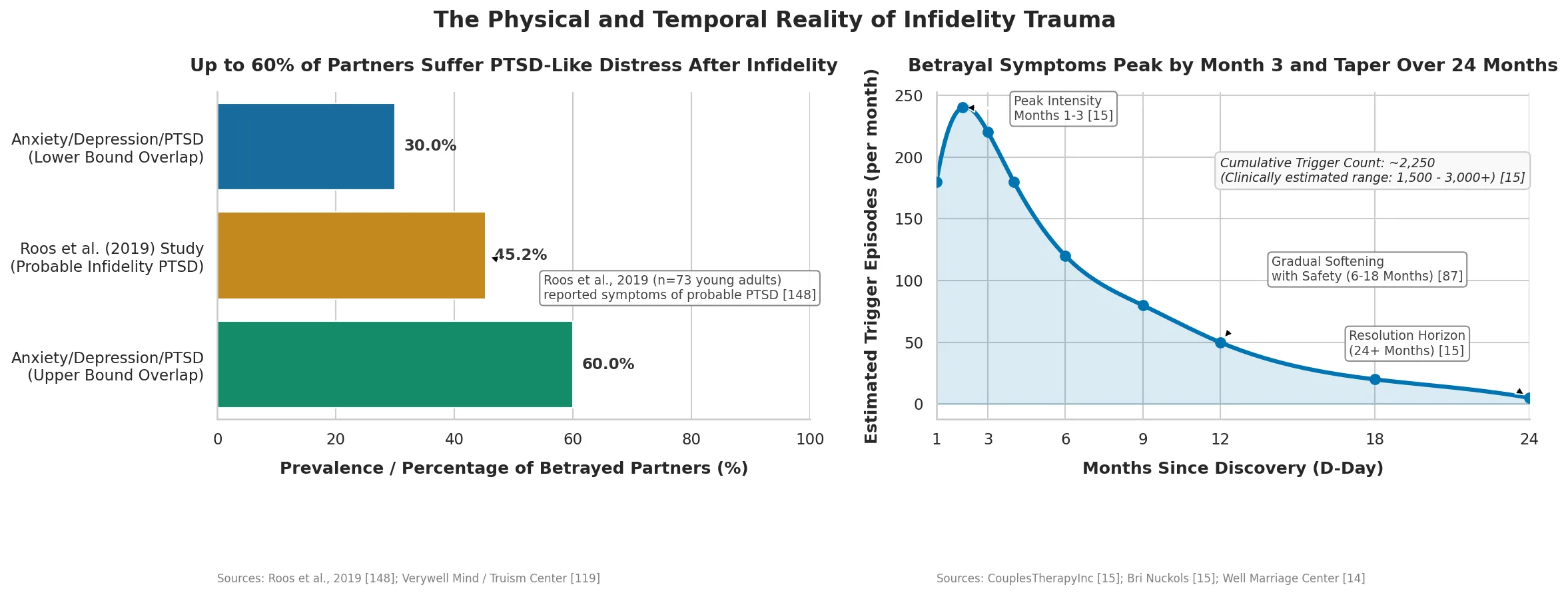
Sources: Roos et al. 2019 (n=73); Verywell Mind / Truism Center; CouplesTherapyInc; Bri Nuckols; Well Marriage Center.
Recovery Phase Tracker
| Phase | Timeline | What to Expect | What Helps |
|---|---|---|---|
| Discovery & Crisis | Months 1–3 | Triggers at their most frequent and intense. Insomnia, panic, intrusive images, and physical symptoms are common and expected. | Radical transparency from the unfaithful partner — device access, location sharing, proactive updates — as evidence of current safety. |
| Stabilization | Months 4–9 | Trigger frequency begins to reduce as safety is verified consistently. Progress is uneven — better weeks followed by harder ones. | Clear, structured agreements around triggers. Both partners practicing the “together” approach rather than managing separately. |
| Integration | Months 10–18 | Triggers decline further. The brain begins to form new, safety-based associations. Previously triggering environments become more manageable together. | Revisiting triggering places or situations deliberately and safely together, building new memories in contexts the brain had tagged as dangerous. |
| Resolution Horizon | Months 18–24+ | Triggers become infrequent for most people. Anniversary reactions may still surface, but are typically shorter and less overwhelming. | Structured support if triggers remain intense at this stage. The presence of ongoing safety — not the passage of time alone — is what drives resolution. |
Note: Recovery timelines vary significantly between individuals and relationships. The phases above reflect general clinical patterns, not rigid milestones. Healing is non-linear, and residual sensitivity — particularly around anniversaries — can persist beyond 24 months for some people. The presence of ongoing transparency is a stronger predictor of trigger reduction than the calendar alone.
When Triggers Aren’t Getting Better
If you are well past the first year and triggers are as intense as ever, the question worth asking isn’t “what’s wrong with me.” It’s “what’s wrong with the current safety?” Triggers persist when the nervous system is still right — when it’s still detecting real signals of unresolved deception, hidden behavior, or inadequate repair.
Persistent intense triggers years into a genuine recovery effort can also benefit from working with a licensed mental health provider who specializes in trauma, in addition to the relational work. If you’re not sure whether what you’re dealing with is a trigger pattern or something that’s moved into a different category of distress, a professional evaluation gives you that clarity. And if you and your spouse are trying to do this work but keep hitting the same walls, a private marriage intensive gives you focused, structured time to work through what regular conversations can’t reach.
Loading Viewer...
FAQ
What is an affair trigger?
An affair trigger is any internal or external cue — a sound, smell, place, date, tone of voice, or behavioral shift — that involuntarily reactivates the emotional and physical pain connected to infidelity. It’s not a conscious choice to stay upset. It’s an automatic nervous system response to something that the brain has associated with the original betrayal.
Why do affair triggers feel physical?
Because they are physical. When the brain detects something associated with a past threat, it fires a stress response before the thinking brain can evaluate whether the current situation is actually dangerous. This produces real physical symptoms — stomach drops, rapid heartbeat, chest tightness, nausea — because the nervous system is treating the reminder as if the original danger is happening right now.
How long do affair triggers last?
There is no fixed timeline, and it varies significantly depending on the person and the quality of the ongoing safety being provided. In general, triggers tend to peak in the first few months after discovery and gradually decrease in frequency and intensity over the following year or two. Anniversary reactions can create temporary spikes beyond that. The presence of consistent, verifiable transparency is a stronger driver of trigger reduction than time alone.
What should the unfaithful partner do when their spouse is triggered?
Stay present and stay regulated. Validate what your spouse is experiencing rather than getting defensive or asking when they’re going to be done with it. Understand that you created the conditions that make triggers possible, and that your job now is to provide evidence of current safety — through proactive transparency, consistent behavior, and patience with the process — rather than expecting them to manage the response on their own.