

You’re still in the same house. Still sleeping in the same bed, most nights. And you haven’t touched each other in months.
Here’s the direct answer: a sexless marriage after infidelity isn’t a verdict on whether your marriage will survive. It’s information. It tells you that the emotional conditions physical intimacy depends on — safety, honesty, feeling genuinely valued — aren’t in place yet. That’s a solvable problem, but not by focusing on the sex. The absence of intimacy is the fruit. The work is finding the root.
Most advice on this topic is written for couples in an ordinary dry spell — date nights, scheduling, trying something new. None of that applies here, because betrayal changes the mechanism entirely. What you’re dealing with isn’t a dead bedroom. It’s a nervous system that hasn’t been given enough evidence of safety to open up again.
Sexless Marriage After Infidelity | Marriage Intervention
Marriage Intervention | Couples Academy
Why Intimacy Shuts Down After Betrayal
Physical intimacy requires a specific internal state: enough safety to be vulnerable with someone. Betrayal by the person you were most vulnerable with removes exactly that. It’s not that desire disappears through choice. The nervous system withdraws it, because the conditions it requires are no longer present.
For many betrayed partners, this shows up physically. Touch that used to be welcome now produces tension, panic, or a kind of blankness — a somatic numbing where the body simply doesn’t respond. Research on post-infidelity distress finds that a substantial share of people who discover a partner’s infidelity experience symptoms overlapping with trauma responses, commonly cited in the range of 30% to 60%. Intrusive images during intimacy, hypervigilance, and shutdown are all documented parts of that picture. None of it is a character failure or a lack of love.
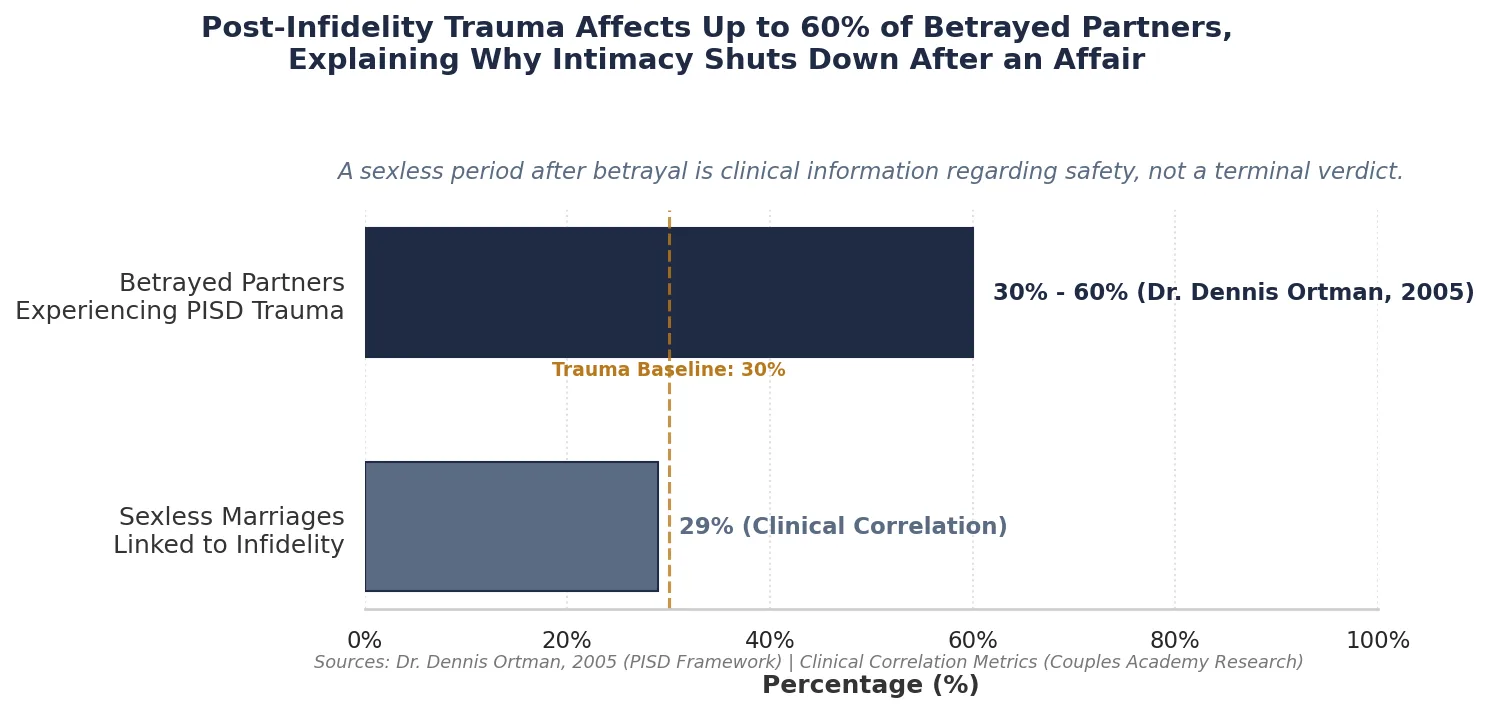
Sources: Dr. Dennis Ortman, 2005 (PISD framework); clinical correlation metrics.
There’s a second layer that’s easy to miss: the unfaithful partner often withdraws too, driven by shame. Some can’t initiate because they feel they’ve forfeited the right to. Some avoid intimacy because it surfaces guilt they can’t sit with. Two people can both want closeness and both be unable to reach for it, for completely different reasons.
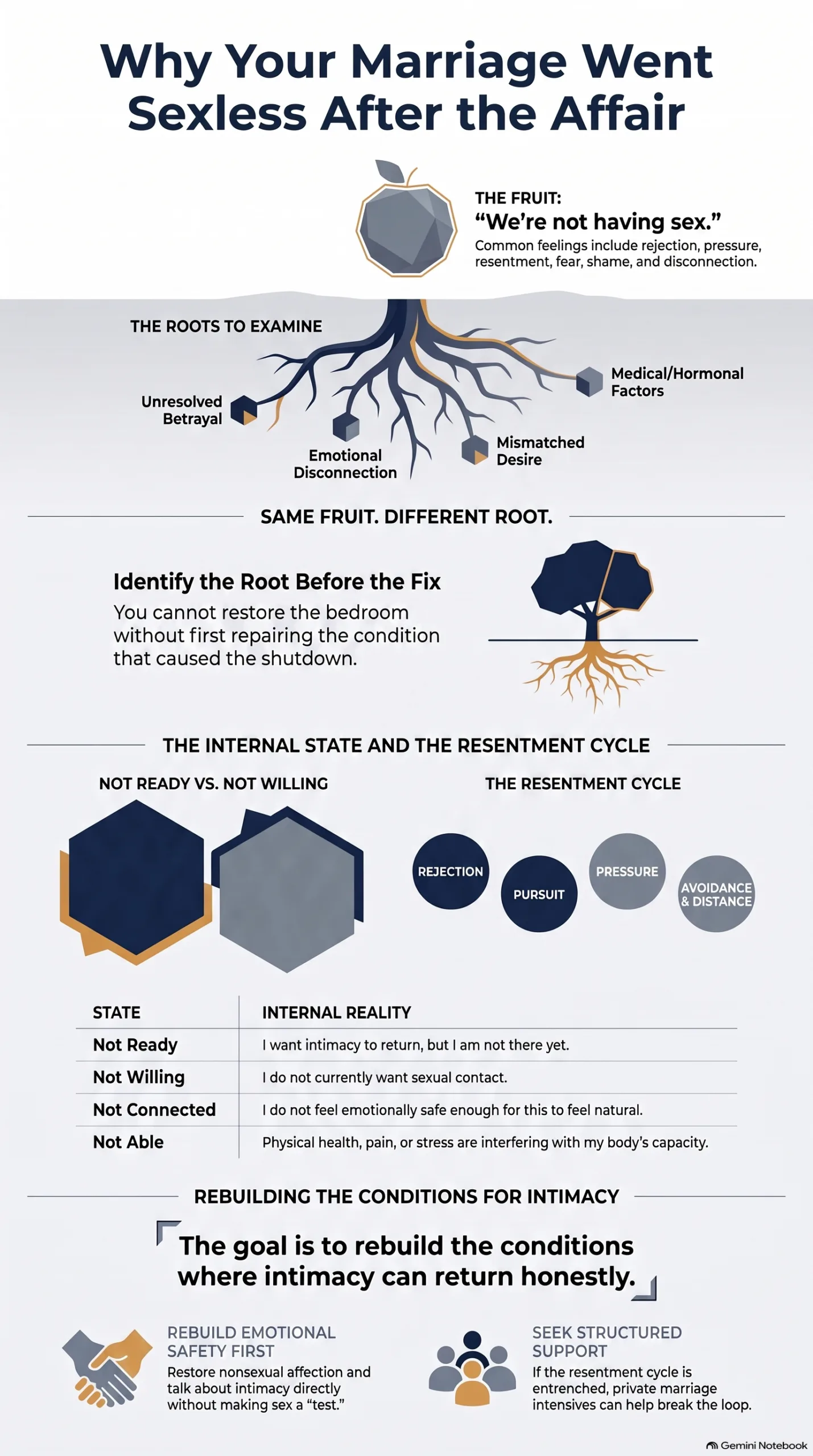
Same Fruit, Different Root
Hasani’s framework for this is the most useful thing in this entire article, because it explains why generic advice keeps failing:
“We’re all experiencing the same fruit, no sex, but there’s a different root that leads to that fruit. And if you take the time to discover the root truly, and then pull it out, it then can create new fruit.”
— Hasani Pettiford, Marriage Intervention
Two couples can present with identical symptoms — no physical intimacy for months — and need completely different interventions. Working on the wrong root produces nothing but frustration and the sense that you’ve tried everything. Here’s what actually tends to be underneath it:
| The Root | What It Sounds Like | What It Actually Needs |
|---|---|---|
| Unresolved trauma | “I want to, and then images come and I go numb” | Trauma-informed support, time, and no pressure to perform through it |
| Missing safety | “I still don’t know if I have the whole truth” | Full disclosure and consistent transparency before anything physical |
| Accumulated resentment | “How am I supposed to want someone I’m constantly resenting?” | Repair outside the bedroom — being shown up for in daily life |
| Shame and avoidance | “I don’t feel like I have the right to reach for you” | Working through shame so it stops reading as further rejection |
| Depletion | “I’m at capacity. There’s nothing left to give anyone” | Actual redistribution of load, not encouragement to try harder |
| Pressure cycle | “Every touch feels like it’s a request, so I brace” | Removing the expectation entirely so touch stops being a negotiation |
| Physical or medical | Pain, medication effects, hormonal changes, health conditions | A medical evaluation — this root gets missed constantly |
The Problem Inside the Bedroom Is Rarely About the Bedroom
Hasani states this plainly: if there’s a major problem inside the bedroom, it’s usually because there’s a major problem outside of it. Danielle describes what that looks like from the inside — the experience of being chronically overlooked, taken for granted, or run ragged, and then being expected to feel desire for the person contributing to it. Her line captures it exactly: “I love my husband, but I have zero desire for him because of how he treats me outside of the bedroom.”
When that dynamic is in place, physical touch stops registering as connection. It registers as another demand from someone who’s already taking more than they’re giving. That’s not stubbornness. It’s the predictable result of an empty cup.
Hasani’s redirection for the pursuing partner is worth sitting with: “Rather than focusing on penetrating her body, you’re focusing on penetrating her heart.” Meaning the work isn’t technique or frequency or trying harder in the bedroom. It’s the daily, unglamorous business of being someone your spouse feels genuinely cared for by.
Not Ready Is Different From Not Willing
This distinction matters enormously and most couples never make it explicitly.
Not ready means the person wants to reconnect and can’t yet. There’s grief in it. They’re engaged in the recovery work, they’re honest about where they are, and there’s movement over time even if it’s slow. Danielle’s description of this state is the most human sentence in the whole conversation: “It’s not that I didn’t want to. I wanted to want to.”
Not willing looks different. It’s disengagement — no participation in repair, no interest in closing the distance, no distress about the distance itself. That’s a different situation requiring a different conversation.
One clarification that has to be stated directly: saying no to physical intimacy is a legitimate boundary, not manipulation. A betrayed partner who isn’t ready isn’t punishing anyone. Reconciling does not obligate anyone to be physically available on a timeline, and pressure applied in that direction reliably makes recovery worse rather than faster.
The Cycle That Keeps Couples Stuck
There’s a loop that runs underneath most of these situations, and both people are usually experiencing it as the other person’s fault.
One partner reaches for connection. The other, not in a state where that’s possible, declines. The first experiences it as rejection — and repeated rejection tends to curdle into something harder. Hasani describes this directly: passion that keeps meeting nothing eventually “flips on its head and now it turns into anger and rage and frustration and aggression.” So the pursuing partner either pushes harder or withdraws entirely. The other partner now feels either pressured or abandoned. Either way, safety drops further. Which makes intimacy less possible. Which produces more reaching, or more distance.
Nobody in this cycle is being unreasonable given their position in it. But the cycle itself is the problem, and it can’t be solved by either person trying harder at their end of it. It gets solved by both people stepping out of the loop and addressing what’s underneath.
What Restoring Intimacy Actually Requires
Research on couples recovering from infidelity consistently finds that open communication, accountability, and transparency have to come before physical reconnection — not alongside it, and definitely not instead of it. Sexual closeness isn’t a switch that gets flipped once enough time passes. It’s nested inside the larger recovery of safety, and it tends to return when the conditions for it return.
A few things that actually help:
Take pressure off entirely, on purpose. As long as every touch might be a request, the lower-desire partner is bracing constantly. Agreeing explicitly that touch isn’t leading anywhere for a defined period sounds counterintuitive and is often the thing that unlocks it.
Rebuild non-sexual touch first. Longitudinal research finds that intimacy behaviors and relationship satisfaction move together and feed each other over time. Sitting close, holding hands, real hugs. These aren’t consolation prizes; they’re how the nervous system relearns that closeness with this person is safe.
Fill the cup outside the bedroom. Danielle’s example from their own marriage: when she was overwhelmed with four small children, they built in a routine where she could pack a bag and go away for a weekend to decompress and breathe. Not a romantic gesture. A structural change in the load.
Talk about sex outside of sex. Research indicates that sexual communication predicts relationship satisfaction more reliably than sexual frequency does. Having one honest conversation about where you each are, at a neutral time, does more than months of hoping the other person figures it out.
When to Get Structured Support
Some couples can work through this with intention and patience. Others are stuck in a loop where every attempt to discuss it ends in flooding, defensiveness, or shutdown — and at that point talking about it more isn’t going to help, because neither person can actually hear the other.
Hasani’s line about getting unstuck applies squarely here: “We have to get to the place where we’re no longer PhDs in the problem and GEDs in the solution.” Most couples in this situation can describe the problem in exhaustive detail. Very few have a plan.
Worth naming separately: if physical pain, medication effects, or a health condition is part of the picture, that warrants a medical evaluation. This root gets overlooked constantly because everything gets attributed to the affair. And if compulsive sexual behavior is part of what you’re navigating, that’s a specific clinical concern involving impaired control and genuine distress — not simply frequency — and it’s worth evaluating with a licensed professional rather than self-diagnosing.
For the relational side of this, our affair recovery coaching addresses the safety and trust work that physical reconnection depends on. And when a couple is genuinely stuck in the cycle described above, a private marriage intensive gives you concentrated, guided time to find the actual root instead of continuing to fight about the fruit.
Loading Viewer...
FAQ
Is it normal for a marriage to be sexless after an affair?
Yes. A significant drop in physical intimacy, or its complete absence, is extremely common after infidelity. Betrayal damages the emotional safety that physical vulnerability depends on, and many betrayed partners experience anxiety, intrusive images, or physical numbing in response to touch. It’s a normal response to a real injury, not a sign that something is additionally wrong with you.
How long does it take to want to be intimate again after infidelity?
There’s no reliable universal timeline, and recovery is rarely linear. What research does consistently indicate is the sequence: communication, accountability, and transparency have to be established before physical reconnection is realistic. Desire tends to return as safety returns — which means the useful question isn’t how long, but what conditions are still missing.
Does the betrayed spouse owe their partner sex during recovery?
No. Choosing to reconcile doesn’t waive anyone’s right to consent. Physical intimacy that happens under pressure or obligation damages trust further, deepens resentment, and makes trauma recovery harder rather than faster. Saying no is a legitimate boundary, and treating it as manipulation or punishment misreads what’s actually happening.
Can having more sex rebuild trust?
No. Trust is rebuilt through consistent accountability, transparency, and reliable behavior over time — not through physical compliance. Trying to reverse the order, using intimacy to prove the relationship is fine, tends to produce resentment on one side and false reassurance on the other.
Can a sexless marriage survive after an affair?
Many do. What determines the outcome usually isn’t the current frequency of intimacy — it’s whether both partners are engaged in identifying and addressing what’s underneath it. A period without physical closeness while genuine repair is happening is very different from prolonged distance that neither person is addressing.