
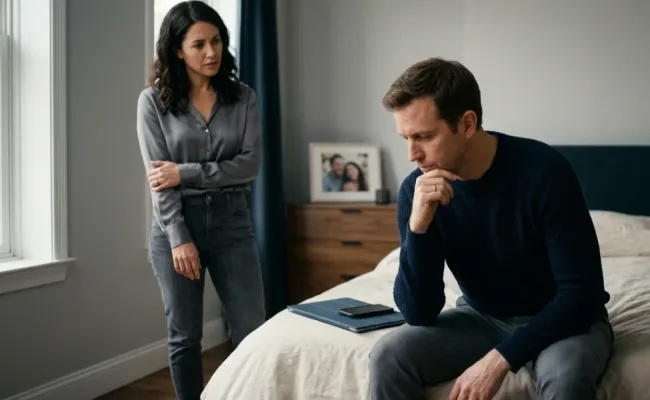
Losing attraction to your spouse while pornography use has become frequent or difficult to control does not automatically mean something is wrong with your spouse. Research suggests that problematic pornography use can be associated with changes in sexual satisfaction, partnered sexual functioning, and sexual motivation for some people. Those patterns can change, but there is no universal reset timeline — and rebuilding desire usually requires understanding what pornography is doing in your particular sexual and relational pattern.
This article is for both people in the marriage: the husband trying to understand what happened to his desire, and the wife who has been told she’s “not enough” and is trying to make sense of that. If pornography is part of a broader pattern of betrayal in your marriage, affair recovery support covers the fuller picture.
“I’m Not Attracted to My Wife Anymore.” Porn Did That. | Marriage Intervention | 005
36:52 · youtube.com/watch?v=p2yd9MuUCsA
Losing Attraction Isn’t About How Your Spouse Looks
When a husband says he’s lost attraction to his wife, the instinctive read — for both of them — is that something changed about her. It usually didn’t.
What pornography does, when it becomes a habitual or dominant source of sexual stimulation, is set a comparison point that real-world partnered sex can’t match — not because a spouse is inadequate, but because the comparison itself is structurally unfair. Screen-based sexual content is edited, immediately available, infinitely novel, and requires nothing from the viewer. Real intimacy requires communication, patience, presence, and navigating another person’s needs. Those are fundamentally different things, and a nervous system trained on one tends to become less responsive to the other over time.
This distinction matters enormously — and it’s the first thing Hasani addresses directly:
“The problem isn’t your wife. The problem is that you’ve been training your arousal system on something she was never designed to compete with — and now you’re comparing a real person to a performance.”
— Hasani Pettiford, Marriage Intervention
Understanding the Language: Attraction, Desire, and Arousal Aren’t the Same Thing
Before anything else can be addressed, it’s worth separating what “not attracted to my wife” might actually mean — because it’s often several different problems described with one phrase.
| What He Says | Possible Issue | What to Investigate |
|---|---|---|
| “I’m not attracted to her.” | Low partner-directed desire | Has screen-based stimulation become the primary source of sexual engagement? |
| “Porn works, but sex doesn’t.” | Different responsiveness to solitary vs. partnered stimulation | Arousal conditioning — the body has learned “screen = arousal” while real intimacy has become less stimulating |
| “I always want something different.” | Novelty-seeking or escalating expectations | Whether pornography use has led to expectations about variety that real intimacy cannot replicate |
| “Sex feels like work.” | Relational tension, stress, or performance pressure | Whether the issue is in the relationship rather than the arousal system |
| “I can’t stop even though it’s hurting us.” | Compulsive or problematic pornography use patterns | Whether the level of distress or impaired control warrants evaluation by a licensed professional |
What Heavy Pornography Use Can Do to Desire Over Time
The brain’s reward system responds strongly to sexual stimuli — and screen-based pornography is a highly concentrated version of that stimulus. Research on reward pathways suggests that frequent engagement with high-novelty sexual content can, for some people, lead to patterns of desensitization: where more intensity or novelty is needed to produce the same level of arousal, and where ordinary partnered sex begins to feel comparatively flat.
This should not be overstated. Pornography does not automatically “rewire” anyone’s brain in a universal, irreversible way. The research does not support that claim. What the evidence does suggest is that when use becomes frequent or difficult to control, some people experience changes in sexual responsiveness — particularly in partnered sex. A 2024 meta-analysis covering 41 studies and more than 70,000 participants found a statistically significant but small negative correlation between pornography use and sexual satisfaction overall; importantly, the association was not statistically significant among men when analyzed separately.
A separate large study of 14,581 adults found that problematic pornography use was moderately associated with sexual-functioning difficulties — whereas frequency of use alone showed a much weaker pattern. That distinction matters, and it’s covered in the next section.
Clinical case reports describe men with no underlying physical health issues who experience arousal or functioning difficulties in partnered sex while remaining fully responsive to pornography alone. This pattern, where the problem is context-specific rather than universal, points toward conditioning rather than a physical medical cause in some cases — though medical factors should always be ruled out first.
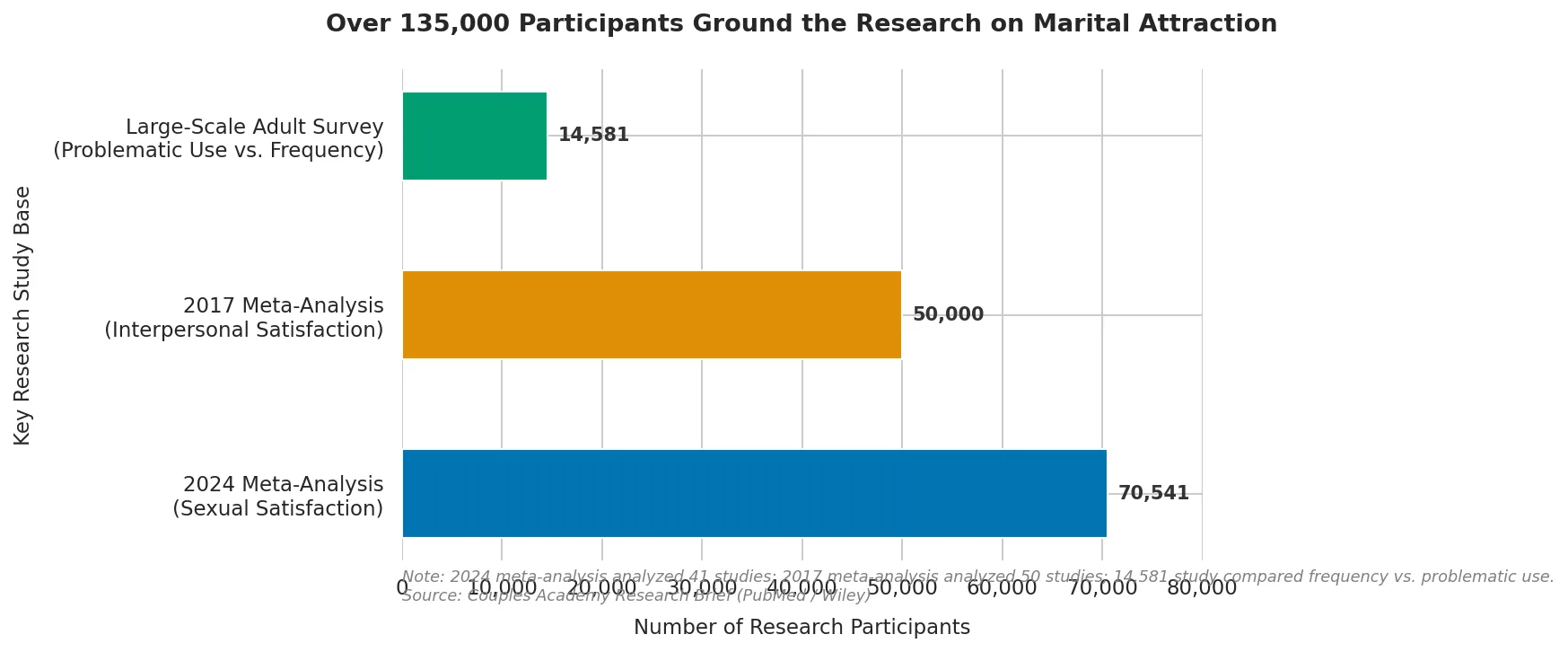
Sources: 2024 meta-analysis (PubMed 39267458); 2017 meta-analysis (Wiley HCRE); large-scale adult survey (PubMed 32810799).
Frequency Isn’t the Same as Problematic Use
This distinction gets missed constantly and it matters. Watching pornography occasionally is not the same as pornography use becoming difficult to control. Research consistently finds that frequency of use and problematic use behave differently in the data — and it’s the latter that is more meaningfully associated with sexual-functioning difficulties.
| Pattern | Frequency Alone | Possible Problematic Use |
|---|---|---|
| Control | Can stop or reduce without significant difficulty | Repeated unsuccessful attempts to reduce or stop |
| Consequences | Use doesn’t significantly affect work, sleep, or relationships | Continued use despite relationship harm, interference with responsibilities |
| Secrecy | Partner is aware or use is openly acknowledged | Hidden, denied, or minimized when confronted |
| Partnered intimacy | Does not significantly affect desire for spouse | Pornography consistently preferred over partnered sex; arousal or functioning difficulties in partnered sex |
| Distress | No significant distress about the pattern | Personal distress about inability to control; escalating content needed for same effect |
Note on clinical language: casual use of the term “porn addiction” doesn’t match the clinical picture. The WHO’s ICD-11 recognizes Compulsive Sexual Behaviour Disorder — an impulse-control disorder requiring impaired control and significant distress — rather than “porn addiction” as a standalone diagnosis. If use feels genuinely out of control or is causing serious harm, evaluation by a licensed professional is the appropriate next step, not self-diagnosis from an article.
That said, an honest look at the pattern above is worth doing. The frequency-vs.-problematic distinction is where most couples start getting specific with each other.
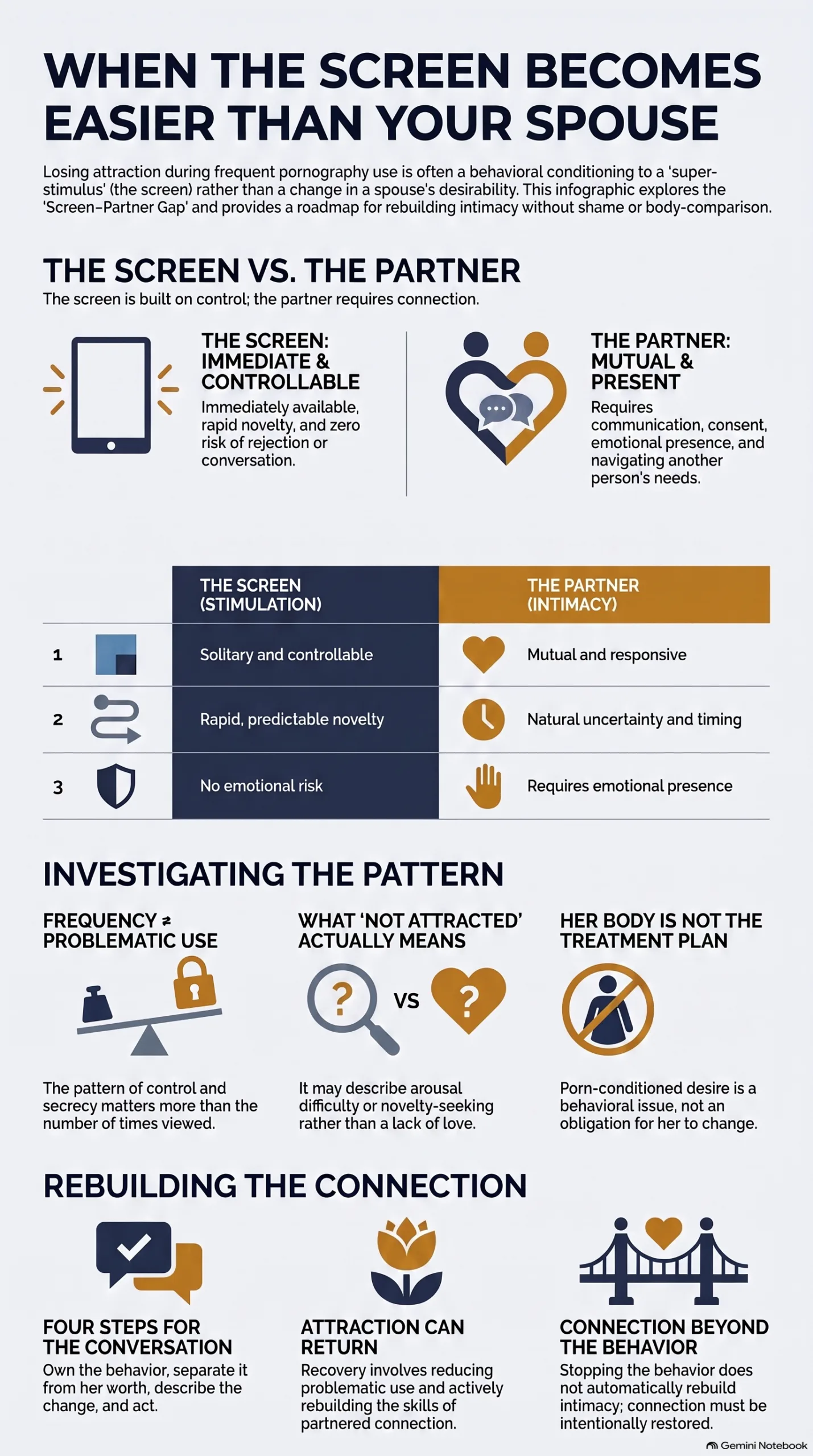
The Screen-Partner Gap
This is the most useful lens for understanding what’s actually happening in a marriage where pornography has become a dominant source of sexual stimulation. The question isn’t whether pornography is “real” or “fake.” The question is whether screen-based sexuality has begun replacing the skills and responsiveness that partnered intimacy requires.
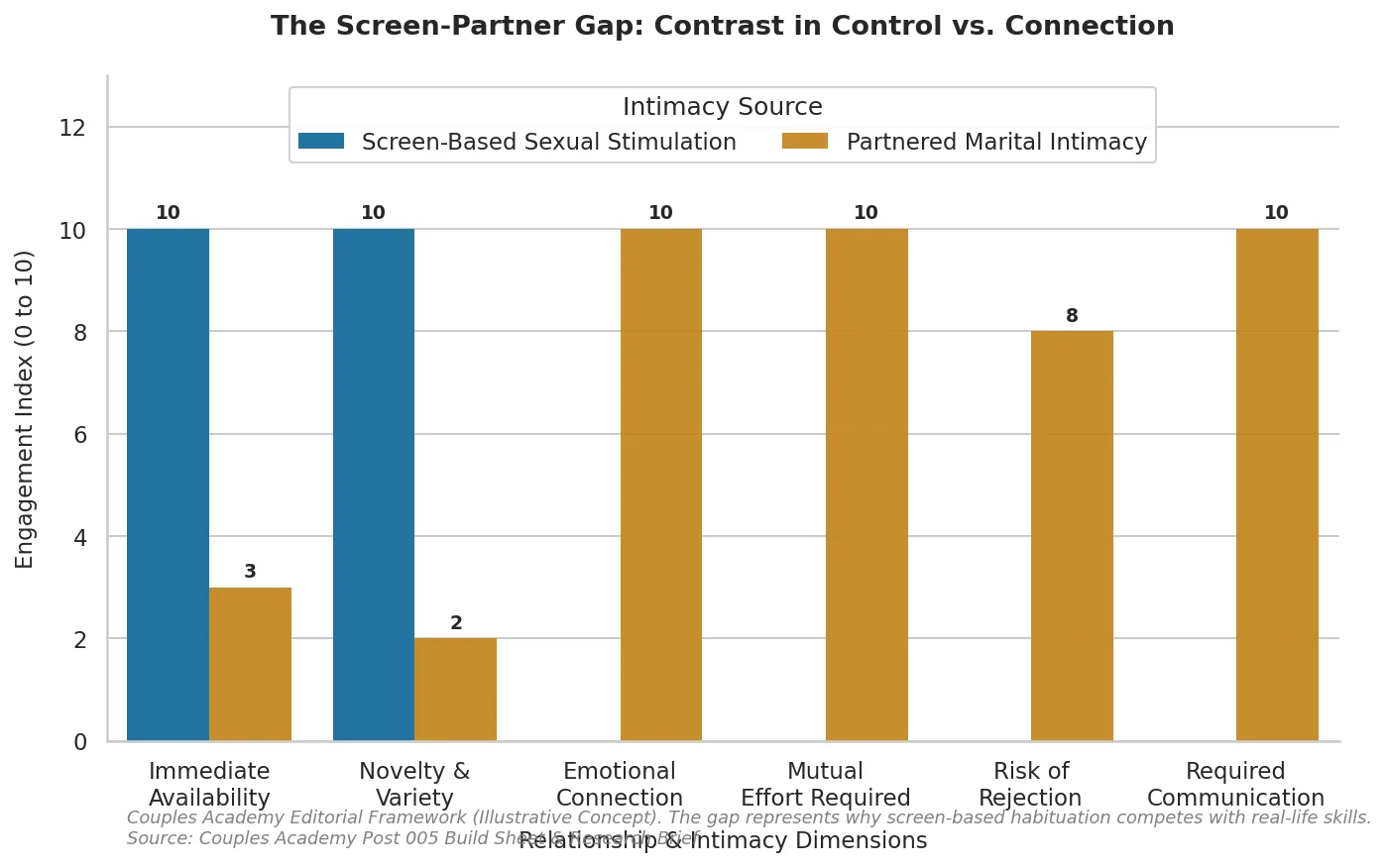
Couples Academy editorial framework (illustrative concept). The gap represents why screen-based habituation competes with real-life intimacy skills.
| Dimension | The Screen | The Partner |
|---|---|---|
| Availability | Immediately available, fully user-controlled | Involves another person’s desire, timing, and consent |
| Novelty | Infinite variety, on demand | Real-life relationship history, natural variation |
| Relational demand | Entirely disconnected from another person’s needs | Requires active communication, mutual responsiveness, emotional presence |
| Reality | Edited, performance-oriented, fictitious | Real bodies, complex relationship, natural uncertainty |
Don’t make your spouse compete with the screen. Investigate the gap.
Can Attraction Come Back After Reducing or Stopping Pornography?
It can — but there’s no universal percentage or timeline, and overclaiming here would be dishonest. Qualitative research with people who identified as having problematic pornography use has documented reports of reduced partner-directed desire, sexual-functioning difficulties, and perceived improvements in both after reducing or stopping. Those are self-reported experiences from a specific population, not controlled outcome studies with generalizable results.
What clinical accounts consistently suggest: there is often a period of adjustment when screen-based stimulation is reduced or stopped, sometimes called a flatline — a period of low libido, reduced arousal, and emotional difficulty that can last weeks and can feel like things are getting worse before they improve. Being prepared for that rather than interpreting it as evidence that recovery isn’t working makes a significant difference.
Stopping pornography alone is rarely sufficient. The arousal association has to be rebuilt toward the partner actively — through non-demand affection, honest communication, and rebuilding the emotional safety that partnered intimacy requires. That’s a couples process, not a solo one. And the other contributing factors — relationship dynamics, stress, health, medication — need to be on the table too, not all attributed to pornography by default.
What Your Wife Is Experiencing While You’re Struggling With This
This section is for her as much as for him.
When a wife learns that her husband is less aroused by her while being responsive to pornography, what she hears is almost never “he has a conditioned arousal problem.” What she hears is “I am not enough” — at a core physical and personal level. Research on women whose partners use pornography consistently documents lower self-reported sexual desirability, more negative feelings about themselves and the relationship, and a sustained sense of competing with something she cannot be.
Danielle names what this experience actually produces:
“When a wife finds out her husband’s desire has been going somewhere else — even to a screen — she doesn’t experience that as a habit he has. She experiences it as being chosen against. That’s not irrational. That’s what it actually is.”
— Danielle Pettiford, Marriage Intervention
There’s a double bind worth naming explicitly: when a wife attempts to adjust herself or her behavior to “keep up” with what she imagines her husband is watching, she typically experiences more harm, not less. This is not a path to reclaiming his desire and it should never be framed as one. His conditioned arousal pattern is his responsibility to address. Her body, boundaries, and self-worth are not variables in that equation.
Unaddressed, her experience tends to move through distinct stages: initial disbelief, then active comparison and self-interrogation, then resentment, and eventually a hardened protective withdrawal that becomes very difficult to reverse. The earlier this is brought into the open — with honesty, not with her being asked to manage his shame — the more workable the recovery is.
How to Have This Conversation Without It Destroying Her
“I’m just not attracted to you anymore” dropped without context is one of the most damaging things a person can say to a spouse. It arrives as a verdict on her worth rather than as a description of a behavioral and arousal pattern he’s struggling with. Those are not the same thing, and they need to be communicated differently.
A more honest framing sounds like: “I’ve been using pornography in a way that I think has affected how my arousal works, and that’s my problem to address — not a verdict on you.” That puts the ownership of the problem where it belongs, gives her something specific and understandable to respond to, and doesn’t ask her to manage his shame while she’s also processing her own pain.
Once the conversation is open, what she needs most is not reassurance that the pornography didn’t mean anything. What she needs is for her experience to be witnessed without defense or minimization, for the behavior to stop, and for the decision about how to proceed to be genuinely hers — not something she’s pressured into for his comfort.
If pornography use was hidden or denied when she asked about it directly, this conversation carries a layer of trickle truth alongside the attraction issue. That’s a separate dimension worth naming carefully, and our guide on ongoing dishonesty after a betrayal covers that pattern specifically.
Getting Structured Help for Both of You
The couples who try to work through this on their own — reading the right things, making the right promises, trying to rebuild desire through willpower — often find themselves circling the same loop: disclosure, hurt, reassurance, temporary improvement, relapse or secrecy, re-disclosure, and reset. The sequence problem is as significant as the behavior problem itself.
Effective support for this situation usually involves three distinct lanes: his individual work on the behavior and what drives it, her individual support for the betrayal experience she’s navigating, and joint couples work that addresses the communication, trust, and intimacy dimensions together. Going straight to couples work without the individual lanes usually means both people bring too much unprocessed material into a shared space that can’t hold it.
If the use has risen to a level that feels genuinely out of control — where stopping has been repeatedly attempted and failed, where the pattern continues despite clear relationship harm — evaluation by a licensed professional who specializes in compulsive sexual behavior is the appropriate starting point, alongside the relational work.
For the relational side, our private marriage intensives are designed for exactly this stage — concentrated, structured work that addresses the trust breach, the arousal pattern, and the couple’s intimacy at the same time rather than in separate silos. If you’re also working through rebuilding intimacy more broadly, that guide works as a companion to this one.
Loading Viewer...
FAQ
Can porn make you lose attraction to your spouse?
Pornography use can be associated with lower sexual or relationship satisfaction for some people, and problematic use has been associated with sexual-functioning difficulties. But research does not show that pornography automatically causes loss of attraction in a universal way. Whether the pattern, context, and level of use have become problematic all matter more than frequency alone.
Does attraction come back after quitting porn?
It can. Some people with problematic pornography use report greater interest in partnered sex after reducing or stopping, but there is no established recovery percentage or timeline. Other contributors to low desire — relationship dynamics, stress, health, and medication — also need to be considered. Stopping pornography alone is rarely sufficient; actively rebuilding desire toward the partner is a separate and necessary part of recovery.
My husband says he loves me but isn’t attracted to me. What does that mean?
Love and sexual desire are related but not identical. Lower attraction can have many contributors — including relationship dynamics, stress, health, medications, and, when pornography use has become problematic, patterns of conditioned sexual stimulation. His statement does not by itself tell you which explanation applies, and his attraction difficulty is his responsibility to address, not a verdict on your worth or desirability.
Is losing attraction a reason to end a marriage?
Loss of attraction does not automatically determine whether a marriage should end. The more useful questions are what changed, whether the cause can be identified, whether both spouses want to address it, and whether the relationship remains emotionally safe. When the cause is a modifiable behavior pattern, and both people are willing to do real work, that is a different situation from a marriage where nothing is being addressed and neither person is improving.