

You wanted to ask one question. Twenty minutes later you’re both shouting, or he’s gone silent and staring at the wall, and you’re further from an answer than when you started. Again.
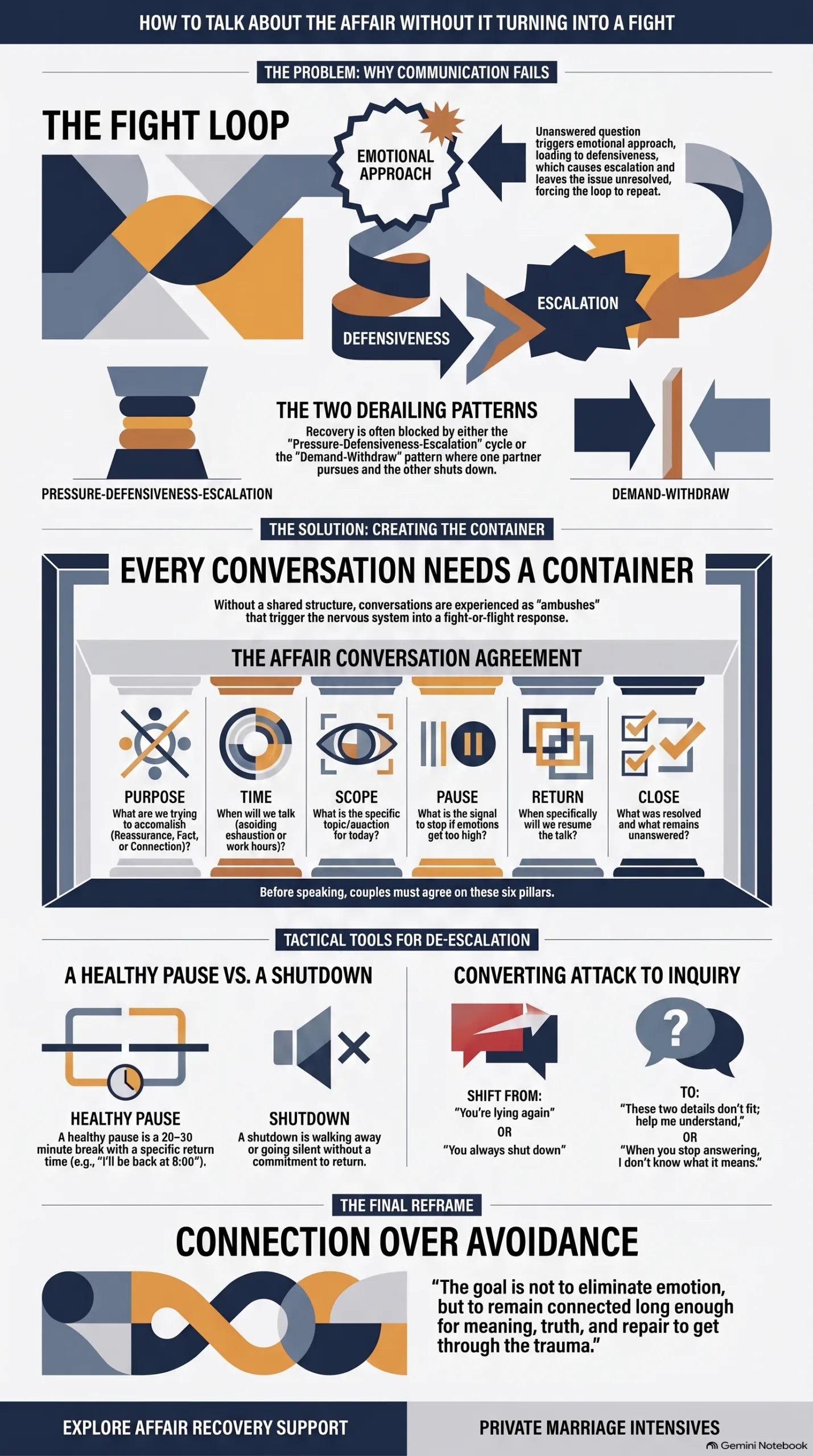
Here’s the direct answer: these conversations turn into fights because betrayal puts both nervous systems into survival mode, and once you’re flooded, the part of your brain that can listen and empathize goes offline. It isn’t a willpower problem or a love problem. The fix is structural: schedule the conversation instead of ambushing each other, agree on ground rules before you start, keep the scope narrow, and take a real break the moment either of you floods.
If part of what keeps derailing these conversations is that the story keeps changing, that’s a separate problem worth naming — this piece on trickle truth covers it directly. No amount of communication technique fixes a conversation where the facts are still being managed.
How to Talk About the Affair Without It Turning Into a Fight | Marriage Intervention
Marriage Intervention | Couples Academy
Why These Conversations Escalate So Fast
Most affair conversations don’t start at zero. They start with both people already wound up — she’s been carrying a question for three days, he’s been bracing for it since he saw her face. By the time anyone speaks, both nervous systems are already partway into threat mode.
There’s a measurable physiological piece to this. Research from Dr. John Gottman found that when a person’s heart rate climbs past roughly 100 beats per minute during conflict, the rational, reasoning part of the brain effectively stops driving. Empathy, careful listening, and measured responses become biologically difficult — not because someone is choosing to be unreasonable, but because the system running the conversation has switched over to fight, flight, or freeze.
Hasani describes another layer of this: what the betrayed partner is experiencing during these conversations isn’t just remembering. It’s closer to reliving.
“Imagine thinking about the most painful experience that has ever happened in your life and you’re constantly reviewing it, revisiting it, and as a consequence reliving it. It’s almost like time travel.”
— Hasani Pettiford, Marriage Intervention
Once you understand that, the intensity of these conversations makes more sense. You’re not discussing a past event. For the betrayed partner, the nervous system is treating it as something happening now.
What Each Partner Is Actually Doing
These conversations tend to break down in a predictable pattern, and both people are usually misreading the other completely.
The betrayed partner isn’t cross-examining. The repeated questions, the returning to details that seem already settled, the fixation on a date that doesn’t quite line up — that’s not punishment or interrogation. It’s an attempt to close loops. When your understanding of your own life has been proven wrong, the mind works relentlessly to rebuild an accurate picture. Every gap and inconsistency is a place where the reconstruction can’t complete, and the brain keeps returning to it.
The unfaithful partner isn’t stonewalling out of indifference. Partners who are genuinely committed to recovery carry enormous shame — a sense of having failed everyone, of being the person who did this. Many go quiet not because they don’t care but because they’re terrified of making it worse. The specific fear is often about accuracy: if I misremember a date, if I say the wrong thing, this whole conversation blows up and we go ten steps back.
Both of those are survival responses. Neither one reads as what it actually is from the other side of the room. Hasani describes the betrayed partner listening with “wounded ears” — hearing intent that wasn’t there, because the nervous system has been trained to detect deception. That misreading is what turns a difficult conversation into a fight.
The Conversation You Need Before the Conversation
The single most effective change most couples make is deceptively simple: stop having these conversations spontaneously.
When a conversation gets dropped on someone unexpectedly — Hasani calls it being “sideswiped” — the response is almost guaranteed to be defensive. Nobody can receive an onslaught of questions they weren’t prepared for and stay open. Scheduling the conversation in advance lets both people prepare their minds and hearts rather than trying to process while already emotionally flooded.
Before you have the next conversation, agree on the structure. This is the meta-conversation, and it’s the one most couples skip.
| Element | Agree On This Beforehand |
|---|---|
| Timing | A specific day and time, agreed in advance. Not when either of you is hungry, angry, late, or exhausted. Not at 11pm. Not right as someone walks in the door. |
| Scope | What this specific conversation is about. One or two loops to close — not the entire affair, not every unresolved thing at once. |
| Duration | A clear start and end point. Knowing the conversation ends makes it possible for both people to stay in it. Open-ended feels like an interrogation with no exit. |
| Ground Rules | No character attacks. No divorce threats used as leverage. No walking out without saying you’re taking a break. Honesty even when the honest answer is “I don’t remember.” |
| Break Protocol | Either person can call a break. Agree in advance on how long and that you will come back. A break isn’t an exit. |
| Stated Need | Each person says what they need from this conversation before it starts. “There’s a loop I need to close.” “I need reassurance right now.” “I need to not be attacked while I answer.” |
The Break That Actually Works
Danielle’s guidance here is direct and it’s the single most useful sentence in this whole article:
“Never share your feelings when you’re in your feelings.”
— Danielle Pettiford, Marriage Intervention
When frustration peaks, step away for at least twenty minutes. This number isn’t arbitrary. Research on physiological arousal suggests that once someone is genuinely flooded, the autonomic nervous system typically needs a minimum of twenty to thirty minutes to return toward baseline. This is a clinically supported baseline, not a universal biological reset — individual recovery varies — but the direction is consistent: less time than that and you’re returning to the table still activated.
There’s an important condition attached. The break only works if you actually self-soothe during it. Walking away and spending twenty minutes rehearsing your argument, replaying what he said, or building the case in your head doesn’t lower anything. Breathing, walking, physically moving, deliberately shifting your attention — those do.
And then you come back. Danielle’s framing is that you return with a heart of reconciliation — including apologizing if you went left, if you yelled, if you said something you didn’t mean. The break isn’t a way to avoid the conversation. It’s how the conversation survives.
What Productive Communication Actually Sounds Like
Hasani defines communication in a way that reframes what you’re actually trying to do in these conversations:
“Communication is the transfer of meaning. It’s the ability to clearly express and accurately receive thoughts, feelings, needs, and truth in a way that creates understanding.”
— Hasani Pettiford, Marriage Intervention
By that standard, most affair conversations aren’t communication at all. Meaning isn’t transferring in either direction. Both people are transmitting and neither is receiving.
A few practical shifts that make transfer more likely:
Lead with the hurt underneath, not the accusation on top. “You were on your phone for an hour and wouldn’t tell me who it was” lands as an attack. “When your phone went off tonight I felt that same drop in my stomach and I need to say it out loud” opens a door.
Ask directly how to reach him. One of the most useful questions in the entire recovery process: “How can I approach you in a way that keeps you open?” Most people have an answer to this and have never been asked.
For the unfaithful partner: answer, don’t defend. Every question isn’t a condemnation. “I don’t remember that specific detail, and I know that’s frustrating — here’s what I do remember” is dramatically better than going silent to avoid being wrong. Silence reads as concealment, even when it’s fear.
Separate Affair Problems From Marriage Problems
Hasani draws a distinction here that resolves one of the most common recurring fights in recovery: affair problems and marriage problems are two different categories, and both need their own space.
To be unambiguous about it: nothing that was wrong in the marriage caused or excuses the affair. That was entirely the unfaithful partner’s choice. Marital issues are not a contributing explanation and they don’t share the blame.
But there’s a failure mode that shows up constantly, and it goes both directions. One is using the affair as a trump card — any ordinary complaint about chores or money or scheduling gets answered with “you cheated,” which ends the conversation and means nothing else in the marriage ever gets addressed. The other is minimizing real, legitimate marital issues because they don’t feel big enough to raise next to the affair. Both of these stall recovery. The affair gets its own conversations. The marriage gets its own conversations. Mixing them means neither one gets resolved.
The Research Context
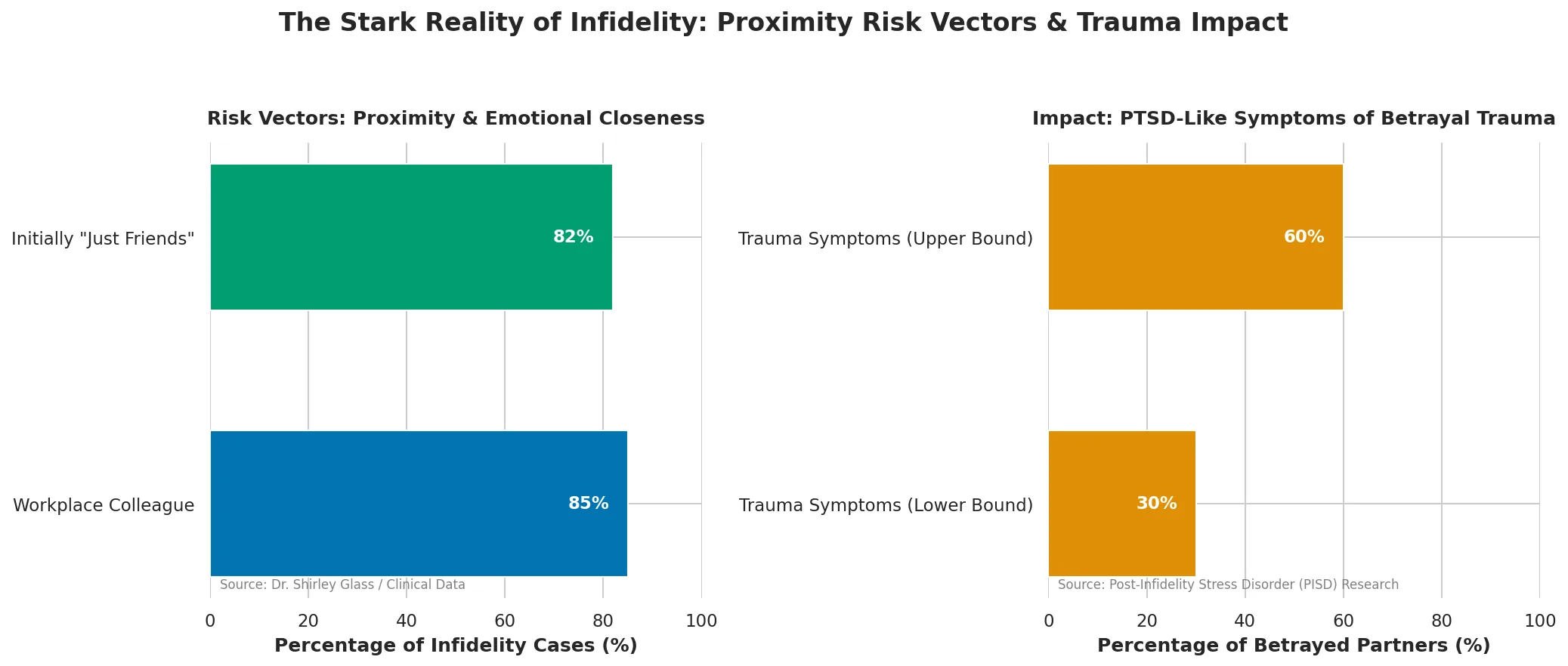
Two pieces of research help explain why these conversations carry so much charge, and why the hypervigilance around them is a reasonable response rather than an overreaction.
Sources: Dr. Shirley Glass / clinical data; Post-Infidelity Stress Disorder research.
Clinical research by Dr. Shirley Glass found that 82% of unfaithful partners began their affairs with someone originally considered “just a friend,” and that a similar share of affairs originate through workplace proximity. This is worth knowing because it explains why a betrayed partner’s questions about ordinary friendships and coworkers aren’t irrational suspicion. The pattern they’re scanning for is the actual pattern.
On the other side, research indicates that a substantial share of people who discover a partner’s infidelity — commonly cited in the range of 30% to 60% — show measurable symptoms of severe anxiety, depression, or trauma-related stress. Some practitioners refer to this cluster as Post-Infidelity Stress Disorder, a clinical framework rather than a formal psychiatric diagnosis. What it captures usefully is that the flashbacks, hypervigilance, and physical symptoms are real and documented, not evidence that someone is failing to move on.
When You Need a Structured Environment
Some couples can implement everything above and see real improvement. Others cannot, and it’s worth being honest about why: when both partners are deeply flooded, wounded ears misinterpret even carefully chosen words. You can say the right sentence and have it land as an attack, because the receiving system isn’t calibrated for neutrality right now.
In that state, a neutral third party isn’t a luxury. Someone outside the dynamic can slow the interaction down, catch the misreads in real time, and hold the environment steady enough that meaning can actually transfer between two people who have lost the ability to do it on their own.
This is what our private marriage intensives are structured around — concentrated, guided time designed to accomplish in a few focused days what fragmented weekly conversations often can’t reach. If you’re earlier in the process and working out what recovery requires from both of you, our affair recovery coaching is the place to start.
Loading Viewer...
FAQ
How do I bring up the affair without starting a fight?
Schedule it in advance rather than raising it spontaneously. Pick a time when neither of you is hungry, angry, rushed, or exhausted. Open with the vulnerability underneath rather than the accusation on top — “I need to talk about something that’s been sitting with me” opens a different conversation than launching straight into questions.
Why does my spouse shut down when I want to talk about the affair?
Shutting down is usually a survival response to being overwhelmed, not indifference. Unfaithful partners who are genuinely committed to recovery often carry heavy shame and go quiet because they’re afraid of making it worse — particularly afraid that misremembering a detail or giving a wrong date will set recovery back significantly. It reads as stonewalling and it usually isn’t.
Is it okay to take a break during an affair conversation?
Yes, and it’s often necessary. When either person becomes physiologically flooded, the nervous system typically needs a minimum of twenty to thirty minutes to settle. Step away, actively self-soothe rather than rehearsing the argument, and then return. The critical part is agreeing beforehand that a break means you’re coming back — otherwise it registers as abandonment.
How often should couples talk about the affair during recovery?
Early recovery involves frequent discussion, which is normal. Many couples find it helps to move toward shorter structured check-ins with a defined start and end rather than open-ended conversations. Clear time boundaries keep the trauma from occupying every hour while still ensuring questions get answered consistently rather than accumulating.
What if my spouse says we’ve already talked about it enough?
Acknowledge the fatigue honestly — it’s real, and these conversations are exhausting for both people. Then be clear that you can’t heal around something you don’t yet fully understand. Proposing structured check-ins with a defined endpoint often resolves this, because what they’re usually resisting isn’t the topic. It’s the sense that there’s no end to it.