

Couples Academy

I’m Obsessed With Checking His Phone: How Do I Stop?

I'm Obsessed With Checking His Phone: How Do I Stop?

You told yourself you’d stop after the first month. Then after the first “clean” check. Then after he handed you the phone willingly and there was nothing there. And you’re still doing it, twenty times a day sometimes, hating yourself a little more each time you reach for it.

Here’s the direct answer: You can’t just white-knuckle your way out of checking his phone. It’s a hypervigilance response, not a character flaw, and it fades through small, steady steps: delaying the urge, tracking the checks that come up clean, and moving from secret snooping to transparency he offers willingly.

If you’ve watched this episode of Marriage Intervention, you already know this exact question came from a caller who described it almost word for word: she couldn’t stop, she knew it was hurting her, and she couldn’t figure out how to trust her own judgment enough to put the phone down.

I Am Obsessed With Checking His Phone | Marriage Intervention | 001

35:18 ·

Why You Can’t Stop Checking His Phone

Checking isn’t really about the phone. It’s about your nervous system trying to re-establish a sense of safety it lost the moment you discovered the affair.

When trust is broken by someone you depend on, the brain shifts into threat-detection mode. It starts scanning constantly for the next sign of danger, because the last time it wasn’t scanning, it missed something enormous. This is what recovery specialists call hypervigilance, and it explains why a delayed reply or a phone left face-down can send your stomach into freefall even when nothing is actually wrong.

The cycle looks like this: a trigger appears, anxiety spikes, you check, you find nothing, and you get a small wave of relief. That relief fades within hours, sometimes minutes, and the cycle starts again. This isn’t a flaw in you. It’s your body doing exactly what it’s built to do after a genuine betrayal. The problem is that no amount of checking can ever fully satisfy it, because the fear isn’t really about what’s on the phone right now. It’s about what already happened.

What Happens Each Time You Feel the Need to Check His Phone

The trigger changes, but the pattern is often the same: uncertainty appears, checking promises relief, and the relief fades. Learning to interrupt that pattern is different from simply forcing yourself to stop.
Trigger What Your Mind May Tell You What Checking Gives You Why the Relief Doesn’t Last A More Useful Response
A delayed text reply “Something may be happening again. I need to know right now.” A temporary drop in uncertainty if you find nothing concerning. The next delayed reply can bring the same fear back because the earlier check did not create lasting trust. Delay the check and ask: “Is there new information here, or is uncertainty itself triggering me?”
The phone is face-down “He must be hiding something from me.” A quick answer to the suspicion the hidden screen created. Even a clean check cannot guarantee what will happen later, so the mind may immediately search for the next clue. If this is a recurring trigger, discuss it as part of an agreed transparency plan instead of repeatedly investigating it alone.
A notification appears “I need to know who that is before I can relax.” Immediate information and a momentary sense of control. Each notification can become another test, making reassurance depend on checking again. Pause before acting. If there is a genuine reason for concern, bring it directly to your spouse rather than automatically reaching for the phone.
Your spouse leaves the room with the phone “Private phone use means secret communication.” A chance to rule out the feared explanation. Checking may answer one moment without resolving the larger question of whether your spouse is behaving transparently overall. Talk about what reasonable openness looks like while trust is being rebuilt instead of creating rules in the middle of a trigger.
A change in tone or behavior “This feels like before. Something must be wrong.” A way to test whether your feeling is pointing to something real. If nothing is found, you may still be left wondering whether you checked the right place or at the right time. Ask what specifically changed. Separate a concrete new behavior from a familiar feeling caused by what happened before.
You’re alone late at night “I can’t let my guard down. This is when something could happen.” Something concrete to do when uncertainty feels especially loud. Checking can become part of the nighttime routine, so being alone itself begins to cue the urge. Rely on the transparency agreements already in place and consciously delay acting on the urge until the intensity has dropped.
A memory of the affair returns “I missed it once. I cannot afford to miss it again.” A feeling that you are actively protecting yourself from another surprise. The check is responding to something that already happened rather than necessarily to new evidence in the present. Name the trigger, remember the clean evidence you’ve already seen, and give yourself time before deciding whether a check is actually needed.
A sudden feeling that something is wrong “My intuition is warning me. I need proof.” A brief sense that you’re doing something instead of waiting helplessly. If checking becomes the automatic answer to every uneasy feeling, uncertainty itself can keep triggering the behavior. Delay the check and ask: “What am I afraid I will find—and would checking actually resolve that fear?”

The pattern to notice:
The phone may change from moment to moment, but the deeper question is often the same: “Am I safe?” Checking can answer that question for a few minutes. Recovery requires building a form of safety that doesn’t depend on checking every time uncertainty appears.


Community-sourced accounts describe this same pattern almost identically: the compulsion “helped uncover more lies” early on, so the nervous system filed it away as a useful survival tool, and it’s genuinely hard to convince your body to stop doing something that once worked.
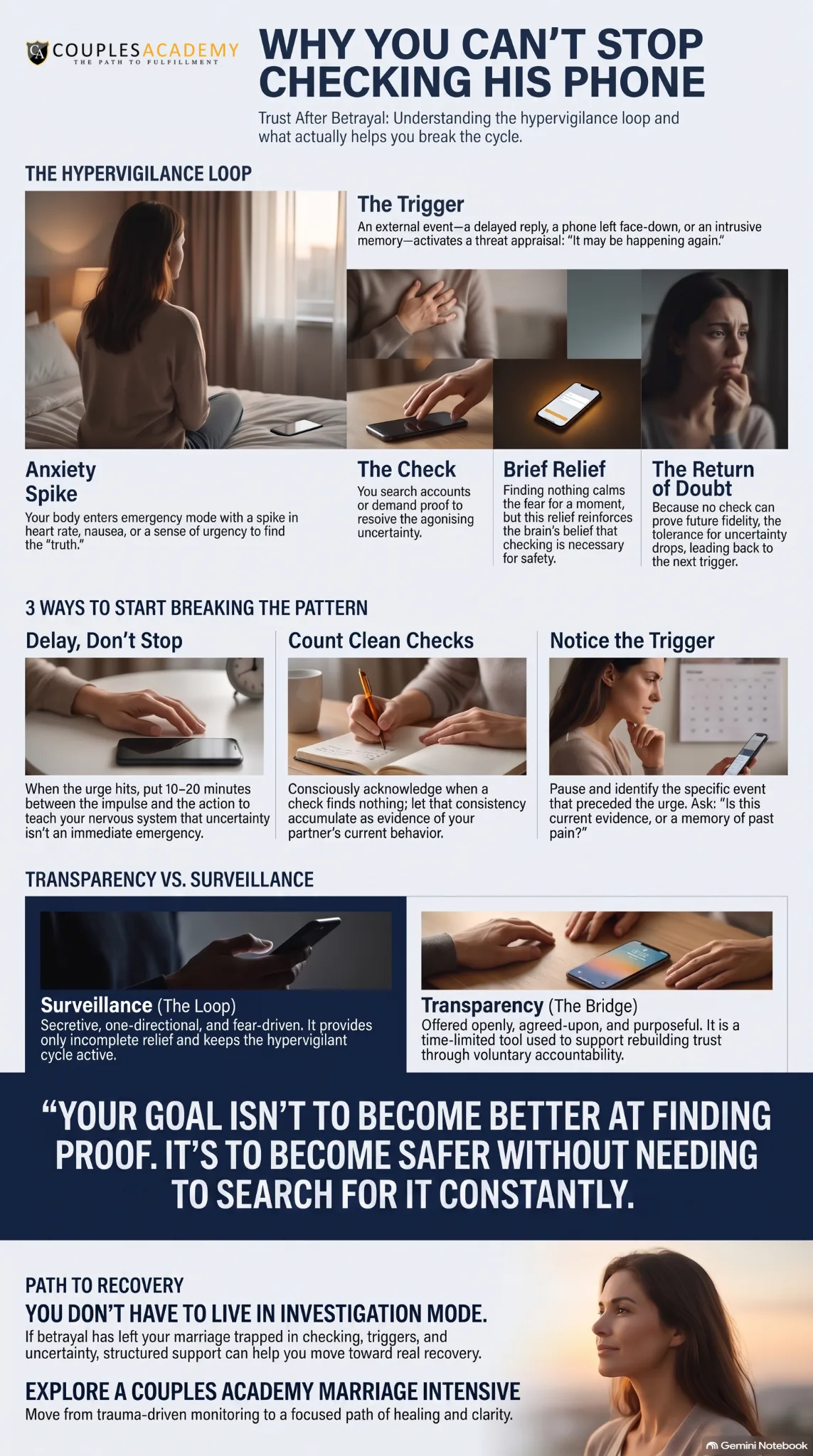
Phone-checking cycle after infidelity showing trigger, anxiety, checking and temporary relief

Is Checking His Phone Helping or Hurting Your Recovery?

Short-term, checking can feel like the only thing keeping you sane. Long-term, it usually works against the healing you’re trying to do.

Every time you check, you re-enter the moment of discovery. Your body doesn’t distinguish between “checking to confirm safety” and “reliving the betrayal,” so each check re-triggers the original stress response. You’re not actually monitoring the present. You’re repeatedly reopening the same wound.

It also tends to erode the very trust you’re trying to rebuild. Repeated secret checking often becomes its own source of conflict, and it can chip away at self-respect in a way that has nothing to do with whether you find anything. One recovery community consistently describes this as feeling like it puts you in a “weaker position,” fixated on your partner’s actions instead of your own healing. None of this means the urge is wrong. It means the urge, left unmanaged, keeps you stuck exactly where the betrayal happened instead of moving you forward.

What Actually Rebuilds Trust (And Why Monitoring Isn’t It)

Trust isn’t rebuilt by proving, over and over, that nothing bad is happening right now. It’s rebuilt through consistent, voluntary behavior over time, and through your own nervous system slowly learning that it’s allowed to stand down. A gradual reduction plan tends to work far better than an abrupt cutoff.

Delay, Don’t Stop

Push the urge back a day at a time rather than aiming for zero checks immediately.

Count Clean Checks

Every check that finds nothing is real evidence. Keep a running list of them.

Notice the Trigger

Pause and ask what set this off, and whether checking will actually solve it.

Three Ways to Start Breaking the Phone-Checking Pattern

The goal isn’t to force yourself from constant checking to zero overnight. It’s to create a little more space between the trigger, the urge, and what you choose to do next.
When This Happens Strategy What to Do in the Moment What You’re Trying to Learn
You suddenly want to check with no clear reason NOTICE THE TRIGGER Ask what happened immediately before the urge appeared and what you’re afraid you might find. Whether something new actually happened—or whether uncertainty itself triggered the urge.
A text comes in late at night DELAY, DON’T STOP Don’t react immediately. Finish what you’re doing, take a short pause, or give yourself a little time before deciding whether you still need to check. That an urge can rise and fall without requiring an immediate response.
Your spouse takes longer than expected to respond NOTICE THE TRIGGER Ask: “What exactly feels wrong here, and would checking the phone actually answer that concern?” The difference between a concrete new concern and a familiar fear created by what happened before.
You checked recently and found nothing concerning COUNT CLEAN CHECKS Don’t immediately erase that result from your mind. Acknowledge it as one piece of evidence about what is happening now. Whether consistent present-day behavior is beginning to differ from what your fear predicts.
You already checked once and want to check again DELAY, DON’T STOP Move the next possible check farther away rather than automatically repeating the one you just completed. Whether the urge is asking for new information—or simply another dose of reassurance.
A memory from the affair suddenly returns NOTICE THE TRIGGER Ask whether something concerning is happening now or whether something in the present simply reminded you of the past. That a powerful reminder does not automatically mean a new betrayal is occurring.
Your spouse willingly hands you the phone COUNT CLEAN CHECKS Notice both the absence of concerning information and the fact that access was offered rather than extracted. Whether voluntary openness is becoming part of the relationship instead of something you have to force or investigate.
You’ve had a stretch of consistent behavior DELAY, DON’T STOP Gradually increase the space between checks instead of following a rigid schedule or demanding that you stop completely. Whether you can begin relying a little more on the pattern of behavior you’re seeing and a little less on constant confirmation.

The goal is not perfection.
First notice the urge. Then create some space around it. Then pay attention to what the evidence is actually showing you. Progress may look like checking less often before it looks like not checking at all.


Transparency vs. Surveillance: The Difference That Matters

There’s a real and important difference between covertly checking someone’s phone and both of you agreeing that transparency is part of how you’re rebuilding together. This ties directly into understanding your infidelity triggers, since knowing what sets off the urge to check makes it easier to tell the difference between fear talking and a real red flag.

Surveillance is secret. It’s one-directional. You’re gathering evidence alone, and even when you find nothing, the relief is incomplete because you know the information wasn’t freely given.

Transparency is offered. It’s mutual, time-limited, and agreed upon by both of you. Many couples in active recovery set up a version of this early on: full access to accounts and devices, offered voluntarily, often for a defined window while trust is being rebuilt.

Transparency vs. Surveillance After Infidelity
Surveillance leaves you responsible for catching another betrayal. Healthy transparency asks the unfaithful spouse to help create safety through openness, consistency, and voluntarily offered information.
Situation Surveillance Can Look Like Healthy Transparency Can Look Like What the Difference Is Really About
Phone access Secretly checking whenever possible or feeling responsible for inspecting the phone in order to know whether you’re safe. Your spouse voluntarily makes the phone accessible as part of an agreed recovery plan rather than forcing you to find opportunities to look. Who is carrying the responsibility for creating openness?
Passwords Trying to discover passwords, repeatedly testing whether they changed, or searching for hidden access points. Passwords or access are willingly shared when the couple has agreed that this level of openness is useful during recovery. Information being offered versus information being extracted.
Location information Constantly watching location data or repeatedly checking it for reassurance throughout the day. Location may be available by agreement without creating an expectation that you must monitor it continuously. Access to information versus responsibility for policing it.
Social media Searching for hidden accounts, secret interactions, deleted messages, or clues across multiple platforms. Clear, mutually understood boundaries around online communication and behavior, with openness rather than secrecy. Trying to catch hidden behavior versus creating conditions where behavior does not need to be hidden.
Unexpected notifications Feeling compelled to identify every caller, text, or notification immediately. Your spouse responds to understandable questions openly rather than becoming secretive, evasive, or defensive about ordinary phone activity. Reassurance through openness rather than reassurance through investigation.
Contact with the affair partner Feeling responsible for discovering whether contact is happening or monitoring every possible channel yourself. Appropriate boundaries are established, and unexpected or unavoidable contact is disclosed proactively rather than discovered later. Hidden or unnecessary contact versus structured, transparent contact when contact truly cannot be avoided.
Questions about whereabouts Repeated questioning designed to catch inconsistencies or confirm where your spouse was every minute. Your spouse communicates clearly enough that you are not constantly left guessing, excluded, or discovering important information after the fact. Shared accountability versus investigative interrogation.
How long transparency continues There is no real endpoint because every clean check simply leads to another need for reassurance. The couple periodically reviews whether the current level of access is still useful and allows it to change as consistent behavior and trust develop. A recovery structure that can evolve versus permanent monitoring designed to create impossible certainty.
The goal isn’t less information. It’s less policing.
Healthy transparency gives you access to information while your spouse takes increasing responsibility for being trustworthy. Over time, the hope is that you can have access without feeling responsible for using it constantly.


One practical middle ground shows up repeatedly in recovery communities: keeping access without using it constantly, retaining the password because it feels safer, but consciously choosing not to look unless something changes. If your partner is genuinely committed to the process, this kind of agreement is a reasonable thing to ask for. If he resists every form of voluntary openness while expecting you to simply trust him again, that resistance itself is useful information.

Getting Support That Fits Where You Actually Are

If you’ve tried gradual reduction and structured transparency and you’re still checking dozens of times a day, still losing sleep over it, or the urge feels driven by something that predates this relationship entirely, that’s worth taking seriously. Compulsive patterns that feel bigger than the situation in front of you sometimes need more support than self-guided strategies can offer, and a licensed mental health provider can help you evaluate what’s underneath it.

Couples-focused recovery intensives can also be especially effective at this stage, because they work with both the hypervigilance itself and the communication breakdown between you and your partner at the same time, in a concentrated format rather than spread out over months.

At Couples Academy, our marriage intensives are built specifically for this stage of recovery, when you’re trying to move forward but you haven’t found a way out of the loop on your own yet.

Important Note

If you are in a situation involving emotional, verbal, or physical abuse, or if you feel unsafe in your relationship in any way, please reach out to a crisis resource or a safety professional before pursuing reconciliation. The guidance above is intended for relationships where both partners have chosen to work toward recovery in a safe environment.

Loading Viewer...


FAQ

Is it normal to check your spouse’s phone after they cheat?

Yes. In the weeks and months after discovery, this is one of the most common responses recovery specialists see. It reflects a nervous system trying to protect you from being blindsided again, not a personality flaw. What matters more than whether you check is whether the frequency is trending down over time as you use structured tools to manage it.

How long does hypervigilance last after infidelity?

There’s no fixed timeline, and it varies a lot by person and relationship. For many, the intensity peaks in the first several months and gradually eases as consistent, voluntary transparency accumulates. Some people notice occasional spikes around anniversaries or stress points well beyond the first year. Reduction is usually gradual, not a clean cutoff.

Should my spouse give me his passwords?

Many couples in active recovery agree on a temporary period of full access, offered voluntarily rather than demanded. This works best when it’s time-limited, mutually agreed upon, and treated as a bridge toward trust rather than a permanent arrangement. If your partner refuses any form of reasonable transparency while expecting your trust to simply return, that resistance is worth addressing directly.

My husband had a baby with another woman. Can we recover?

This situation adds a layer of ongoing complexity that most infidelity recovery doesn’t involve, since a child from the affair usually means some level of continued contact. Recovery is still possible for some couples in this situation, but it typically requires very clear, explicit boundaries around that contact and a level of transparency well beyond what’s needed in most affair recovery. This is a conversation worth having directly with a recovery specialist rather than working through alone.