

You’ve both decided to stay. You’re doing the work. And then the lights go off and your body does something you didn’t authorize — you go rigid, or blank, or an image arrives that you can’t unsee. Afterward you lie there wondering what’s wrong with you.
Here’s the direct answer: rebuilding physical intimacy after an affair isn’t a matter of trying harder or waiting long enough. Your body is running a protection program, and it will keep running it until it has enough evidence that closeness with this person is safe again. That means the work isn’t in the bedroom. It’s in the honesty, transparency, and consistency that have to come first — and in removing the pressure that turns every touch into a test.
If you’re earlier in this and trying to understand why intimacy stopped altogether, this piece on sexless marriage after infidelity covers the diagnostic side of it. This one is about the process of moving through it. For the broader relational side of reconnection, our guide to rekindling intimacy is a useful companion.
Sex After Betrayal: How to Rebuild Intimacy After Infidelity | Marriage Intervention
24:19 · Marriage Intervention | Couples Academy
Why Physical Intimacy After an Affair Feels Impossible
Before the affair, the bedroom was probably one of the few places in your life that required no vigilance. That’s what made it work. Physical intimacy depends on being able to drop your guard with someone, and dropping your guard requires believing you won’t be hurt.
Betrayal contaminates that space. Now the same room carries unwanted mental images, unanswered questions, and the specific vulnerability of being physically open with the person who caused the injury. It’s not that the desire disappeared. It’s that the conditions desire depends on were removed.
There’s also a second dynamic that gets missed constantly: the unfaithful partner often struggles here too. Some carry enough shame that they can’t initiate. Some avoid intimacy because it surfaces guilt they can’t sit with. Two people can both want to reconnect and both be unable to reach for it, for entirely different reasons, and each can read the other’s hesitation as rejection.
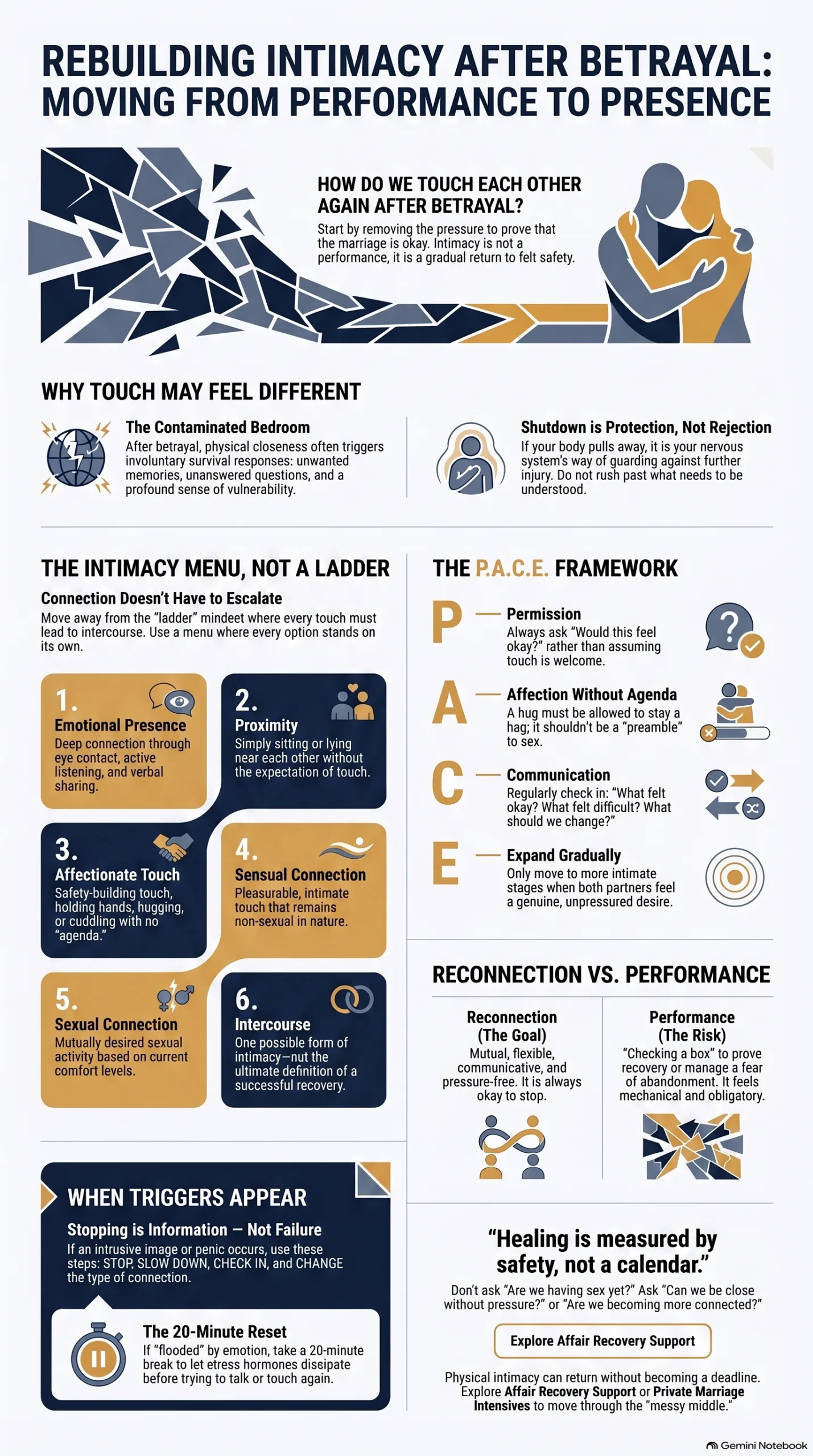
What Your Body Is Actually Doing — and Why That’s Normal
If your body pulls away, tenses, or goes numb during intimacy, that’s not a malfunction and it’s not rejection of your spouse. It’s your nervous system guarding against further injury. Research indicates that somewhere between 30% and 60% of betrayed partners experience trauma-like symptoms following discovery, including intrusive images, hypervigilance, and physical shutdown. One study of young adults found that roughly 45% showed symptom scores consistent with probable infidelity-related traumatic stress.
There’s a specific physiological threshold worth knowing about here. Research by Dr. John Gottman found that when a person’s heart rate climbs past roughly 100 beats per minute during emotional activation, the reasoning part of the brain effectively goes offline. Empathy, perspective-taking, and calm response become biologically difficult — not because someone is choosing to be difficult, but because the system running the moment has switched over to survival mode.
This is why “pushing through” a trigger doesn’t work. You can’t reason your way past a nervous system that has already flooded. What works is stopping, separating, and giving the body the time it actually needs to come back down.
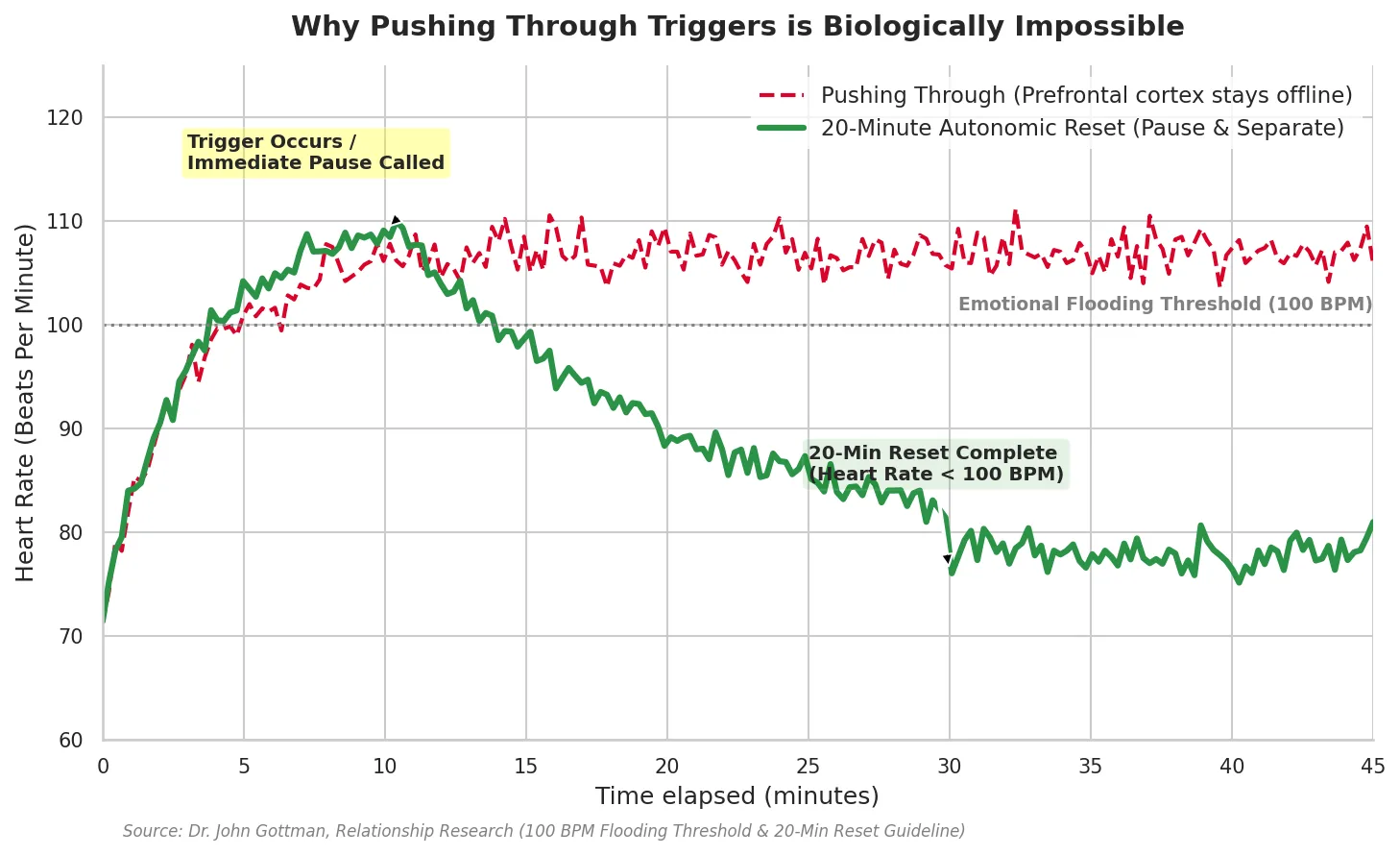
Source: Dr. John Gottman, relationship research (100 BPM flooding threshold and 20-minute reset guideline).
The Emotional Prerequisites That Come First
Physical intimacy after betrayal needs a foundation underneath it. Trying to rebuild the physical relationship while the foundation is still missing is why so many couples feel like they’re failing at something that should be simple.
Truth
The full account is out. Nothing is still being managed or released in pieces. A body cannot relax around someone who might still be holding something back.
Trustworthiness
Consistent, observable behavior over time — not promises. Transparency offered rather than extracted. Contact with the affair partner fully ended and staying ended.
Communication
The ability to say what feels okay, what feels difficult, and what needs to change — outside the moment, without it becoming a fight.
Choice
Both people genuinely free to say no, at any point, without it becoming a referendum on the marriage. Consent isn’t waived by reconciling.
Health & Safety
Any health implications addressed honestly and directly. This is a legitimate prerequisite, not an accusation.
Perfect healing isn’t required before intimacy can return. But intimacy shouldn’t outrun honesty, consent, and readiness — and when it does, it tends to set recovery back rather than move it forward.
What Rushing Intimacy Does to Recovery
There’s a specific trap couples fall into at this stage: treating sex as the scorecard. If we can do this, we must be okay. If we can’t, we must be failing.
The difference between reconnection and performance is worth naming precisely, because they can look identical from the outside.
| Reconnection | Performance |
|---|---|
| “I want to be close to you.” | “If we have sex, maybe that means we’re okay.” |
| “We can stop whenever we need to.” | “We started, so we have to finish.” |
| “This felt meaningful.” | “We checked the box.” |
Intimacy that happens to prove something, or to manage a fear of abandonment, tends to feel mechanical and obligatory to both people. It becomes transactional — something completed rather than something shared. And it produces the opposite of what it’s reaching for: the betrayed partner feels further from safety rather than closer to it, and the unfaithful partner gets reassurance that isn’t real.
Sex can absolutely be part of recovery. It just shouldn’t become the recovery scorecard.
Why Communication Matters More Than Frequency
There’s a research finding here that reframes what couples should actually be working on. A 2022 meta-analysis spanning 93 studies and more than 38,000 individuals found that sexual communication was positively associated with both relationship satisfaction and sexual satisfaction — and that communication quality showed notably stronger associations than frequency did.
A separate study of 126 couples found something sharper still: while both frequency and communication predicted sexual satisfaction, only communication predicted overall relationship satisfaction. Increasing how often you have sex doesn’t restore a marriage. Rebuilding the safety to talk about it does.
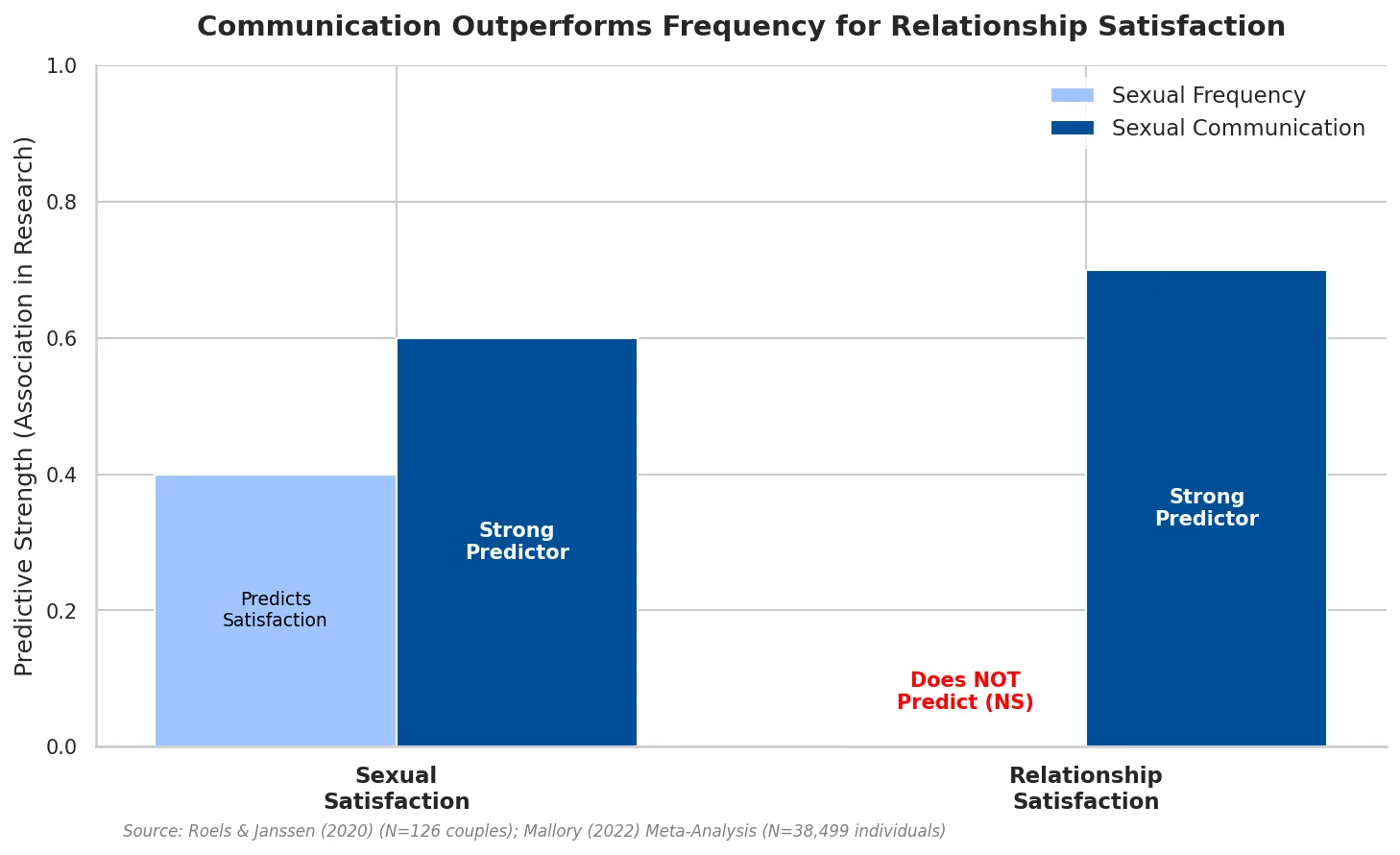
Sources: Roels & Janssen (2020), n=126 couples; Mallory (2022) meta-analysis, n=38,499 individuals.
Intimacy Is a Menu, Not a Ladder
One of the most useful reframes at this stage: stop treating physical connection as a staircase where every step has to lead upward to intercourse. That ladder mindset is exactly what makes every touch feel like a negotiation, and it’s why the lower-desire partner starts bracing at the first sign of affection.
Instead, treat it as a menu where every option is a complete experience in itself:
Emotional presence — eye contact, real listening, being genuinely known. Proximity — sitting or lying near each other with no expectation of touch. Affectionate touch — hand-holding, hugging, cuddling with no agenda. Sensual connection — pleasurable, intimate touch that stays non-sexual. Sexual connection — mutually desired, based on where you both actually are. Intercourse — one possible form of intimacy, not the definition of a successful recovery.
A hug doesn’t have to become a kiss. A kiss doesn’t have to become sex. When that’s genuinely true and both people believe it, the bracing stops — and paradoxically, that’s usually when desire starts finding its way back.
The PACE Framework
A practical structure for approaching physical closeness during this stage, designed to keep pressure out of it.
P
Permission
Ask rather than assume. “Would this feel okay?” costs nothing and changes everything about how touch lands.
A
Affection Without Agenda
Let touch remain touch. A hug has to be allowed to stay a hug rather than functioning as a preamble.
C
Communication
Check in regularly, outside the moment: what felt okay, what felt difficult, what should we change.
E
Expand Gradually
Move toward more intimate connection only when both people feel genuine, unpressured desire — not on a schedule.
When a Trigger Appears Mid-Moment
This will happen, and it doesn’t mean anything has gone wrong. An unwanted memory surfaces. Someone becomes uncomfortable. Desire vanishes. One person changes their mind. All of that is normal at this stage.
The sequence that works: stop — immediately, without needing to explain first. Slow down and separate physically if needed. Check in with each other. Change course to something that feels manageable, or to nothing at all. Talk afterward, once both nervous systems have settled.
If either person is genuinely flooded, take the full twenty minutes apart before trying to talk. Coming back too early means returning to a conversation with a nervous system that’s still activated, which is how a manageable moment turns into a fight.
Stopping is information, not failure. A successful intimate moment isn’t defined by whether intercourse happened.
“Healing is measured by safety, not a calendar.”
— Couples Academy practitioner guidance
You’re Not Rebuilding the Old Bedroom
This is worth saying directly, because a lot of couples are quietly trying to get back to exactly how things were before — and measuring themselves against a version of the relationship that no longer exists.
What you’re actually building involves pressure-free affection, honest communication about sex, patience, consistency outside the bedroom, learning new forms of closeness, and gradual expansion of intimacy that both people genuinely want. That’s a different relationship than the one before the affair. For many couples, it ends up being a more honest one.
The question worth asking isn’t “are we having sex yet.” It’s “can we be close without pressure?” and “are we becoming more connected?”
When You Need Outside Support
Some couples can work through this with intention and patience. Others get stuck in a loop where every attempt to discuss it ends in defensiveness, shutdown, or a fight — and at that point, more conversations aren’t the answer, because neither person can actually hear the other.
A few things also warrant support beyond the relational work: if physical pain, medication effects, or a health condition is part of the picture, that deserves a medical evaluation rather than being attributed entirely to the affair. And if trauma symptoms remain intense well beyond the first year, a licensed mental health provider who specializes in trauma can help in ways that relational work alone can’t.
For the relational side, our affair recovery coaching addresses the safety and honesty work that physical reconnection depends on. And when a couple is genuinely stuck, a private marriage intensive gives you concentrated, guided time to move through what fragmented conversations at home can’t reach.
Loading Viewer...
FAQ
How long does it take to be intimate again after infidelity?
There’s no reliable timeline, and treating it as a deadline tends to make it take longer. What research consistently indicates is the sequence rather than the schedule: honesty, accountability, and transparency have to be established before physical reconnection is realistic. Intimacy returns as safety returns, which means the more useful question is what conditions are still missing rather than how many months it’s been.
Why don’t I want to be touched after my spouse cheated?
Because your nervous system is protecting you. Physical intimacy requires dropping your guard with someone, and your body has recent evidence that doing so wasn’t safe. Between 30% and 60% of betrayed partners experience trauma-like responses including physical shutdown and intrusive images. This is involuntary and normal, not a sign that you’ve stopped loving your spouse or that recovery isn’t working.
Can physical intimacy help heal a marriage after an affair?
It can be part of healing, but it can’t lead it. Research shows that sexual communication predicts relationship satisfaction while frequency alone does not — meaning the ability to talk honestly about intimacy matters more than how often it happens. Intimacy that occurs to prove the marriage is fine tends to feel mechanical and set recovery back rather than advance it.
What does rebuilding intimacy after betrayal actually look like?
It starts with removing the pressure entirely — agreeing explicitly that touch isn’t leading anywhere for a defined period. From there it’s a gradual expansion: emotional presence, physical proximity, affectionate touch, and onward only when both people genuinely want to move forward. Triggers along the way are expected. Stopping when one appears is the correct response, not a setback.