Stop Calling it a ‘Mistake’ — Why Minimizing the Affair Destroys Trust
He calls it a mistake. You keep hearing something closer to a plan.
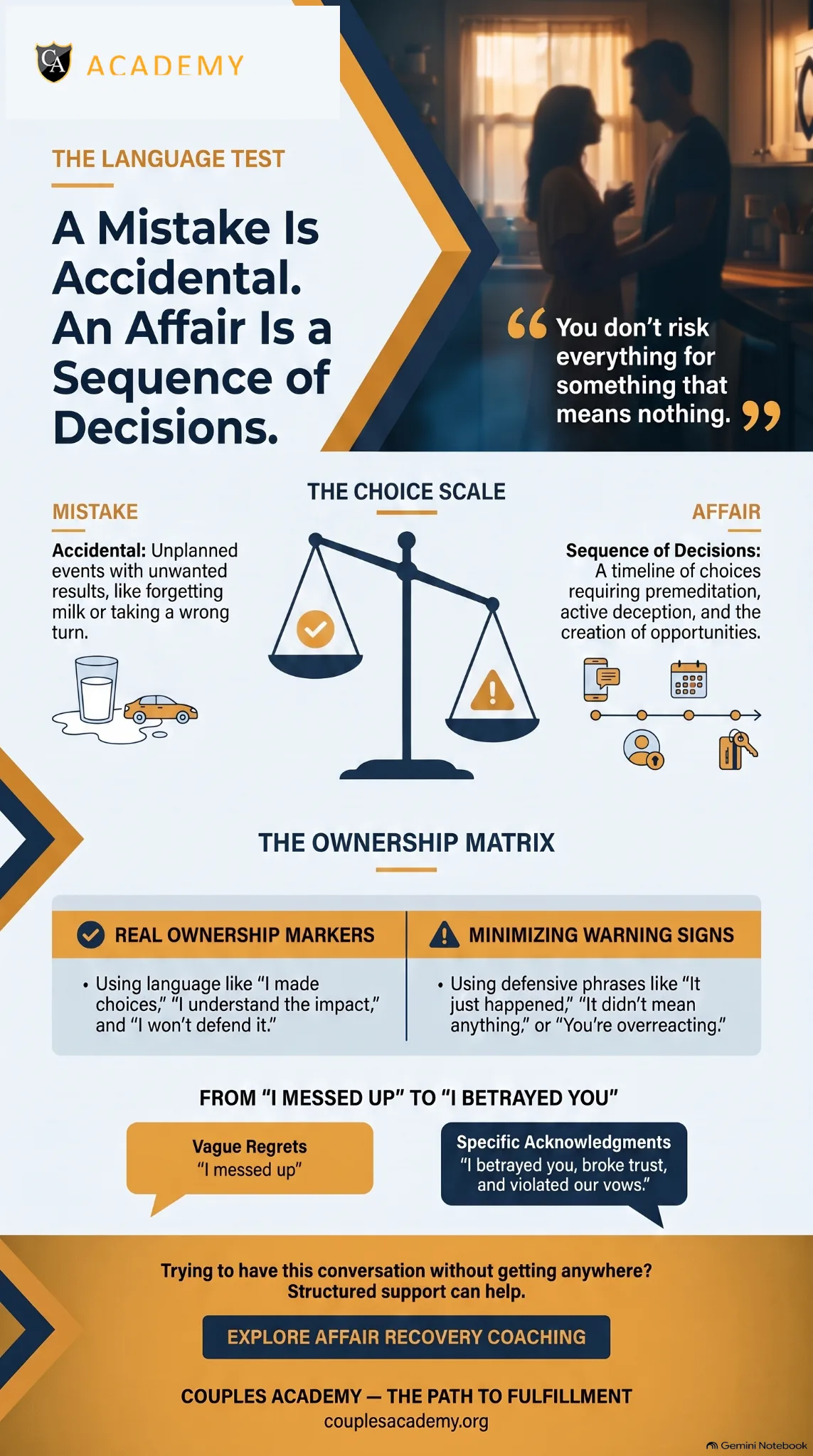
Here’s the direct answer: the word “mistake” isn’t the real problem. What it’s being used to avoid is. A mistake is something that happens by accident. An affair happens through a sequence of choices: creating opportunity, hiding it, lying about it, sometimes for months. Whether “mistake” is genuine shorthand for regret or a way of making the whole thing sound smaller depends on what comes after it, not on the word itself.
If you’re trying to decide whether a long-term affair specifically is something you can move past, this piece on forgiving a long-term affair covers that question directly. Here, we’re focused on something that applies no matter how long it lasted: what the language he uses right now actually tells you.
Stop Calling It a “Mistake” — Why Minimizing the Affair Destroys Trust | Marriage Intervention | 004
31:24 ·
A Mistake Is Accidental. An Affair Is a Sequence of Decisions.
A mistake is forgetting to grab milk on the way home, or taking the wrong exit because you weren’t paying attention. It’s unplanned. Nobody sets out to do it.
An affair doesn’t work that way. It requires noticing an opportunity and not walking away from it. Creating privacy that didn’t need to exist. Deciding, more than once, to keep going instead of stopping. Coming up with an explanation for where the time went. None of that happens by accident, and the longer it went on, the more decisions it took to keep it hidden.
Here’s a comparison worth sitting with: an accountant who transposes a couple of numbers because they’re exhausted made a mistake. An accountant who transposes numbers on purpose, repeatedly, to move money without anyone noticing, didn’t make a mistake. They ran a scheme. The difference isn’t the size of the error. It’s whether it was planned and covered up.
What Minimizing Language Actually Tells You
“It was a mistake.” “It didn’t mean anything.” “You’re overreacting.” “We just had a few encounters.” None of these phrases are neutral. Each one quietly makes the affair sound smaller, more accidental, or more your problem than his.
This kind of softened language has a name in recovery circles: minimizing. It’s not necessarily a sign that someone is a bad person. Often it’s a way of managing their own shame, of making the thing they did easier for them to carry. But regardless of the intent behind it, what you hear on the receiving end is usually some version of “your pain doesn’t match what actually happened,” which tends to make things worse, not better.
What Minimizing Language Can Hide
The problem is not automatically the phrase someone uses. The question is whether the language accurately names what happened—or makes the choices, secrecy, and impact sound smaller than they were.
What You May Hear
What They May Be Trying to Communicate
What You May Hear Instead
A More Accountable Way to Say It
“It was a mistake.”
Regret, remorse, or an attempt to summarize something they deeply wish they had not done.
“You’re reducing a series of choices to one moment that simply happened.”
“I made choices that betrayed you, and I understand why calling all of it a mistake can make what happened sound smaller.”
“It didn’t mean anything.”
An attempt to reassure you that the affair was not a deeper romantic relationship or that the marriage still mattered.
“You risked our marriage for something you’re now telling me was meaningless.”
“Whatever it meant to me at the time, I understand that it was significant because of what my choices did to you and to our marriage.”
“Why can’t you just move on?”
Discomfort with repeatedly returning to the affair and a strong desire for the relationship to feel normal again.
“Your discomfort with this conversation matters more than the fact that I’m still hurting.”
“I understand that you may still need to talk about this, even when the conversation is difficult for me.”
“I already said I’m sorry.”
A belief that the apology communicated remorse and should help the relationship begin moving forward.
“You think one apology should end the conversation and restore the trust that was lost.”
“My apology matters, but I understand that words alone don’t repair trust. I need to keep showing you something different.”
“We were having problems too.”
An attempt to explain what the marriage felt like before the affair or provide context for what was happening at the time.
“You’re making problems in our marriage partly responsible for your decision to cheat.”
“We had relationship problems that we need to address, but choosing an affair was still my responsibility.”
“They came onto me.”
An attempt to explain how the interaction began or make clear that they did not initiate the first advance.
“You’re focusing on what the other person did instead of the choices you made afterward.”
“I may not have initiated the first interaction, but I was responsible for the boundaries I crossed and the contact I chose to continue.”
“It just happened.”
An attempt to describe something that developed gradually rather than beginning with a deliberate plan to have an affair.
“You’re describing repeated decisions as though there was never a point where another choice could have been made.”
“It may have developed gradually, but there were still choices I made along the way that allowed it to continue.”
“You’re overreacting.”
A defensive reaction to an intense or difficult conversation and a desire for the immediate conflict to stop.
“You’re telling me that my response is the problem instead of acknowledging what caused it.”
“I may be uncomfortable with how painful this conversation is, but I understand why what happened has affected you so deeply.”
“We just had a few encounters.”
An attempt to describe the relationship as limited, casual, or less emotionally significant than a longer affair.
“You’re using softer language that makes what happened sound smaller than it feels to me.”
“We crossed the boundaries of our marriage, and I hid that from you. I need to name what happened accurately rather than make it sound less serious.”
Listen for what comes after the words.
“Mistake” can be shorthand for genuine regret or a way of shrinking what happened. The clearer signal is whether your spouse can name the choices, acknowledge the impact, and take responsibility without making you carry part of the blame.
There’s also a quieter version of this pattern worth watching for: softer words standing in for harder truths. “We had an encounter” instead of “we had an affair.” “I strayed” instead of “I lied to you for months.” The specific words matter less than what they’re doing, which is making something ugly sound a little more palatable.
The Words That Signal Real Ownership
Saying “I take full responsibility” and actually taking it are two different things. Real ownership sounds less like a rehearsed line and more like specific, unqualified statements: “I made a series of choices that betrayed you.” “I planned around it and lied about where I was.” “The pain you’re in is because of what I did, not because you’re overreacting.”
Notice what’s missing from those sentences: no “but.” No shared blame. No explanation offered as a defense. Context about what was going on in the marriage can be part of an honest conversation eventually, but it should never replace the sentence “I chose this.”
Words are a start, not the finish line. What actually confirms ownership is what happens afterward: full contact with the affair partner ending and staying ended, a willingness to answer hard questions without getting defensive, transparency that’s offered rather than extracted. If the words are there but the actions never show up, the accountability wasn’t real to begin with.
Saying “I’m Accountable” vs. Actually Showing Accountability
Accountability is not proven by one apology or one perfectly worded conversation. It becomes more believable when specific ownership is followed by consistent behavior.
Area of Recovery
Minimizing or Defensive Response
Real Ownership Can Sound Like
What You Can Actually Observe
Naming what happened
“It was just a mistake.”
“I made a series of choices that crossed our boundaries and required me to hide things from you.”
What happened is described accurately without repeatedly shrinking, softening, or changing the story.
Responsibility for choices
“They came onto me.”
“I was responsible for the boundaries I crossed and for the contact I chose to continue.”
Your spouse focuses on their own decisions rather than making the affair partner the main actor in the story.
Problems in the marriage
“We weren’t getting along, so you have to understand why this happened.”
“We had real problems, but those problems did not make the affair your responsibility.”
Problems in the relationship can be discussed without using them to transfer responsibility for choosing the affair.
Answering difficult questions
“Why do we have to keep talking about this?”
“I understand why you still have questions. I’ll answer what I reasonably can without pretending you should already be over it.”
Your spouse can stay in difficult conversations without immediately shutting down, becoming defensive, or demanding that the subject disappear.
Acknowledging the impact
“It didn’t mean anything.”
“Whatever it meant to me at the time, I understand that what I did had a serious impact on you and on our marriage.”
Your spouse can acknowledge the seriousness of what happened without arguing that your reaction is too large for the affair.
Boundaries with the affair partner
“You should just trust me that it’s over.”
“I understand why words alone aren’t enough. I’m willing to establish clear boundaries and be open about any contact that cannot reasonably be avoided.”
Appropriate boundaries remain consistent, including honest handling of unavoidable contact involving work, children, legal matters, or other legitimate obligations.
Transparency
“I already told you the important parts. Why do you need to know anything else?”
“I don’t want you to keep discovering important information after the fact. I’ll answer your reasonable questions honestly and correct anything I’ve left unclear.”
Important information is offered more proactively instead of appearing in fragments only after contradictions, discoveries, or repeated questioning.
Patience when the pain resurfaces
“I already said I’m sorry. You need to let it go.”
“I know my apology doesn’t decide when you’re ready to move forward. What would be helpful from me right now?”
Your spouse continues showing up when the subject is uncomfortable instead of treating forgiveness or renewed trust as something they are owed.
The test isn’t whether they know the right words.
Listen for specific ownership, then watch what follows. Accountability becomes credible when the language and the behavior start telling the same story.
Why “It Didn’t Mean Anything” Makes Things Worse
This phrase is usually meant as reassurance. What he’s often trying to say is “I wasn’t in love with her, our marriage is what matters.” What tends to land instead is something much harder to hear: you risked everything for something that meant nothing. What does that make me?
Whatever it was he was chasing, whether that’s validation, escape, distraction, or something else entirely, it meant something to him at the time. Pretending otherwise doesn’t make the betrayal smaller. It just adds a layer of dismissal on top of it. What actually helps is closer to: “I won’t pretend it was nothing. I understand it was significant because of what it did to you and to us.”
How to Respond When Your Spouse Minimizes
It’s easy to get pulled into a loop here: you push to be heard, he gets defensive, you push harder, he shuts down further. Neither of you ends up anywhere new.
A more useful approach is naming the language itself rather than his character. Something like: “When you call it a mistake, I hear the choices and the impact getting smaller. I need you to describe what you actually chose, and what you understand it did to me.” That’s a request for specificity, not an accusation.
When Your Spouse Minimizes: Questions That Lead Toward Accountability
The goal is not to win an argument about the wording. It is to move the conversation from a softened version of what happened toward specific choices, responsibility, impact, and what changes next.
When You Hear This
What Not to Get Pulled Into
A More Useful Response
What the Answer May Help You Learn
“It was just a mistake.”
A long argument over the dictionary definition of “mistake” or whether the word itself proves anything.
“When you call all of it a mistake, I hear a series of choices getting compressed into one event. What choices do you believe you made along the way?”
Whether your spouse can name their own decisions specifically instead of only describing the final outcome.
“It didn’t mean anything.”
Trying to prove how emotionally important the affair partner was or wasn’t.
“I don’t need to prove what that person meant to you. I need you to understand what your choices did to me and to our marriage.”
Whether your spouse can acknowledge impact even if they describe the affair itself as emotionally insignificant.
“Why can’t you move on?”
Defending exactly how long you’re allowed to be hurt or proving that your recovery is happening quickly enough.
“I want to move forward too. But moving forward doesn’t mean pretending the impact disappeared. Can we talk about what still needs to change for this to feel safer?”
Whether your spouse is willing to participate in repair even when the conversation remains uncomfortable.
“We were having problems too.”
Relitigating the entire marriage in the middle of a conversation about responsibility for the affair.
“We can absolutely talk about the problems in our marriage. Right now I’m asking what responsibility you take for choosing the affair instead of addressing those problems directly.”
Whether relationship problems can be discussed without turning them into shared responsibility for the decision to cheat.
“I already said I’m sorry.”
Debating whether the apology was sincere enough or treating one apology as the entire measure of remorse.
“I hear that you’re sorry. What I need now is to understand what is going to be different because of what happened.”
Whether the apology is being followed by changes in boundaries, honesty, transparency, and behavior.
“Nothing like this will ever happen again.”
Demanding a guarantee about the future that neither person can actually prove in one conversation.
“I hope that’s true. What specifically will you do differently the next time you’re tempted, disconnected, unhappy, or presented with an opportunity?”
Whether the promise is supported by specific boundaries and changed behavior rather than reassurance alone.
“You’re overreacting.”
Escalating into an argument over whether you’re entitled to feel what you’re feeling.
“We may disagree about how I’m reacting, but I don’t want this conversation to become about whether I’m allowed to be hurt. I want to talk about what happened and what comes next.”
Whether your spouse can return to the substance of the conversation instead of making your reaction the central problem.
“Why do you keep asking the same questions?”
Feeling guilty for needing clarity or turning the conversation into another interrogation.
“I’m asking again because I’m still trying to understand what happened and whether the story is consistent. Is there something about this question that’s difficult for you to answer?”
Whether your spouse is willing to clarify important facts and whether the account remains consistent rather than changing each time it is discussed.
Don’t get trapped arguing over the phrase.
A better question is: Can your spouse move from explaining the language to naming the choices, acknowledging the impact, and describing what will actually be different now?
It also helps to shift the questions you’re asking him. Instead of circling “why did you do it” over and over, try: “What are you doing to make sure this doesn’t happen again?” “What boundaries are you putting in place?” “What will you do the next time you’re tempted?” Those questions point toward the future instead of relitigating the past, and they tend to reveal a lot more about whether real change is happening.
Important Note
Everything above is about minimizing language in an otherwise safe relationship, not about threats, intimidation, coercion, or violence. If you feel unsafe, controlled, or afraid of your partner in any way, please reach out to a crisis resource or a safety professional first. That situation calls for a different kind of help than what’s covered here.
Moving From Minimizing to Accountability
Accountability isn’t a punishment he’s serving. It’s the starting point recovery actually depends on. Some people move from minimizing language into real ownership fairly quickly once the shame starts to settle. Others stay stuck there for a long time, and the longer that lasts, the harder it becomes to build anything on top of it.
If it feels like the same conversation keeps happening on repeat, that’s often less about needing to find the right words and more about needing structure neither of you can create alone. That’s exactly what structured affair recovery coaching is built for. And if he’s genuinely ready to move past minimizing but isn’t sure what accountability requires from here, this piece on whether patterns repeat is a useful next read for him.
Loading Viewer...
FAQ
What does it mean when my spouse calls the affair a mistake?
It could mean either thing, and the word alone won’t tell you which. It can be genuine shorthand for regret, or it can be a way of making a planned, hidden sequence of choices sound like something that just happened. The clearest way to tell the difference is whether he follows it up with specific ownership of what he actually did, or uses it to close the conversation down.
How do I know if my spouse takes real accountability?
Listen for specific, unqualified ownership: naming the choices, not just the outcome, and naming the impact on you without adding a “but.” Then watch whether his actions match it over time. Full distance from the affair partner, transparency offered rather than pulled out of him, and staying present when you’re triggered instead of getting defensive are all stronger evidence than any single sentence.
Why does my spouse say the affair meant nothing?
Usually it’s meant to reassure you that there wasn’t real love involved. What it tends to communicate instead is that he risked the marriage for something worthless, which can make the betrayal feel even more senseless. Whatever the affair meant to him, it doesn’t change what it did to you and the relationship.
Can we recover if they won’t admit what they did?
Recovery gets significantly harder without honest naming of what happened, because you can’t rebuild safety around a version of events that keeps shrinking. That doesn’t mean one defensive conversation ends everything. It means persistent minimization, well after the initial shock has worn off, is a real signal worth paying attention to rather than something to talk yourself out of noticing.