
Divorce Statistics
What the Data Says About Marriage, Separation, and Second Chances
Divorce statistics can help couples understand larger relationship trends, but they should never be treated as a prediction for one specific marriage.
You may have heard that “50% of marriages end in divorce.” That number is often repeated, but the real story is more nuanced. Divorce rates in the United States have declined significantly from their peak, people are marrying later, and many couples are making more intentional decisions about marriage, separation, and reconciliation.
This page brings together key divorce statistics, financial impact data, common reasons for divorce, and relationship trends to help couples understand the numbers — and what those numbers may mean if their own marriage is at a turning point.
Key Statistics
Divorce Statistics at a Glance
The most useful divorce statistics come from national public health data, family research centers, and peer-reviewed relationship research.
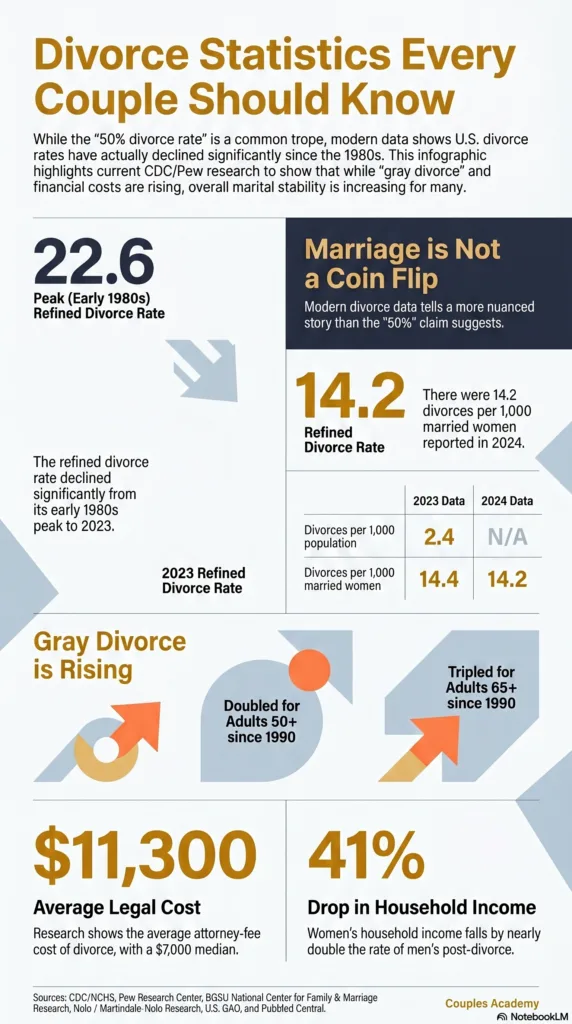
2.4
divorces and annulments per 1,000 population in provisional 2023 CDC/NCHS data.
14.4
divorces per 1,000 married women in 2023, according to Pew Research Center.
14.2
divorces per 1,000 married women in 2024, according to BGSU/NCFMR.
22.6 → 14.4
the refined divorce rate fell from its early 1980s peak to 2023.
Source note: The 2023 crude divorce rate is based on CDC/NCHS provisional marriage and divorce data. The 2023 refined divorce rate and long-term trend are based on Pew Research Center reporting. The 2024 refined divorce rate is based on Bowling Green State University's National Center for Family & Marriage Research.
The “50% of Marriages End in Divorce” Myth
The idea that half of all marriages end in divorce is one of the most repeated relationship statistics. But it is also one of the most misunderstood.
Divorce rates were much higher during the late 20th century, especially around the divorce-rate peak of the early 1980s. Since then, the refined divorce rate has declined significantly. That does not mean divorce is rare, but it does mean marriage is not simply a coin flip.
The more accurate takeaway is this:
Divorce remains a serious risk for many couples, but the risk depends on factors like age at marriage, education, income, relationship history, conflict patterns, infidelity, emotional disconnection, and whether couples seek help before the relationship reaches a breaking point.
For couples in crisis, statistics should not create panic. They should create clarity.
Is Divorce Becoming More or Less Common?
Overall divorce rates in the United States have declined from their peak.
The refined divorce rate — divorces per 1,000 married women — peaked around 1980 at 22.6. By 2023, that figure had fallen to 14.4. In 2024, BGSU/NCFMR reported a refined divorce rate of 14.2.
There are several reasons researchers point to for this decline:
- People are marrying later.
- Many couples are more financially established before marriage.
- Fewer people are entering marriage casually or under pressure.
- Some couples cohabitate before marriage.
- Marriage has become less common, but often more intentional.
This creates a more hopeful and accurate picture than the old “50%” claim. Divorce is still real. Relationship breakdown is still painful. But the long-term trend suggests that many marriages are becoming more stable, not less.
Divorce Trends by Age: Why Gray Divorce Matters
One of the most important divorce trends is gray divorce — divorce among adults age 50 and older.
While divorce has declined overall, divorce among older adults has risen sharply compared with 1990 levels. Pew Research Center has reported that divorce among adults 50 and older roughly doubled between 1990 and 2015, while divorce among adults 65 and older roughly tripled.
Gray divorce matters because older couples often face unique emotional, relational, and financial challenges, including:
- Dividing retirement assets
- Selling or refinancing a long-term family home
- Rebuilding financially with less time before retirement
- Managing adult children’s reactions
- Facing loneliness or social isolation
- Reconsidering identity after decades of marriage
- Deciding whether the marriage can be repaired before separation becomes final
For couples over 50, divorce is not only an emotional decision. It can affect retirement, family structure, health, adult children, and long-term financial stability.
Why Do Couples Divorce?
Every divorce has its own story, but research consistently identifies several common contributors.
A study published through the National Library of Medicine found that the most commonly cited major contributors to divorce included lack of commitment, infidelity, and too much conflict or arguing.
Relationship Patterns
Common Reasons Couples Report for Divorce
Divorce is usually not caused by one isolated problem. Many couples report several overlapping issues that build over time.
| Reported Reason | Why It Matters | What Couples Can Address |
|---|---|---|
| Lack of Commitment | When one or both partners stop investing in the relationship, repair becomes harder. | Clarify willingness, expectations, priorities, and what rebuilding would require. |
| Infidelity | Affairs can break trust, emotional safety, and the shared reality of the marriage. | Truth, accountability, boundaries, affair recovery, and trust rebuilding. |
| Conflict & Arguing | Repeated unresolved conflict can create resentment, emotional shutdown, and hopelessness. | Communication, emotional regulation, repair attempts, and conflict patterns. |
| Financial Stress | Money issues often reveal deeper problems around trust, priorities, control, and security. | Shared financial values, transparency, planning, and decision-making. |
The Financial Cost of Divorce
Divorce is not only emotionally difficult. It can also create a major financial disruption.
Nolo/Martindale research reports that the average total attorney-fee cost for divorce was about $11,300, with a median of $7,000. Costs can rise significantly when cases involve disputes over custody, support, property, business assets, or trial.
The long-term financial impact can be even more serious than the immediate legal cost. A U.S. Government Accountability Office report found that women’s household income, on average, fell by 41% with divorce, almost twice the size of the decline experienced by men.
For couples considering divorce, the financial question is not only, “What will the legal process cost?” It is also:
- What happens to housing?
- What happens to savings?
- What happens to retirement?
- What happens to household income?
- What happens to the children’s financial stability?
- What happens if both spouses have to rebuild separately?
This does not mean couples should stay in harmful or unsafe marriages because divorce is expensive. It means couples should understand the full cost of the decision before assuming divorce is the only path forward.
The Toll Divorce Can Take
Divorce can affect more than a couple’s legal status. It can affect emotional health, physical health, finances, children, social networks, and long-term family stability.
For example, research summarized by Duke Health found that women who had been divorced once were 24% more likely to experience a heart attack than women who remained married, and women divorced two or more times were 77% more likely. The same study found that men’s risk increased mainly after two or more divorces.
Those numbers should be handled carefully. They do not mean divorce directly causes every health outcome, and they should not be used to create fear. But they do show that major relationship disruption can create serious stress, especially when combined with financial instability, isolation, conflict, and uncertainty.
The healthier message is this:
When a marriage is in crisis, couples should slow down, get support, and make decisions from clarity instead of panic.
What Divorce Statistics Mean for Couples in Crisis
Statistics can show trends, but they cannot tell you whether your marriage is over.
If your relationship has been affected by infidelity, constant conflict, emotional distance, separation, or the threat of divorce, the most important question is not only what the statistics say. The more important question is what you are willing to do next.
Some couples need weekly counseling. Others need urgent marriage support. Some couples need a private marriage intensive because the relationship feels unstable and the decision point feels close.
Couples Academy helps couples slow down the crisis, address the real issues, and explore whether repair is possible before divorce becomes the final answer.
Divorce Prevention
When Divorce Feels Close, Clarity Matters
Divorce statistics can show what many couples experience, but they cannot decide the future of your marriage. If your relationship is at a turning point, Couples Academy can help you take a more focused and intentional next step.
Frequently Asked Questions About Divorce Statistics
The “50% of marriages end in divorce” claim is often repeated, but modern divorce data is more nuanced. Divorce rates have declined significantly since their peak around 1980, and the refined divorce rate has fallen substantially in recent decades. The risk of divorce depends on many factors, including age at marriage, education, income, relationship history, conflict, infidelity, and willingness to seek help.
CDC/NCHS provisional 2023 data reports 672,502 divorces and annulments from 45 reporting states and D.C., with a divorce rate of 2.4 per 1,000 population. Pew Research Center reported a refined divorce rate of 14.4 divorces per 1,000 married women in 2023, and BGSU/NCFMR reported 14.2 in 2024.
Overall, divorce has become less common compared with its peak in the early 1980s. However, divorce among adults 50 and older — often called gray divorce — has increased significantly since 1990.
Research commonly identifies lack of commitment, infidelity, and too much conflict or arguing as major contributors to divorce. Financial stress, marrying young, substance abuse, and domestic violence may also contribute in many cases.
Gray divorce refers to divorce among adults age 50 and older. This trend matters because older couples often face unique challenges involving retirement, assets, adult children, health, housing, and long-term financial stability.
Nolo/Martindale research reports an average of about $11,300 in attorney fees, with a median of $7,000. Costs vary widely depending on whether the divorce is contested, whether children are involved, whether property or business assets must be divided, and whether the case goes to trial.
It is common for one partner to be more willing than the other. A consultation may help clarify the situation, but lasting repair usually requires both partners to participate in some way. If one partner refuses any form of support, the willing partner may still benefit from individual guidance and clarity.
Some couples can rebuild after serious issues, including infidelity, conflict, and emotional disconnection. Repair usually requires honesty, accountability, emotional safety, changed behavior, and a clear process. For couples in crisis, urgent marriage support or a private marriage intensive may help create clarity before a final decision is made.
Ready to Take the Next Step?
Divorce statistics can show what many couples experience, but they cannot tell you what is still possible for your marriage.
If your relationship is facing infidelity, emotional disconnection, constant conflict, separation, or the threat of divorce, Couples Academy can help you take a focused and intentional next step.
Start with a confidential consultation, or explore whether a private marriage intensive may be the right fit for your situation.
!
Important Note
Couples Academy provides relationship coaching, marriage support, and educational resources. If you are in immediate danger, experiencing abuse, domestic violence, or a mental health emergency, please contact emergency services or a qualified crisis resource in your area.