
Infidelity Statistics:
What the Research Says About Cheating, Affairs, and Recovery
Infidelity statistics can help couples understand how common betrayal is, who reports cheating, why affairs happen, and how relationships are affected after trust is broken. But statistics can never tell the full story of one marriage.
If you are reading this after discovering an affair, the numbers may feel overwhelming. This page is designed to provide context, not fear. Infidelity can be devastating, but research and real-world experience both show that the next steps matter. With honesty, accountability, structure, and the right support, some couples are able to begin the difficult work of affair recovery and rebuilding trust.
Key Statistics
Infidelity Statistics at a Glance
The most reliable infidelity statistics come from nationally recognized survey data, but the numbers vary depending on how each study defines cheating.
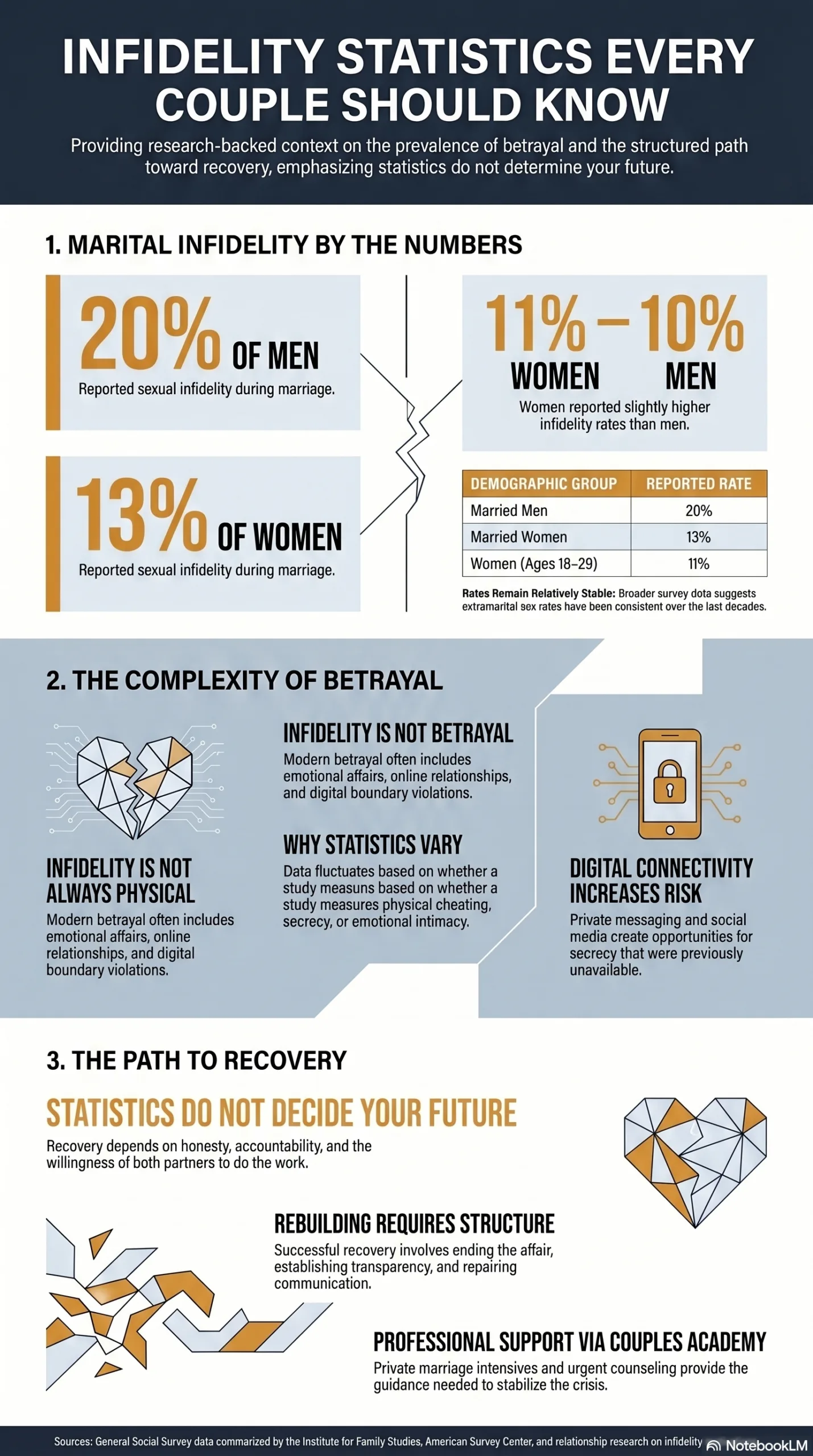
20%
of married men reported having sex with someone other than their spouse while married.
13%
of married women reported having sex with someone other than their spouse while married.
11% vs. 10%
among ever-married adults ages 18–29, women reported slightly higher infidelity rates than men.
Stable
GSS data suggests extramarital sex rates have been relatively stable over the last couple of decades.
Source note: The 20%, 13%, 11%, and 10% figures are based on General Social Survey data summarized by the Institute for Family Studies. The broader context about stable infidelity rates and changing definitions of cheating is supported by American Survey Center reporting. Infidelity estimates vary depending on whether a study measures sexual infidelity, emotional affairs, online behavior, or broader boundary-crossing.
A Note About Infidelity Statistics
Infidelity statistics can vary widely because studies do not always define cheating the same way. Some research focuses only on sexual infidelity during marriage. Other surveys include emotional affairs, online affairs, secrecy, flirting, pornography, dating app activity, or other boundary-crossing behaviors.
That is why two sources may report very different numbers and still be discussing the same general topic. Before accepting any statistic about cheating, it is important to ask:
- Who was surveyed?
- Was the group married, ever-married, dating, or in any committed relationship?
- Did the study measure sexual infidelity, emotional infidelity, online behavior, or all of the above?
- Was the survey anonymous?
- Was the question about cheating personally, or about being cheated on?
- Was the statistic based on research, a poll, or a commercial survey?
The most responsible way to read infidelity statistics is to understand the definition behind the number.
These Statistics Are Real. So Is the Help.
If you're reading this because infidelity has affected your marriage, Couples Academy offers private, confidential support.
Over 800 couples. 28+ years of experience. Hasani Pettiford is the nation's #1 Infidelity Recovery Specialist — and Couples Academy has helped couples across the US and internationally rebuild after betrayal.
Schedule a Confidential Consultation →How Common Is Infidelity in Marriage?
One widely cited analysis of General Social Survey data found that 20% of men and 13% of women reported having sex with someone other than their spouse while married.
That does not mean every marriage faces infidelity, and it does not mean every affair has the same cause or outcome. It does mean that betrayal is common enough that many couples face it, yet personal enough that every situation requires careful attention.
Infidelity is not just a statistic. For the couple experiencing it, it can feel like the entire relationship has changed overnight — which is exactly why a structured affair recovery program matters more than the numbers themselves.
Who Reports Cheating More: Men or Women?
Overall, men report marital infidelity at higher rates than women. However, the gender gap changes by age.
Among ever-married adults ages 18–29, women reported slightly higher rates of infidelity than men, at 11% compared with 10%. In older age groups, men report higher rates overall.
Research summaries also show that infidelity patterns can shift across life stages. Women’s reported infidelity rates peak later in life, while men’s reported rates are highest among older age groups.
Research Snapshot
Infidelity Statistics by Group
These figures help show how reported infidelity varies by gender and age, based on survey data.
| Group | Reported Infidelity Rate | What It Means |
|---|---|---|
| Married Men | 20% | Reported having sex with someone other than their spouse while married. |
| Married Women | 13% | Reported having sex with someone other than their spouse while married. |
| Women Ages 18–29 | 11% | Among ever-married adults in this age group, women reported slightly higher rates than men. |
| Men Ages 18–29 | 10% | Among ever-married adults in this age group, men reported slightly lower rates than women. |
Note: Survey results depend on how infidelity is defined and how comfortable respondents feel answering honestly.
Is Infidelity Becoming More Common?
It may feel like infidelity is everywhere because social media, podcasts, reality TV, and online forums frequently discuss cheating and betrayal. But available survey data does not show strong evidence that marital infidelity has dramatically increased in recent years.
One reason infidelity feels more common is that people now have more ways to cross boundaries privately. Texting, social media messages, dating apps, direct messages, and online communities can create opportunities for secrecy that did not exist in the same way in previous generations.
This does not mean every online interaction is cheating. It does mean couples need clear boundaries around privacy, secrecy, emotional intimacy, and digital behavior.
Emotional Affairs, Online Affairs, and Digital Infidelity
Not all infidelity is physical.
For many couples, the deepest injury comes from secrecy, emotional intimacy with someone outside the relationship, hidden communication, or repeated boundary violations. Emotional and digital infidelity can be difficult to measure because couples do not always define these behaviors the same way.
One partner may view private messages with an ex as harmless. The other may experience it as betrayal. One person may see social media flirting as attention-seeking. The other may see it as a violation of trust.
This is why infidelity statistics are only part of the conversation. Couples also need to define what trust means inside their own relationship.
Why Do People Cheat?
Infidelity is never justified, but understanding common motivations can help couples identify what needs to be addressed.
Research on infidelity motivations has identified several recurring themes, including:
- Anger or resentment
- Lack of love
- Low commitment
- Emotional neglect
- Desire for sexual variety
- Situational opportunity
- Self-esteem or validation
- Unmet emotional needs
- Avoidance of conflict
- Poor boundaries
These motivations do not excuse betrayal. But for couples trying to recover, understanding the deeper patterns behind the affair can be part of the repair process.
What Happens After an Affair Is Discovered?
Discovery often creates emotional shock for both partners.
The betrayed partner may experience anger, grief, intrusive thoughts, anxiety, confusion, or a deep sense that reality has been shaken. The partner who was unfaithful may experience shame, defensiveness, fear, guilt, or uncertainty about how to repair what happened.
Without structure, many couples get stuck in painful cycles:
- Repeated questioning without clarity
- Defensiveness and blame-shifting
- Emotional shutdown
- Pressure to “just move on”
- Constant checking or monitoring
- Avoiding hard conversations
- Escalating arguments
- Fear that trust can never be rebuilt
Affair recovery requires more than an apology. It requires honesty, accountability, emotional safety, changed behavior, and a process for rebuilding trust over time — which is exactly the structure a private marriage intensive is built to provide.
Affair Recovery
Statistics Do Not Decide the Future of One Marriage
Infidelity statistics can show patterns, but they cannot determine what is possible for your relationship. Recovery depends on honesty, accountability, emotional safety, changed behavior, and whether both partners are willing to do the work required.
!
Important Note
Couples Academy provides relationship coaching, marriage support, and educational resources. If you are in immediate danger, experiencing abuse, or facing a mental health emergency, please contact emergency services or a qualified crisis resource in your area.
Frequently Asked Questions About Infidelity Statistics
Infidelity estimates vary depending on how the study defines cheating. One widely cited analysis of General Social Survey data found that 20% of married men and 13% of married women reported having sex with someone other than their spouse while married.
Overall, men report marital infidelity at higher rates than women. However, among ever-married adults ages 18–29, women reported slightly higher rates than men. The gap changes by age and life stage.
Not always. Some studies measure only sexual infidelity, while others include emotional affairs, online affairs, secrecy, or romantic behavior outside the relationship. This is why infidelity statistics can vary widely.
It depends on the study. Some surveys ask only about sexual behavior, while others include online emotional affairs, private messaging, dating app activity, or other digital behaviors that may violate relationship boundaries.
Research has identified several common motivations, including anger, low commitment, lack of love, neglect, sexual desire, desire for variety, self-esteem, and situational opportunity. These motivations do not excuse betrayal, but they can help explain what must be addressed during recovery.
Some marriages can begin recovering after infidelity, but recovery usually requires honesty, accountability, emotional safety, changed behavior, and a clear repair process. Statistics alone cannot determine whether one specific marriage can recover.
Many couples benefit from getting support early because emotions are often intense and conversations can quickly become reactive, defensive, or harmful. Urgent marriage support or a private marriage intensive can help couples slow down the crisis and create a clearer next step.