

When you think of cheating or an affair, you probably imagine it only as sexual intimacy with someone who isn’t your partner or spouse. But that leaves a large gray space between platonic friendships and physical affairs, doesn’t it? Turns out, there is something called an emotional affair — and they can be difficult to spot, even for those involved.
Emotional cheating is problematic and disruptive; it can ruin everything you built between you and your partner. This guide covers everything you need to know: what an emotional affair actually is, whether it counts as infidelity, the warning signs, what causes them, and what recovery looks like for couples who face one.
What Is an Emotional Affair?
Also known as emotional cheating or an emotionally charged friendship, an emotional affair is defined as a person feeling closer to someone outside of their current relationship than they do to their partner. Because of this intense connection, an individual may begin to feel chemistry and attraction to this “friend.” The result is less energy given to your partner or spouse and more to someone else.
It usually begins with joking around, sharing secrets and feelings, and spending time together. At first, an emotional affair feels like a normal friendship — until your focus shifts to this individual instead of your partner.
The defining factors are how much you think about the other person compared to your partner, and the level of transparency you have about the relationship. Emotional cheating doesn’t require any physical contact. You can meet someone online, at work, through a dating app, or on social media and fall into an emotional affair without a single in-person encounter.
Emotional affairs are often intoxicating because:
- You can openly discuss your marital dissatisfaction with someone else
- Emotional needs are fulfilled that your spouse may be ignoring or not interested in
- You receive much-needed social interaction
- You have an escape from an emotionally or physically distant partner
- You and the other person have chemistry, even if you don’t know one another in person

Emotional Affairs vs. Platonic Friendships
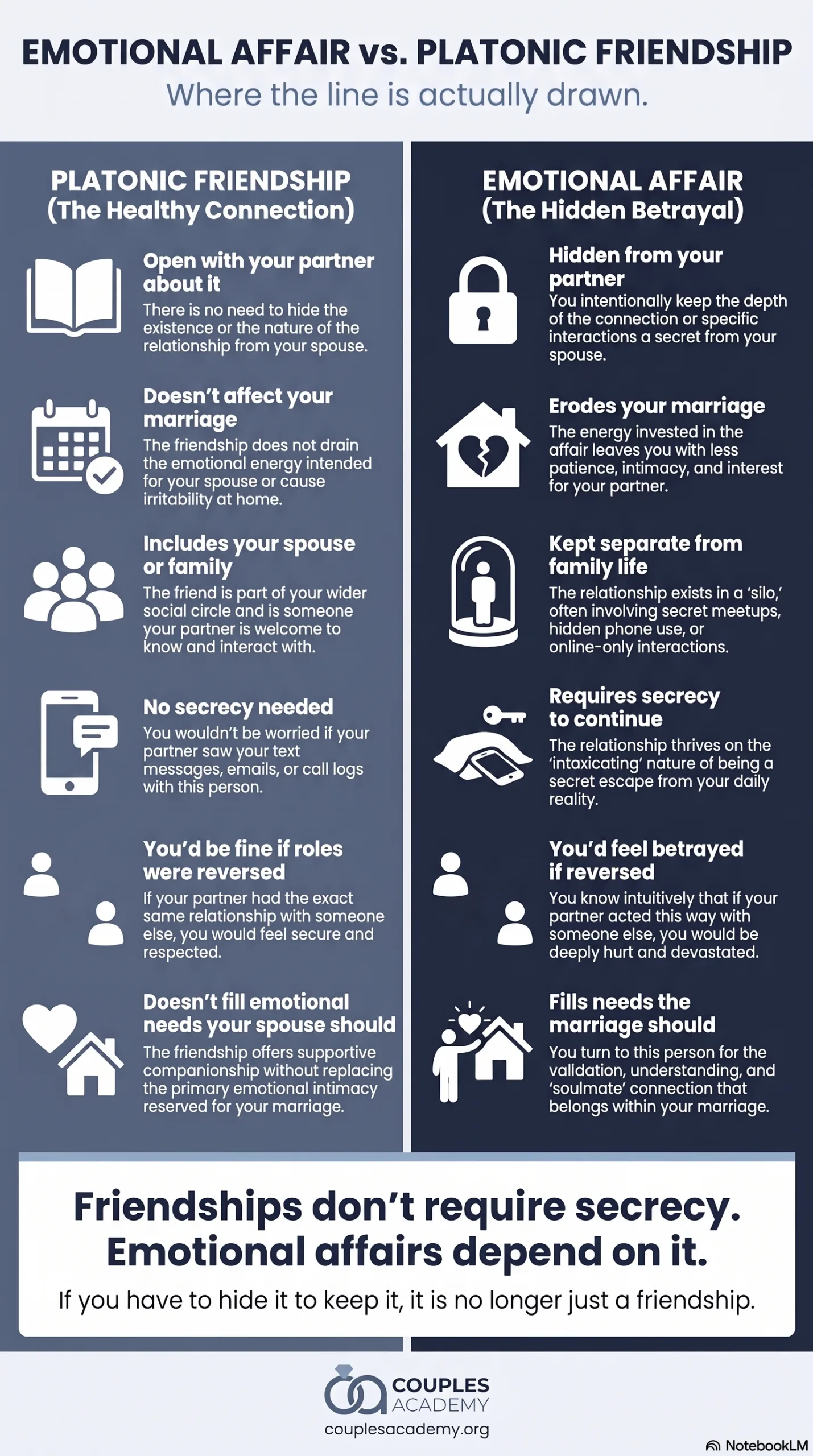
Since emotional affairs often begin as friendships, it can be difficult to tell the difference between a very strong platonic friendship and emotional cheating. There are key defining characteristics to consider.
A friendship is a supportive relationship with inherent boundaries. You may see your friend once a week or a few times a month — and you’re okay with this separation. With an emotional affair, you are more than eager to see or speak to the individual in question, and the relationship starts overshadowing the one you have at home.
The clearest test: if you find yourself nervous about interactions, worried that your partner might overhear or see the conversations you have, or if you would feel betrayed if the tables were turned — it has become emotional cheating. Friendships don’t require secrecy. Emotional affairs depend on it.
Does an Emotional Affair Count as Cheating?
Yes. Emotional cheating counts as a betrayal of trust in a relationship — and if it counts as infidelity in a relationship, it is most definitely infidelity in a marriage.
Although emotional cheating often looks and feels a lot like a friendship, it is not. It pulls your attention away from the relationship and makes it impossible to address the issues at home. Even without sex involved, you are being emotionally unfaithful to your partner. When two people marry, they vow to love and support their spouse — when you redirect that emotional investment to someone else in secret, you have broken that vow.
Some people believe emotional infidelity can cause no harm — if there’s no physical intimacy, what’s the damage? Ask anyone who has been on the receiving end. Sometimes it is easier to stomach knowing that your partner had a one-night mistake than knowing they spent months developing an emotionally intimate relationship with someone else. The betrayal isn’t in the physical act; it’s in the intimacy, secrecy, and redirected devotion.
Does Texting or Social Media Count?
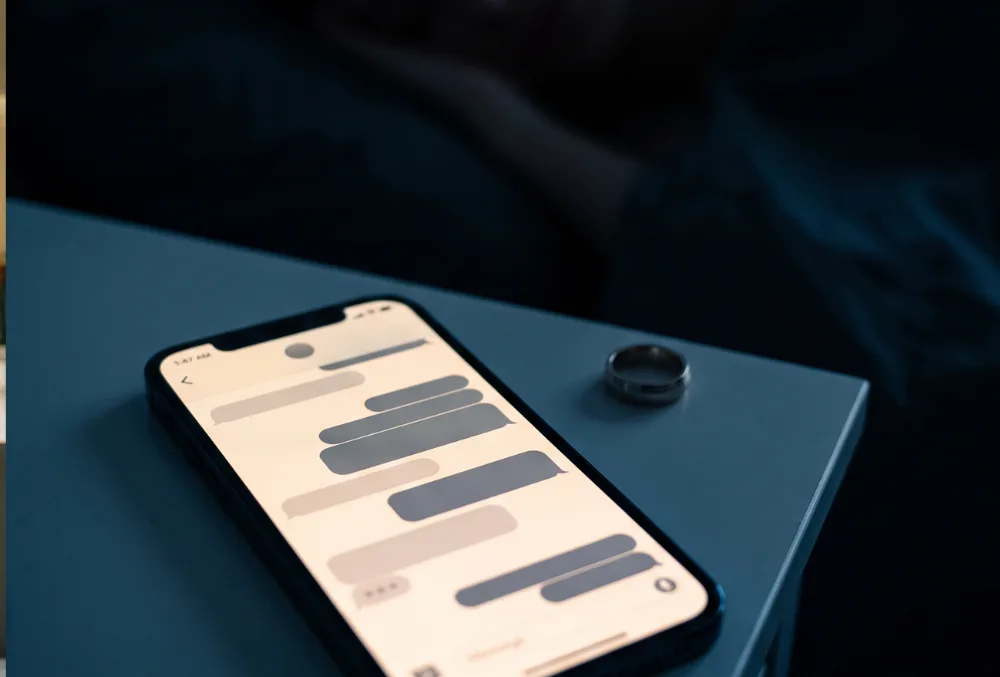
Yes, texting someone can count as an emotional affair. Instant messaging has made connecting incredibly easy, and harmless conversation can quietly become something more. It becomes an emotional affair when you communicate with your “friend” more than your partner — using that connection to discuss emotions or issues you can’t tell your partner, or seeking validation your partner doesn’t give.
Here’s a clear example: Is there someone in your life to whom you respond immediately while leaving your spouse on “read” for the rest of the day? That could be an emotional affair.
Social media works the same way, with an added risk: there are fewer disruptions and responsibilities online, only the conversation. That can lead to idealization, fantasy, and chemistry with someone you’ve never met — which is exactly why long-distance emotional affairs can feel so consuming.
Signs of an Emotional Affair
Because emotional affairs develop gradually and depend on secrecy, the signs can be hard to detect — including for the person having one. Here are the warning signs, organized by what to look for.
Signs you may be having an emotional affair:
- You tell the outside person things you would never tell your partner — including marital frustrations
- You turn to them whenever your partner is unavailable, or after unresolved conflicts
- You anticipate time with them, adjust your schedule for them, and daydream about them
- You believe they know and understand you better than your spouse does
- You exchange gifts, use terms of endearment, or dress up when you’ll see them
- You compare your partner to them — and your partner comes up short
- You’ve lost interest in intimacy with your spouse
- You keep the communication secret; if your partner saw the messages, they would be deeply upset
- You respond to questions about the friendship with defensiveness: “We’re just friends — nothing more”
- You’ve begun fantasizing about them, get butterflies around them, or have difficulty concentrating on anything else
- You feel anxiety at the thought of your partner finding out — and know you’d be ashamed if they did
- If the situation were reversed, you would feel deeply betrayed
Signs your partner may be emotionally cheating:
- They withdraw from communicating and interacting with you
- They become hyper-critical of you, or their affection and terms of endearment disappear
- After unresolved conflicts, they connect with this other person instead of you
- They hide their phone or screen when you’re around
- They stay distant — extra time at work, new projects, new hobbies out of the blue
- The friend gets mentioned constantly — or suspiciously never at all
- When you bring up the friendship, they become hostile and defensive: “They’re just a friend”
- Something is wrong — you can feel it in your gut
Keep in mind that one or two items on these lists are not enough to conclude someone is emotionally cheating. But if several are noticeable in your relationship, it may be a sign something is going on — and even if there is no affair, these patterns point to issues in the relationship worth addressing sooner rather than later.
If You Recognize This Pattern in Your Marriage
Emotional affairs are often harder to recover from than physical ones — because they are harder to define, harder to end, and harder to grieve.
Couples Academy offers private, confidential support for couples navigating emotional affairs — including what happened, how to stop it, and what recovery actually looks like.
Emotional Affairs and Micro-Cheating
Micro-cheating isn’t the same as an emotional affair, although the two can overlap. Micro-cheating is a small action that crosses a line — if the action would upset your partner or violate their sense of trust, it qualifies. Flirting is the classic example, and micro-cheating is often a sign that someone may cheat in the future.
The difference: micro-cheating doesn’t require a connection. Think of micro-cheating as a fixation or a boundary-crossing moment, while an emotional affair requires sustained emotional and time investment in a specific person.

What Causes Emotional Affairs?
There is no universal reason for infidelity, and there is rarely malicious intent involved in emotional cheating — it usually just happens. The friendship begins with honest intentions, then an unconscious shift in boundaries turns it into something else.
Often, that shift happens where there are unmet needs. Emotional cheating is enabled when you reach out to someone who seemingly understands you better in the moment than your partner does. Pains, fears, hopes, dreams — the need to share our inner world is part of being human. When your partner is unavailable for those conversations (or when past attempts were met with dismissal or judgment), you may unknowingly start sharing them with someone else.
Emotional affairs typically develop through a predictable progression — innocent connection, growing investment, quiet boundary erosion. We cover the full progression in How Do Emotional Affairs Start?, which is worth reading whether you’re trying to understand what happened or protect your marriage from it happening.
How to Stop an Emotional Affair
If you’ve recognized yourself in this article, know this: the impact of continuing can be devastating, and the best thing to do is stop now. The short version of what that requires:
1. Distance yourself from the other person. You cannot move on from an emotional affair without freeing yourself of it. If this feels like a breakup, that tells you how invested you’d become. Put real distance between you and refocus on your relationship.
2. Be truthful with your partner. The secrecy required to hide emotional cheating is one of the reasons it’s so damaging. Coming clean is a vital step in regaining trust — it shows your partner you understand what you did and are ready to make it right.
3. Get structured support. Ending an emotional affair and then recovering together is not something most couples can navigate alone. A guided process gives you both a safe way to talk about what happened and the issues underneath it.
For the complete step-by-step process, read How Do You Stop an Emotional Affair?
Recovering From an Emotional Affair
For the betrayed partner, recovery from emotional infidelity is grueling. There will be confrontation, coldness, anger, and despair. A few principles matter most:
Get the answers you need for closure. Healing begins when the secrets come out into the open. Full disclosure — ideally with an unbiased guide in the room to keep the conversation away from shame and blame — reveals exactly what work has to be done.
Avoid blaming yourself. Whatever the problems in your relationship, infidelity is never justified. Your partner must be held accountable for their decisions. Their infidelity is their responsibility, no matter the issues that preceded it.
Take your time. “Forgive and forget” is easy to say and unrealistic to live. There will be days you feel in love with your partner, and days something triggers the pain all over again. That’s normal. Recovery takes months or years, and there’s no rush — what matters is that you’re both working through it, together, with real structure.
That structure is exactly what a dedicated affair recovery program provides: full disclosure, trust repair, and a clear path forward, guided by specialists who work with betrayal every day.
Loading Viewer...
Download Emotional_Affair_Recovery Guide
Frequently Asked Questions About Emotional Affairs
Is an emotional affair really cheating if nothing physical happened?
Yes. Emotional cheating is a betrayal of trust. The damage comes from the intimacy, secrecy, and redirected emotional investment — not from physical contact. Many betrayed partners describe emotional affairs as more painful than physical ones.
How can I tell the difference between a close friendship and an emotional affair?
Friendships don’t require secrecy. If you hide the relationship, would be ashamed if your partner read the messages, or would feel betrayed if the roles were reversed, the line has been crossed.
Can a marriage survive an emotional affair?
Yes. Many marriages not only survive emotional affairs but come out stronger — though it requires the affair to fully end, honest disclosure, and real work from both partners, usually with structured support rather than time alone.
Why did my partner have an emotional affair if our marriage seemed fine?
Emotional affairs usually grow from unmet needs and eroded boundaries rather than malicious intent. That doesn’t excuse the betrayal — but understanding what enabled it is a key part of making sure it doesn’t happen again.
What should we do first after an emotional affair is discovered?
The affair must end completely — all contact severed. From there, the priority is honest disclosure and getting structured support quickly, before unhealthy patterns (defensiveness, endless interrogation, avoidance) set in.
Ready for a Structured Path Forward?
Emotional Affairs Require More Than Just Ending Contact.
Recovery from an emotional affair requires understanding what need it was filling — and how to fill that need within the marriage instead.
Confidential · By Application Only · Customized to Your Situation