

Updated: 8/17/2026
The first phone call most people make after discovering an affair is to someone who can help fix it. The question is whether the kind of help they find actually matches the kind of crisis they’re in.
Here’s the direct answer: structured support after infidelity helps — consistently and meaningfully. But the form of that support matters, and affair recovery is a specialized enough situation that who you work with, and what they’re specifically equipped to handle, makes a real difference to the outcome. A generalist who has never worked in this niche isn’t wrong to try, but they’re working without a map.
If you’re earlier in the process and not yet sure whether getting outside support is even necessary, our affair recovery overview covers what the full process looks like and what both partners need to do for it to work. This page is for people who are ready to take that step and want to understand what to look for.
Do You Really Need Marriage Support After Infidelity? | Marriage Intervention | 018
Does Structured Support After Infidelity Actually Help?
Yes — consistently and substantially. The research on couples who receive structured support after infidelity versus those who try to navigate it alone shows meaningful differences in outcomes: higher levels of relationship satisfaction, better communication, lower psychological distress, and more durable progress on trust over time.
That finding makes intuitive sense. Affair recovery requires both partners to do things that are extraordinarily difficult without guidance: the betrayed partner needs to process genuine trauma while the unfaithful partner needs to stay emotionally present, take full accountability, and resist the urge to manage their own shame at the expense of their partner’s healing. Doing all of that simultaneously, without a structured process or a neutral third party, is genuinely hard.
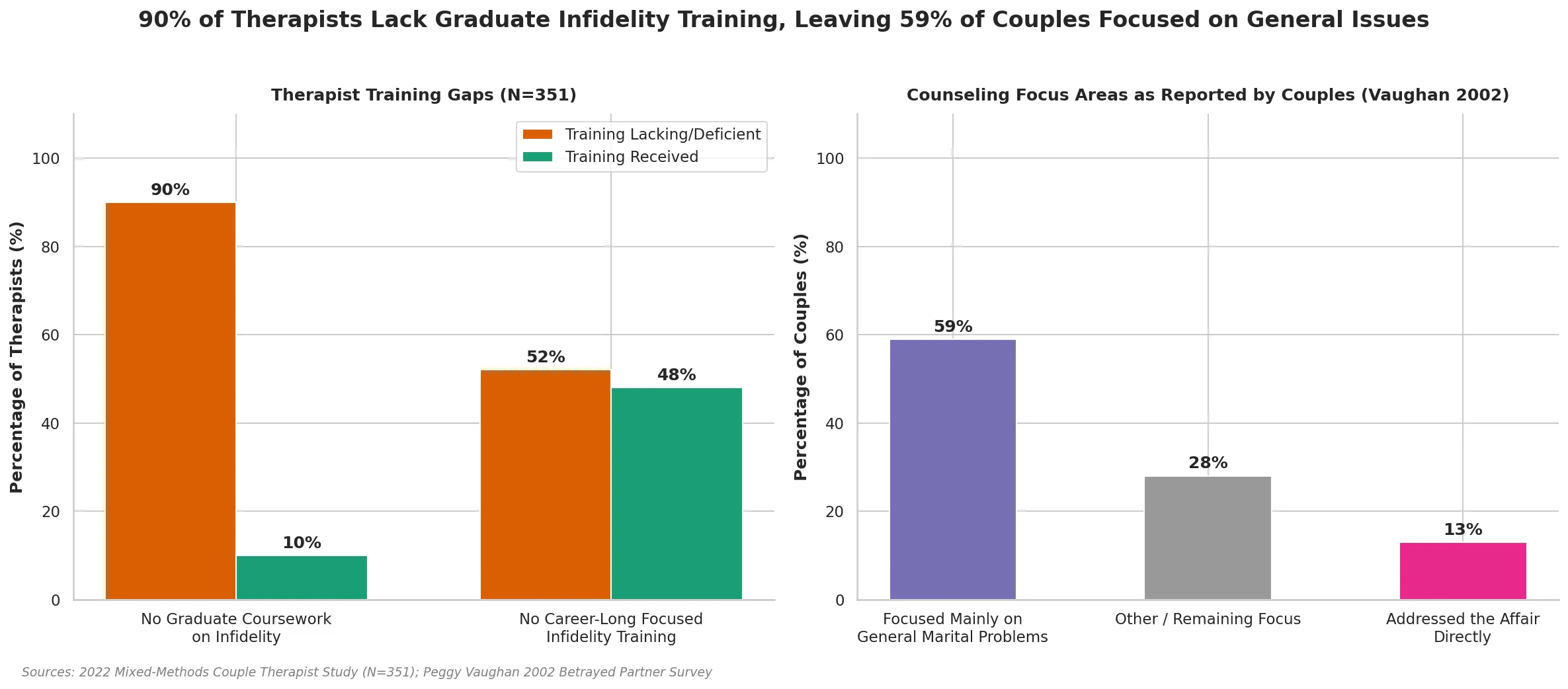
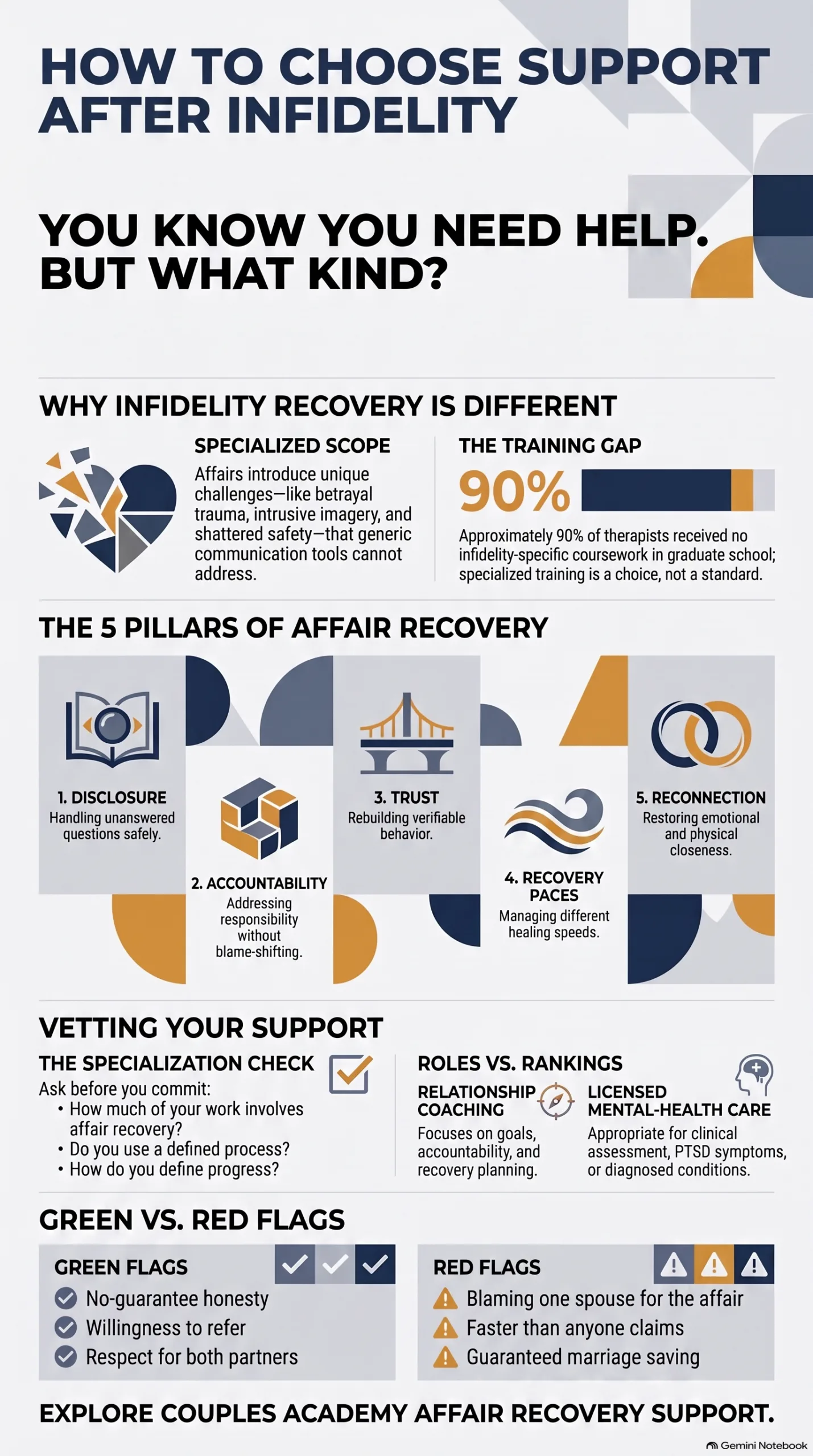
The caveat worth adding immediately: “getting support” isn’t a single thing. A generalist who works with couples on communication and life transitions is equipped for something real and valuable. They’re not automatically equipped for the specific combination of betrayal trauma, hypervigilance, shame response, and trust reconstruction that affair recovery requires. Those are distinct skill sets, and finding someone with the right one matters.
What Makes Affair Recovery Different From General Couples Work
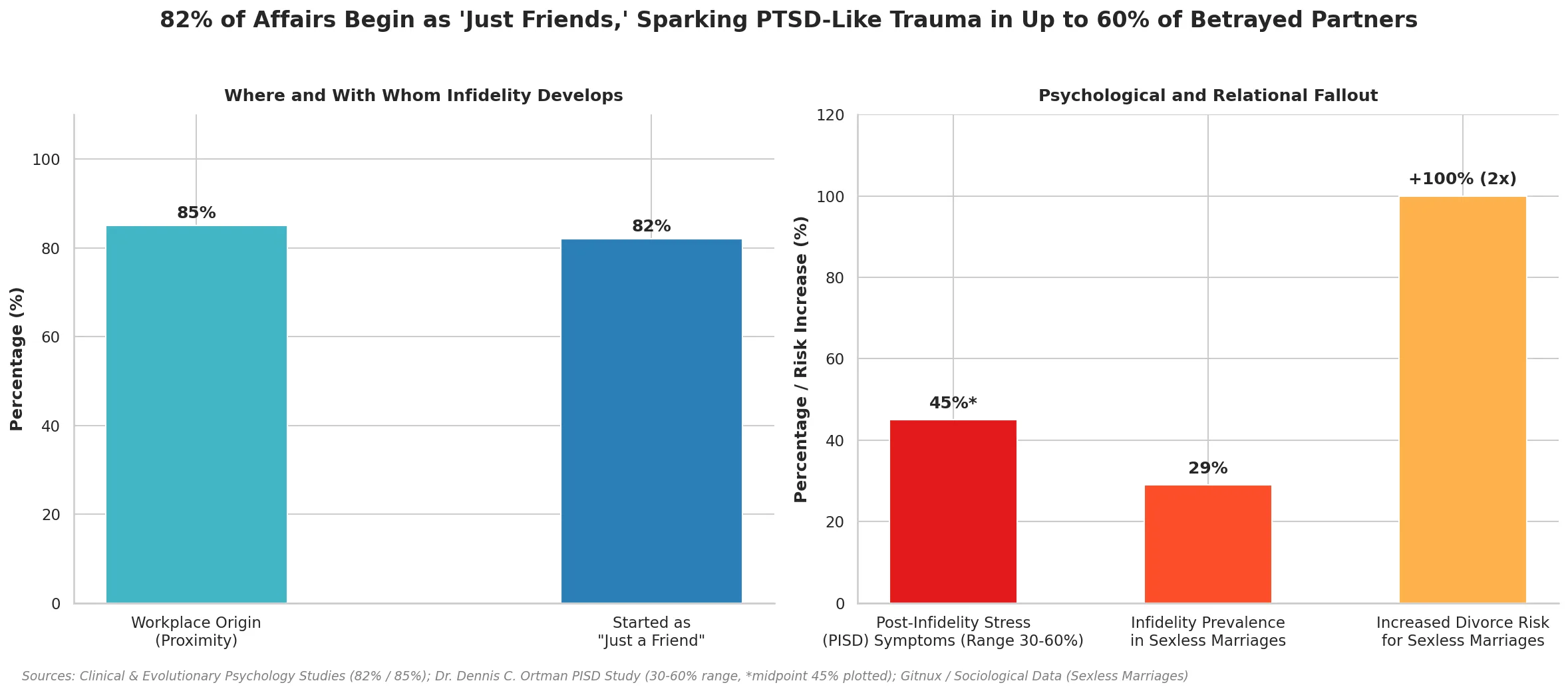
Most relationship challenges involve two people who both want to improve something and disagree about how. Affair recovery involves something structurally different: one person who did something that the other did not agree to, a significant trauma response in the betrayed partner, and the challenge of rebuilding trust with someone who proved they were capable of sustained deception.
Hasani describes the challenge this way:
“Most practitioners are trained to work with couples as a unit. Affair recovery requires working with two people who are in completely different places at the same time — one in trauma, one in shame — and helping both of them without losing either one.”
— Hasani Pettiford, Marriage Intervention
That description captures why a generalist approach often stalls in this specific context. A practitioner who attempts to facilitate communication and find common ground between two people — which is the right approach for most relationship challenges — can inadvertently treat betrayal as a dispute to mediate rather than as an injury to address. The betrayed partner ends up feeling like their experience is being given equal weight with the behavior that caused it. That’s not parity. It’s a second injury.
Affair recovery specialists approach it differently: accountability comes first, trauma response is treated as real and physiological rather than as a communication style to balance, and the unfaithful partner’s shame is managed in a way that doesn’t shift the burden of managing it back onto the betrayed partner.
The Three-Lane Approach
Hasani and Danielle describe the structure that produces the best outcomes in affair recovery: what they call three lanes on the same highway.
Lane 1: Individual Support for the Betrayed Partner
A space to process trauma, name what happened, and begin stabilizing — without having to manage the unfaithful partner’s reaction at the same time. The betrayed partner needs somewhere to be fully honest without filtering it for the marriage.
Lane 2: Individual Support for the Unfaithful Partner
A space to work through shame honestly, understand the patterns and vulnerabilities that led to the affair, and develop the emotional capacity to stay present for the betrayed partner’s recovery without collapsing under the weight of guilt.
Lane 3: Couples-Focused Recovery Work
The joint work that can only happen once both people have some individual stabilization: rebuilding communication, establishing new agreements, working through the disclosure process, and gradually rebuilding trust and safety together.
Most couples go straight to Lane 3 — couples work together — without having done any of Lane 1 or Lane 2. That’s why the sessions keep breaking down: both people are bringing unprocessed individual material into a joint setting where neither of them is yet equipped to hold it.
When Specialization Matters Most
Not every form of support needs to be affair-specific. Individual support — individual sessions for either partner to work through their own experience — can be enormously valuable from a skilled practitioner regardless of their infidelity specialty, because that lane is primarily about the individual and their own processing.
Specialization matters most in the couples lane. When both people are in the same room, with the full weight of the betrayal between them, the practitioner needs to understand the specific dynamics at play: how to hold accountability without shaming, how to validate the betrayed partner’s trauma without dismissing the unfaithful partner’s genuine remorse, and how to structure disclosure conversations so they don’t become uncontrolled re-traumatization events.
Danielle puts it plainly:
“Affair recovery isn’t a subcategory of marriage work. It’s its own thing. The tools are different, the pacing is different, and what the couple needs from the person guiding them is different.”
— Danielle Pettiford, Marriage Intervention
What to Look for When Choosing Support
Regardless of what form of support you pursue, these questions are worth asking before you commit.
| Question to Ask | Why It Matters |
|---|---|
| Have you worked specifically with affair recovery, not just couples conflict? | The two require genuinely different approaches. A practitioner who defaults to “both partners need to take responsibility” misses the structure of what betrayal actually is. |
| How do you handle the disclosure process? | Unstructured disclosure tends to produce trickle truth or re-traumatization. A practitioner who has a specific approach to managing full disclosure is significantly more likely to get through it cleanly. |
| Do you work with both partners individually as well as together? | The three-lane approach significantly outperforms going straight to joint sessions. If the answer is “I only see couples together,” that’s worth knowing. |
| What does success look like in your work with couples like us? | A practitioner who defines success as “staying together” has a different north star than one who defines it as “both partners reaching clarity and safety.” Both are legitimate, but knowing which you’re working with matters. |
| What’s your approach when one partner isn’t ready to engage? | Recovery can stall when one partner is genuinely not yet ready. A practitioner with a clear strategy for that situation will serve you better than one who simply waits for the dynamic to change on its own. |
The Role of Intensive, Concentrated Support
Weekly sessions spread across months can work — and for many couples, they do. But there’s a specific situation where a more concentrated format produces meaningfully better results: when the couple has already tried standard sessions without finding traction, when both people are deeply flooded and the ordinary conversation keeps collapsing, or when a decision — stay or leave — needs to be made with real clarity rather than continuing in chronic limbo.
Concentrated intensive formats address something that weekly sessions structurally can’t: the momentum problem. Recovery requires building on itself — each session needs to move something so the next session can go further. When there’s a week or two between sessions, the acute crisis often resets, and the next session starts over rather than continuing. Intensive work compresses that timeline so the momentum can actually build.
At Couples Academy, our private marriage intensives are specifically designed for this — concentrated, structured time in an affair-recovery-specific format that addresses all three lanes simultaneously. If you’re at a decision point and need real movement rather than continued holding pattern, the intensive format is worth considering seriously.
Starting Before You Feel Ready
One of the most common reasons couples delay getting support is that they’re waiting until things settle down enough to have the conversation, or until both partners are ready. Neither of those conditions tends to arrive on their own. The acute crisis is often exactly when structured support is most useful — not as a replacement for the raw processing that needs to happen, but as a container for it. Starting earlier gives the process more time to do its work before both people are too depleted to fully engage with it.
Loading Viewer...
FAQ
Does marriage support actually help after an affair?
Consistently, yes — and the research shows meaningful differences in outcomes compared to couples who try to navigate it alone. That said, the form and quality of the support matter. Affair-recovery-specific work consistently outperforms generalist couples work in this context, because the dynamics at play are specific enough to require specialist approaches.
What’s the difference between general couples support and affair recovery support?
General couples work assumes both partners share responsibility for a dynamic they want to improve. Affair recovery starts from a different premise: one person made a choice that the other didn’t agree to, that choice produced a trauma response, and rebuilding requires accountability before mediation. A generalist who applies a balanced communication framework to this situation can inadvertently re-injure the betrayed partner by treating the betrayal as a shared problem to solve together.
Should we get individual support or couples support after infidelity?
Both, structured in the right sequence. Each partner has individual work to do — the betrayed partner processing trauma, the unfaithful partner working through shame and understanding the patterns that led to the affair — that can’t effectively happen in a joint session. The joint work is most productive once both people have done some individual stabilization. Going straight to couples sessions without individual support usually means both people are bringing too much unprocessed material into a space that isn’t designed to hold it.
When should we consider an intensive rather than weekly sessions?
A concentrated intensive tends to produce better results when weekly sessions haven’t been gaining traction, when both partners are deeply flooded and the ordinary conversation keeps collapsing, or when there’s a real decision to make that needs clarity rather than more time in uncertainty. The momentum that intensive work creates is structurally different from what weekly sessions can produce, and for some couples it’s the difference between continuing to spin and actually moving.