He’s crying. He’s saying he loves you, that he always has. And you’re sitting there thinking: if that’s true, how did you do this to me?
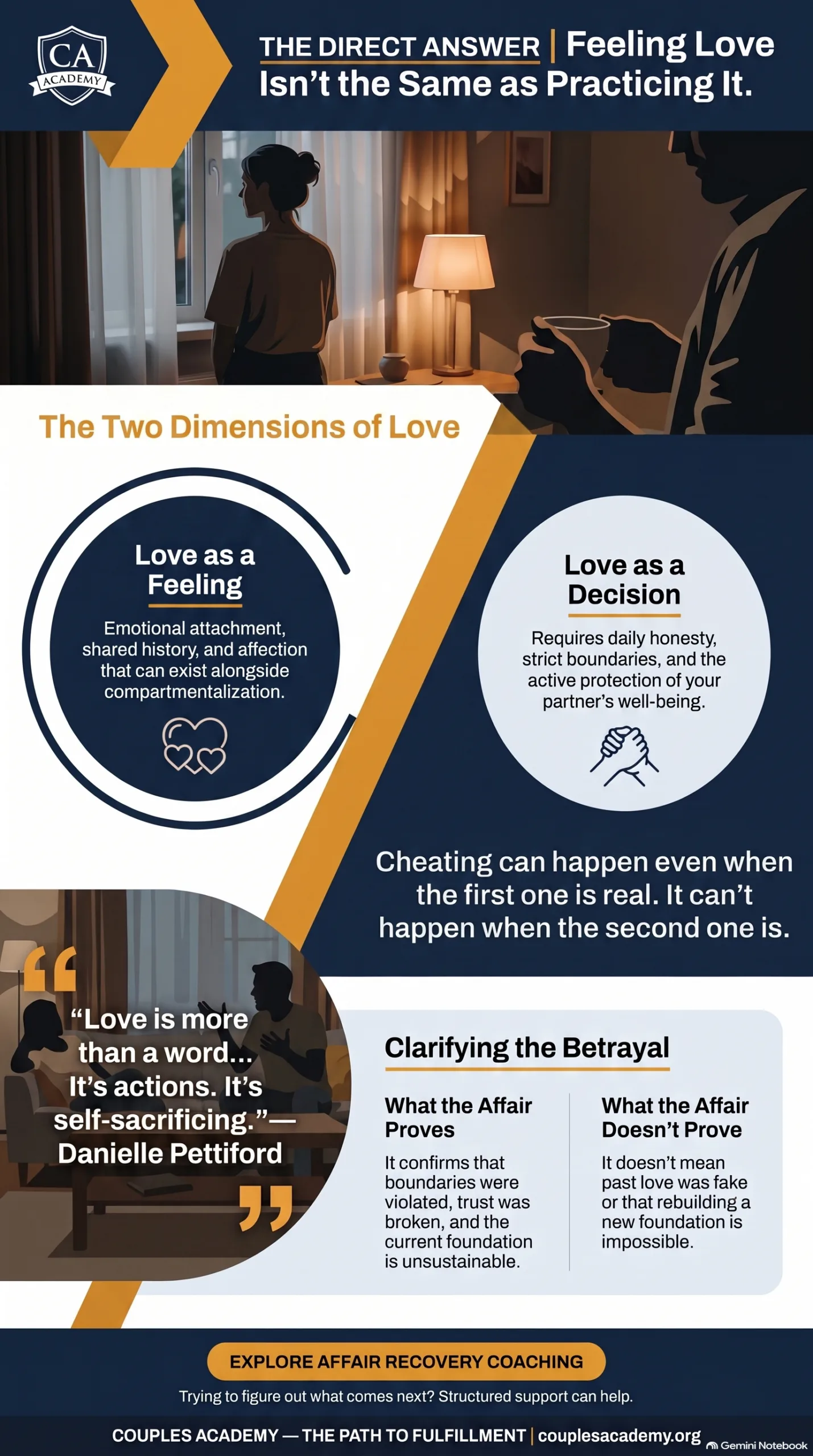
Here’s the direct answer: a person can still feel love, attachment, or affection for you and cheat. Feeling love isn’t the same as practicing it. Cheating breaks the honesty, protection, and commitment that love in a marriage actually depends on. So the affair doesn’t prove every loving moment between you was fake. It proves those feelings weren’t the thing running the show when it counted.
Love as a Feeling vs. Love as a Practice
A person can experience affection, attachment, guilt, or fear of losing the marriage and still make choices that betray it. Recovery depends less on proving what they felt then—and more on what those feelings become in practice now.
What Someone May Feel
What That Feeling Can Mean
What Love in Practice Requires
What to Look For Now
Affection & care
Someone may genuinely care about their spouse while still making choices that cause profound harm.
Honesty, protection of the relationship, respect for agreed boundaries, and consideration for your wellbeing.
Whether caring words are becoming caring actions—and whether those actions remain consistent.
Attachment
A strong emotional bond can remain even when someone’s behavior contradicts the commitment they made.
Choosing the relationship through loyalty, restraint, honesty, and appropriate boundaries.
Consistency—not only emotional declarations when the marriage feels threatened.
Missing you
Missing the relationship, your presence, or the life you’ve built together can be very real.
Transparency, openness, and behavior that helps restore emotional safety instead of recreating secrecy.
A willingness to stay present for difficult conversations rather than only saying how much you’re missed.
Fear of losing the marriage
Fear can be intense, but fear of consequences is not the same thing as practicing love.
Caring about your wellbeing even when doing so is uncomfortable, inconvenient, or requires difficult change.
Responsibility for the betrayal—not simply panic about divorce, exposure, or losing the life you shared.
Guilt
Feeling terrible about what happened may be genuine, but feeling bad is not the same as repairing the damage.
Accountability, ownership, honesty, and meaningful changes in behavior.
Less minimizing and blame-shifting—and more willingness to name the choices that were made.
Attraction or temptation
Feeling drawn toward another person is different from deciding to act on that attraction and conceal it.
Boundaries, restraint, foresight, and choices that protect the commitment before secrecy develops.
Clear boundaries and evidence that your spouse is taking responsibility for protecting the relationship going forward.
Wanting to keep the marriage
Someone can deeply want the home, family, history, and stability of the marriage after betraying it.
Commitment expressed through sacrifice, restraint, transparency, and repeated choices—not simply wanting the marriage to continue.
Appropriate boundaries with the affair partner, honest disclosure, and sustained participation in repair.
“I love you”
The words may describe a genuine internal feeling, but they cannot tell you whether the relationship is currently safe or trustworthy.
Love practiced through honesty, protection, accountability, respect, and consistency.
Ask the question the article keeps returning to: What does “I love you” look like now?
The distinction that matters:
Feelings tell you what someone experiences. Choices show you what is governing their behavior. After infidelity, you need more than an answer to “Do you love me?” You need to see what that love is willing to do.
If part of what’s making this harder is language like “it was just a mistake” or “it didn’t mean anything,” this piece on minimizing an affair covers that specific pattern. Here, we’re answering the question underneath all of it: can someone actually love you and still do this.
Cheating and Love Cannot Coexist — Here’s Why | Marriage Intervention | 006
28:56 · youtube.com/watch?v=c10Iio1b8rE
The Question Every Betrayed Spouse Asks First
If he loved me, he wouldn’t have done this. If he did this, does that mean he never loved me at all? That’s the loop, and it’s a brutal one, because neither half of it feels survivable on its own.
Here’s what makes it easier to hold: cheating doesn’t let you retroactively prove that every loving moment in your marriage was a lie. What it does prove is that whatever he felt wasn’t governing his choices when it mattered. Those are two very different things, and the second one is the one worth focusing on.
“Love is more than a word. It’s way more than a feeling. It’s actions. It’s self-sacrificing.”
— Danielle Pettiford, Marriage Intervention
What Love Actually Requires — And What Cheating Violates
Love in a marriage isn’t only a feeling. It’s also a set of things you keep doing: staying honest, protecting the relationship, choosing your spouse over whatever’s tempting you in the moment. That part is a decision, made over and over, often when nobody’s watching.
An affair requires the opposite on almost every front. It requires hiding things. Managing two separate stories so they don’t collide. Deciding, more than once, to keep going instead of stopping. None of that happens by accident, and none of it lines up with protecting the person you supposedly love.
What Cheating Violates — And What Repair Has to Rebuild
“I love you” tells you what someone says they feel. Repair becomes visible through what they consistently protect, tell the truth about, take responsibility for, and choose now.
What a Committed Relationship Requires
What the Affair Violated
What Repair Looks Like
What You Can Actually Observe
Honesty
Secrecy, omissions, lies, and managing different versions of reality to keep the affair hidden.
Truthful disclosure, greater transparency, and fewer hidden areas of life.
Your spouse tells the truth more consistently without making you extract every important fact through repeated questioning.
Protection of the relationship
Choices were made that exposed the marriage to secrecy, risk, and betrayal.
Actively protecting the relationship through clear decisions, restraint, and appropriate boundaries.
Your spouse protects the marriage even when no one is watching and no immediate consequence is hanging over them.
Agreed boundaries
Relationship boundaries were crossed, ignored, hidden, or gradually moved to make the affair possible.
Clear expectations are established and honored around outside relationships, communication, privacy, and contact.
Your spouse maintains appropriate boundaries proactively rather than only after being confronted.
Commitment
Another desire, relationship, or opportunity was allowed to override the commitment made to the marriage.
Repeatedly choosing the relationship through loyalty, restraint, honesty, and concrete decisions.
The effort continues after the immediate crisis passes instead of appearing only when the marriage feels at risk.
Consistency
The affair required one version of life inside the marriage and another outside it.
Words, choices, routines, and boundaries begin to line up instead of contradicting one another.
“I love you” is supported by a steady pattern of behavior rather than isolated promises or emotional moments.
Accountability
Responsibility may be reduced through excuses, blame-shifting, minimization, or language that makes the affair sound smaller than it was.
Naming the choices that were made, acknowledging their impact, and taking responsibility without making you responsible for the betrayal.
Less defensiveness and minimizing; more ownership of what happened and what has to change.
Consideration for your wellbeing
Personal wants or outside attention were prioritized without fully protecting you from the consequences.
Taking your need for truth, stability, boundaries, and emotional safety seriously—even when doing so is uncomfortable.
Your spouse becomes less focused on escaping uncomfortable conversations and more willing to understand what you need to move forward.
Patience during recovery
Expecting trust, closeness, or normalcy to return quickly ignores the impact of what happened.
Giving you room to process, ask reasonable questions, establish boundaries, and decide what you need without pressure.
Your spouse remains present through anger, grief, uncertainty, and repeated conversations without demanding that you “move on” on their timetable.
What matters now:
You may never be able to measure exactly how much love existed in someone’s mind during the affair. You can measure whether honesty, protection, accountability, boundaries, and consistency are showing up now.
Temptation itself isn’t the betrayal. Being attracted to someone else, wondering what else is out there, feeling pulled toward something new: none of that stops just because a person is married. What separates a marriage that holds from one that doesn’t is what happens next, whether that pull gets acted on or turned away from. Turning away from it takes real effort. Acting on it repeatedly, and hiding it, takes something else.
“But He Says He Loves Me” — Why That Statement Isn’t Enough
“I love you” is a report on how he feels. It’s not evidence that he’s currently safe, honest, or trustworthy. Those are separate questions, and it’s worth resisting the urge to let one answer stand in for the other.
A lot of what gets called love in this moment is really something else. Guilt. Fear of losing you. Attachment to the life you’ve built together. Those things can feel enormous and still not be love in the sense that matters here, which is love as something reliably practiced, not just something felt.
A more useful way to hear “I love you” right now is as an open question, not an answer: okay, then what is that actually going to look like? What’s changing? What are you doing that shows it, not just says it?
The Difference Between Love as a Feeling and Love as a Decision
Feeling answers the question “what do I experience.” Decision answers “what do I choose.” They’re related, but they’re not the same thing, and an affair makes that gap painfully obvious.
It’s entirely possible to still hold real affection for a spouse while making a series of choices that betray them. People aren’t wired to only be capable of caring about one person at a time; that’s true of friendships, of family, and it’s part of why this contradiction is so disorienting instead of simply impossible. The feeling being real doesn’t mean the decision was being honored.
This is also why affairs happen in marriages that looked happy from the outside, sometimes even to the people in them. An affair isn’t only about a marriage running out of love. It’s often about something unresolved in the person who cheated: wanting to feel wanted again, running from something uncomfortable, chasing a version of themselves they felt like they’d lost. None of that requires the marriage to have been loveless. It just means love wasn’t enough, on its own, to keep the decision intact.
What It Means for Your Recovery If Love and Cheating Can’t Coexist
You may never get a fully provable answer to what he felt, when, or how much. That’s genuinely frustrating, but it’s also not the question your recovery actually depends on.
The more useful question is what’s true now. Is he telling the truth without you having to extract it? Is he taking responsibility instead of managing your reaction to it? Are there real boundaries in place, not just promises? Is he patient with the fact that you’re not over this yet? Those are things you can actually observe, unlike his internal state a year ago. His love, whatever it was, doesn’t obligate you to trust him again. And not being sure yet doesn’t mean you’ve already decided anything about the marriage.
Where to Go From Here
You don’t have to resolve whether the whole marriage was real before deciding what you need next. Those are two separate projects, and trying to finish the first one before starting the second one usually just keeps you stuck.
If you’re at the point of asking whether truth, accountability, and real change are possible from here, our affair recovery coaching is built for exactly that stage. And if the two of you keep circling the same conversation without getting anywhere new, a private marriage intensive gives you a structured, focused way to actually work through it together.
Questions About the Past vs. Questions That Help You Recover
Some of the questions betrayal creates may never come with perfectly provable answers. Recovery gets more practical when you separate what only your spouse can claim to have felt from what you can actually observe now.
The Question That Keeps Coming Back
Why It May Be Impossible to Fully Prove
A More Useful Question Now
What You Can Actually Observe
“Did he really love me while he was cheating?”
Affection, attachment, and caring can exist alongside choices that contradict them. You cannot directly measure another person’s internal feelings after the fact.
Is he practicing love through his choices now?
Honesty, appropriate boundaries, accountability, transparency, protection of the relationship, and consistency between words and actions.
“How could he do this if he cared about me?”
Caring about someone does not guarantee that every choice will protect them. Understanding why an affair happened is different from proving exactly how much someone cared at the time.
Does he understand the choices he made and the damage they caused?
Ownership without blame-shifting, less minimizing, willingness to answer reasonable questions, and concrete changes designed to prevent secrecy from continuing.
“Does ‘I love you’ mean anything now?”
The words describe what your spouse says they feel. By themselves, they cannot establish whether the relationship is currently honest, safe, or trustworthy.
What behavior is accompanying those words?
Voluntary transparency, consistent boundaries, truthfulness, patience, follow-through, and behavior that continues after the immediate crisis passes.
“Was our whole marriage a lie?”
An affair proves that important truths and boundaries were violated. It does not automatically prove that every loving interaction, memory, or part of the relationship before it was false.
Do I have enough truth now to understand what was real, what was hidden, and what I need next?
Whether significant deception has stopped, whether the story remains consistent, and whether your spouse is willing to discuss what happened without rewriting or minimizing it.
“Does he love her more than me?”
Comparing private feelings creates a question that may never have a reliable measurement—and can keep the affair partner at the center of your recovery.
Has the affair ended, and is he protecting this relationship now?
Appropriate boundaries with the affair partner, an end to secrecy, voluntary accountability, and consistent investment in rebuilding the marriage.
“Why wasn’t loving me enough to stop him?”
Love as a feeling does not automatically govern behavior. People can act against commitments, values, and relationships they still care about.
What is different now that makes another betrayal less likely?
Greater self-awareness, clearer boundaries, changed routines where needed, accountability, and willingness to address the choices that made secrecy possible.
“Was I not enough?”
Your spouse’s decision to cheat cannot objectively measure your attractiveness, worth, adequacy, or value as a partner.
Why am I using his choices as evidence about my worth?
Whether you can gradually separate your identity from the betrayal and make decisions based on your values, boundaries, and needs rather than comparison.
“Can I ever trust him again?”
No conversation can give you a guarantee about the future, and an apology cannot restore trust instantly.
Is there enough consistent evidence for me to consider giving trust back gradually?
Truthfulness, accountability, predictable behavior, respected boundaries, patience, and a sustained willingness to repair rather than demand trust.
The shift:
You do not have to solve every question about what your spouse felt in the past before deciding what you need now. Past feelings may be impossible to prove. Present behavior is something you can actually evaluate.
Loading Viewer...
FAQ
Can you cheat on someone you love?
Yes, if love means feelings of attachment or affection. Those feelings don’t make cheating impossible. But cheating directly contradicts what love looks like in practice inside a committed relationship, which is honesty and protection. Someone can feel love and still make choices that betray it.
Does cheating mean he never loved me?
Not necessarily. It doesn’t let you erase your entire history together as fake. What it proves is that agreed boundaries were violated and that his feelings, whatever they were, weren’t enough to stop him. Those are different conclusions, and only one of them is something the affair actually confirms.
Why do people cheat if they’re happy?
Affairs happen in relationships that look happy from the outside more often than people expect. It’s rarely only about the marriage. It’s often about something the unfaithful partner is chasing or running from in themselves: wanting to feel desired again, avoiding something uncomfortable, reaching for a version of who they used to be. A happy marriage isn’t automatically an affair-proof one.
Can a marriage survive if love was missing?
It’s possible, but it can’t just go back to how things were. What tends to matter most isn’t whether love was technically present before the affair. It’s whether both people are willing to rebuild honesty, accountability, and safety from here, which is a different project than proving what was or wasn’t true in the past.