

He says she’s just a friend. You know nothing is happening. And you still can’t stop thinking about it.
Here’s the direct answer: whether men and women can be platonic friends is the wrong question — especially now. Research says yes, genuine cross-sex friendships are real and common. But in a marriage rebuilding trust after infidelity, the only question that actually matters is whether a specific friendship is compatible with the transparency, boundaries, and safety that recovery requires. Those are different questions, and only one of them is useful to you right now.
If the friendship that crossed a line was with a coworker, this piece on what to do when he still works with her covers the specific complications of that situation. And if you’re trying to understand where a friendship ends and an emotional affair begins, this piece on emotional affairs defines the line clearly. Here, we’re focused on the broader question of opposite-sex friendships and what boundaries actually need to look like going forward.
Can Men and Women Really JUST Be Friends? | Marriage Intervention | 013
27:46 · Marriage Intervention | Couples Academy
The Question Nobody Wants to Answer Honestly
Almost no affair starts as an affair. It starts as a friendship — a coworker who just gets you, an old friend you reconnected with, someone you met through a shared interest. Nobody thinks it needs any rules. And then, slowly, over weeks or months, the boundaries that nobody set start to erode.
This is what makes the “just friends” question so loaded after infidelity. The person who cheated probably said “we’re just friends” before everything happened too. Now that phrase doesn’t just describe a relationship. It carries the weight of everything that came after it.
What the Research Actually Says
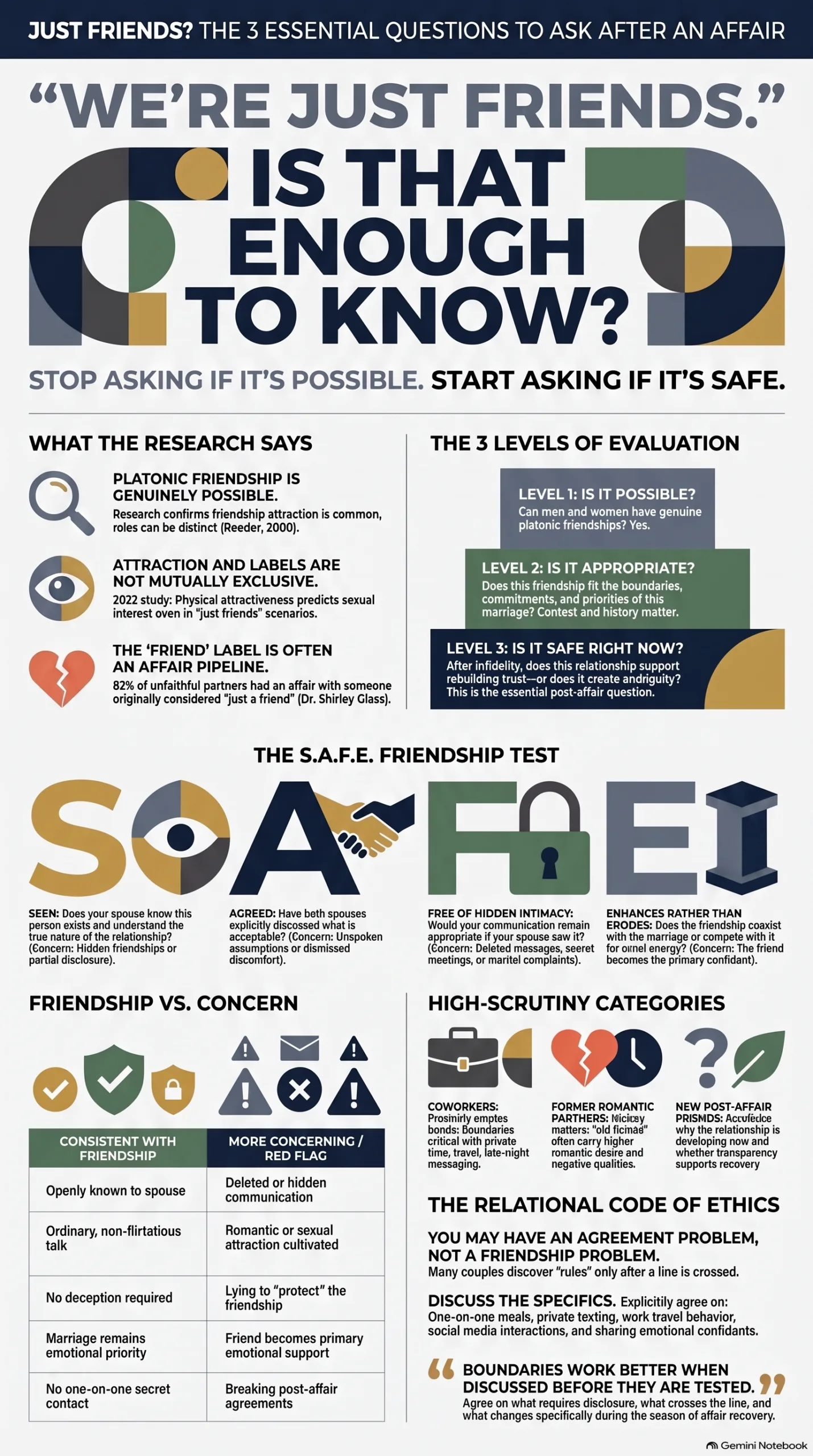
Research does not support the idea that men and women can never have genuine platonic friendships. Cross-sex friendships are common, and friendship attraction — the experience of genuinely caring about and valuing someone as a friend — is the most prevalent form of attraction in opposite-sex friendships, more common than romantic or sexual attraction.
That said, the research has some important nuances. Sexual interest coexists with platonic friendship more often than most people acknowledge — and it’s frequently asymmetrical, meaning one person may experience it while the other doesn’t. Studies have also found that cross-sex attraction is more often experienced as a burden or complication than as a benefit, and that higher attraction to an opposite-sex friend correlates with lower satisfaction in a person’s primary relationship.
Friendships with former romantic partners — exes — sit in a different category entirely. Research consistently shows that these friendships involve significantly more romantic desire and more negative relational qualities than friendships with people who were never romantic. The history doesn’t disappear just because the label changed.
Why This Question Hits Differently After an Affair
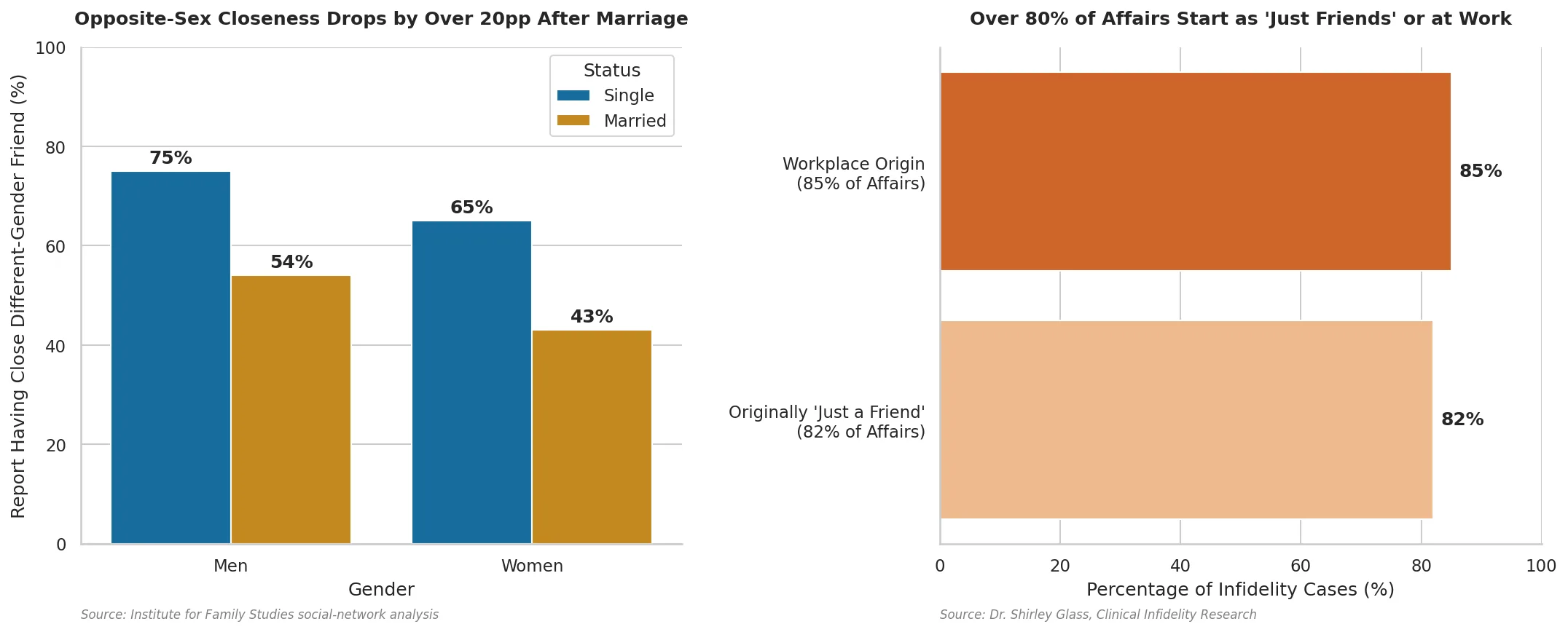
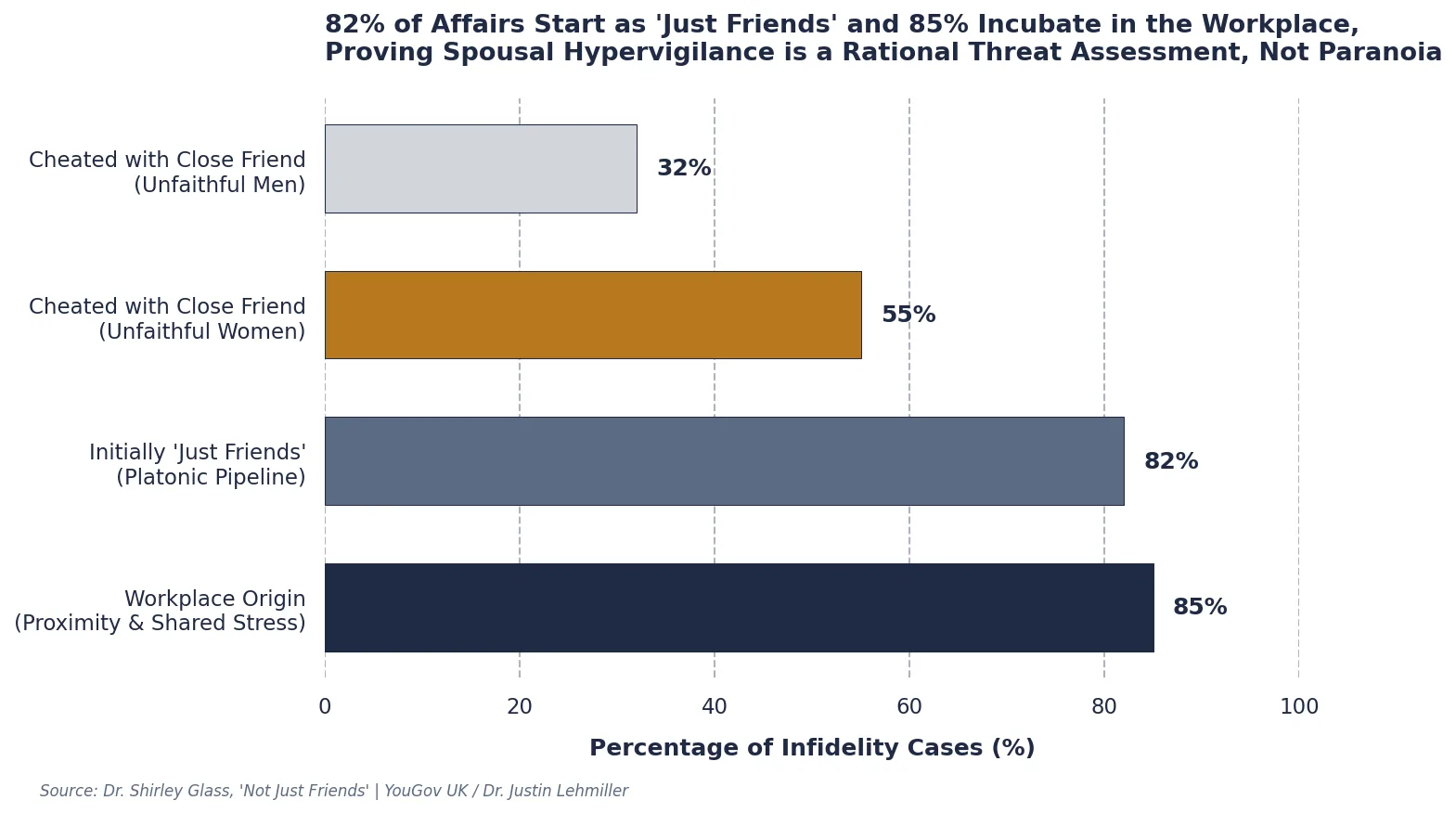
In a marriage that hasn’t experienced infidelity, opposite-sex friendships are a normal topic to navigate. After an affair, the entire frame shifts. Clinical research by Shirley Glass found that 82% of unfaithful partners had their affair with someone who was originally considered just a friend. That statistic isn’t a reason to assume every friendship is a threat. But it does explain why the “just friends” label no longer provides reassurance the way it once might have.
Your nervous system has been trained, by real experience, to treat that phrase as a risk signal. That’s not paranoia. It’s not controlling behavior. It’s a survival response to what actually happened. As Danielle puts it:
“I always say this. If there’s no smoke, odds are there’s not a fire. But if you smell smoke, there’s a fire somewhere.”
— Danielle Pettiford, Marriage Intervention
Worth saying clearly: intuition is real information worth exploring, not proof of ongoing betrayal. Post-infidelity hypervigilance is also real — the nervous system will fire on things that turn out to be nothing, because it’s calibrated to prevent another blindside. Discomfort and suspicion are signals to bring to a direct conversation, not conclusions on their own. But they shouldn’t be dismissed either.
Three Levels of the Right Question
Instead of asking “can men and women be friends?” — a question that has a yes answer and still doesn’t help you — work through three more specific levels. Each one gets you closer to what you actually need to know.
Level 1: Is It Possible?
Yes. Platonic cross-sex friendship is psychologically real. Healthy adults are capable of having genuine, non-romantic friendships with people of the opposite sex. This is not in serious dispute. But “possible” is just the starting point.
Level 2: Is It Appropriate?
For this specific friendship, in this specific marriage, with this specific history — does it meet the standard for an appropriate outside relationship? Is it known to both spouses? Does it enhance the marriage rather than compete with it? Is it free of secrecy and hidden intimacy?
Level 3: Is It Safe Right Now?
Even if the friendship is technically appropriate, is it compatible with where this marriage actually is right now? During active trust reconstruction, the bar isn’t “is this technically okay.” It’s “does this support or slow down our recovery?” A friendship that would have been fine two years ago may not be safe right now.
The Boundaries That Make Friendship Safe in a Marriage
Hasani asks a question worth sitting with: what is the function of this friendship? Not the label — the function. Who is this person meeting emotional needs for? If an outside friend is providing connection, validation, or escape that should be going into the marriage, that friendship is quietly making the spouse obsolete. It doesn’t have to be sexual to be destructive.
The shift that changes everything isn’t the friendship itself. It’s whether it’s hidden. As Hasani puts it: when someone says “we’re not doing anything,” that needs to become “we’re not hiding anything.” Those are not the same sentence.
Use the SAFE Friendship Test as a quick diagnostic for any opposite-sex friendship in a marriage that’s rebuilding.
| The SAFE Test | The Question | Red Flag If… |
|---|---|---|
| S — Seen | Does your spouse know this person exists, know the nature of the friendship, and feel included rather than excluded? | The friendship is hidden, minimized, or only disclosed when discovered |
| A — Agreed | Have both spouses explicitly agreed on the nature and limits of this friendship, without one being pressured into acceptance? | One spouse is uncomfortable and their discomfort is being dismissed or argued away |
| F — Free of Hidden Intimacy | Are texts, calls, and time spent together shared openly — or are there deleted conversations, private meet-ups, or information you’d be embarrassed for your spouse to see? | Conversations are deleted, the friendship is described in edited versions, or the friend is being told things the spouse isn’t |
| E — Enhances the Marriage | Does this friendship support the marriage — or is it competing with it for emotional energy, time, and connection? | The outside friend is the primary source of emotional support, validation, or shared humor that used to belong to the marriage |
When a Friendship Is More Than a Friendship
A friendship becomes emotionally intimate in a way that threatens a marriage when it involves secrecy, when an outside person becomes the primary emotional confidant instead of the spouse, or when marital grievances are being processed with the friend instead of inside the marriage. Hasani and Danielle describe this using the “walls and windows” framework: a healthy marriage has windows between spouses — openness, vulnerability, emotional access — and appropriate walls to the outside. An emotional affair flips this. The walls go up between spouses and the windows open to the outside friend.
An emotional affair doesn’t require physical contact to do serious damage. What defines it is the secrecy and the emotional prioritization — the fact that someone outside the marriage has become the safe place, while the spouse has become the wall. If that pattern is present, the label “just friends” doesn’t change what it is.
What to Do When You Disagree About the Line
This is one of the most common places couples get stuck after an affair. One partner wants to maintain a friendship. The other is not okay with it. Both people feel their position is reasonable.
Here’s a principle worth holding onto: when spouses disagree about where the safety line is, the more protective standard takes precedence during recovery. Not because one person gets to be a dictator — but because the person who was betrayed has a legitimate, urgent need to feel safe, and “fighting for the friendship” over a spouse’s peace signals that the friendship matters more than the marriage does. That’s information.
Most couples never explicitly agreed on what opposite-sex friendship looks like in their marriage before infidelity happened. They entered with unspoken assumptions and didn’t find out they had different ones until something went wrong. The conversation you’re having now — uncomfortable as it is — is the one you probably should have had earlier. Have it fully, without one person being pressured to accept something they’re not okay with.
Rebuilding Trust Around Opposite-Sex Relationships
The practical roadmap for this stage of recovery involves what Hasani calls a “season of containment” — a temporary period where opposite-sex friendships outside the marriage are put on pause entirely, not as a permanent rule but as a focused investment in rebuilding the friendship that exists inside the marriage.
Many couples realize during this period that they weren’t actually friends with each other — that they had no real shared interest, chemistry, or enjoyment with each other, and that most of that energy was going elsewhere. Rebuilding it requires directing intentional attention back into the marriage: shared time, real conversation, choosing each other rather than defaulting to each other.
Gradually, as safety rebuilds, outside friendships can be reintroduced — but only on a fully disclosed, integrated basis. A “friend of the marriage” is someone who can call the house, knows both spouses, and actively supports the relationship. A private friendship that one spouse doesn’t know about, or that one spouse is asked to just trust, is not compatible with this stage of recovery. Research on couples who successfully navigate affair recovery consistently identifies open communication, explicit accountability, and mutually negotiated boundaries as the non-negotiable elements of that process.
Loading Viewer...
FAQ
Can men and women be platonic friends?
Yes. Research shows that genuine platonic cross-sex friendships are real and common. Friendship attraction — caring about and valuing someone as a friend — is the most prevalent form of attraction in opposite-sex friendships. That said, sexual interest also coexists with platonic friendship more often than people typically acknowledge, and it tends to be asymmetrical and is often experienced as a complication rather than a benefit.
Should my spouse end opposite-sex friendships after cheating?
In most cases, yes — at least temporarily. A “season of containment” where opposite-sex friendships are paused gives the marriage focused space to rebuild. This isn’t about permanent isolation; it’s about directing energy toward the relationship that needs it most right now. Any friendship that’s reintroduced after that period should exist on a fully disclosed, mutually agreed basis that both spouses are genuinely comfortable with.
How do I know if my spouse’s friendship is appropriate?
Run it through the SAFE test: is it Seen (known and disclosed to you), Agreed (mutually accepted without pressure), Free of Hidden Intimacy (no deleted conversations, private meet-ups, or shared secrets), and Enhancing the Marriage (supporting the relationship rather than competing with it for emotional energy). Any friendship that fails one of these checks is worth addressing directly.
What are healthy opposite-sex friendship boundaries in marriage?
The clearest standard: the friendship should exist on a fully integrated, disclosed basis where both spouses know the person, nothing about the friendship needs to be hidden, and the time and emotional energy going to the friend isn’t being redirected from the marriage. Private one-on-one time, deleted messages, or a friendship that your spouse knows about only in edited form all fall outside that standard — regardless of what the friendship “actually is.”