

You’ve said it out loud, maybe for the first time: maybe this marriage is over. And you don’t know whether that’s the truth speaking, or the pain.
Here’s the direct answer: before you file, there are five questions worth sitting with honestly. Not to talk you out of it — but to make sure the decision you make is one you can actually live with. Divorce is a permanent, multi-generational choice. The goal isn’t to rush toward it or away from it. It’s to make it from clarity, not from the highest point of pain you’ve ever felt.
This article respects both paths. Some people work through these questions and decide to try one more time. Others work through them and realize, with clear eyes, that they’re done. Both outcomes are legitimate. The point is to arrive at either one deliberately — not reactively.
⚠ Important Safety Note
If your marriage involves physical violence, threats, coercive control, stalking, or fear for your safety, this decision requires a different framework entirely. Do not treat “trying harder to save the marriage” as the immediate goal. Prioritize your safety and obtain appropriate professional, local, and legal guidance for your specific situation.
5 Things to Consider Before Divorce | Marriage Intervention | 017
Why This Decision Deserves More Than a Moment of Pain
There’s a reason most people search “things to consider before divorce” at 1 a.m. after a fight, not on a calm Tuesday afternoon. The decision feels most urgent exactly when you’re least equipped to make it clearly.
Divorce is a permanent, multi-generational decision. It affects where you live, what your finances look like, how your children experience their parents, and who you become on the other side of it. That kind of decision made from the highest point of pain tends to look different six months later — and in either direction. Some people who were certain they wanted out find, once the acute crisis passes, that what they wanted was for the pain to stop. Others who weren’t sure find that the clarity they needed came only after they slowed down and actually looked at the evidence.
“Most people don’t want to necessarily end the marriage. They just want to end the pain that they’re currently going through.”
— Hasani Pettiford, Marriage Intervention
The Difference Between Wanting Out and Being Done
These two things can feel identical and they aren’t. Wanting out is a description of present suffering. Being done is something different — a deep emotional apathy where you’ve stopped caring enough to even fight, where the relationship has become so depleted that there’s nothing left to be angry about.
If you’re still in the screaming or the silence, still swinging between wanting to fix it and wanting to end it, you may still be in the valley of indecision — the painful oscillation between love and anger that isn’t a verdict on the marriage but is a real description of where you currently are.
A useful gut-check question: if there were a structured, guaranteed path to safely remove the current pain from this relationship, would you still want to leave? If the honest answer is yes, that’s important information. If you hesitate, that’s important too.
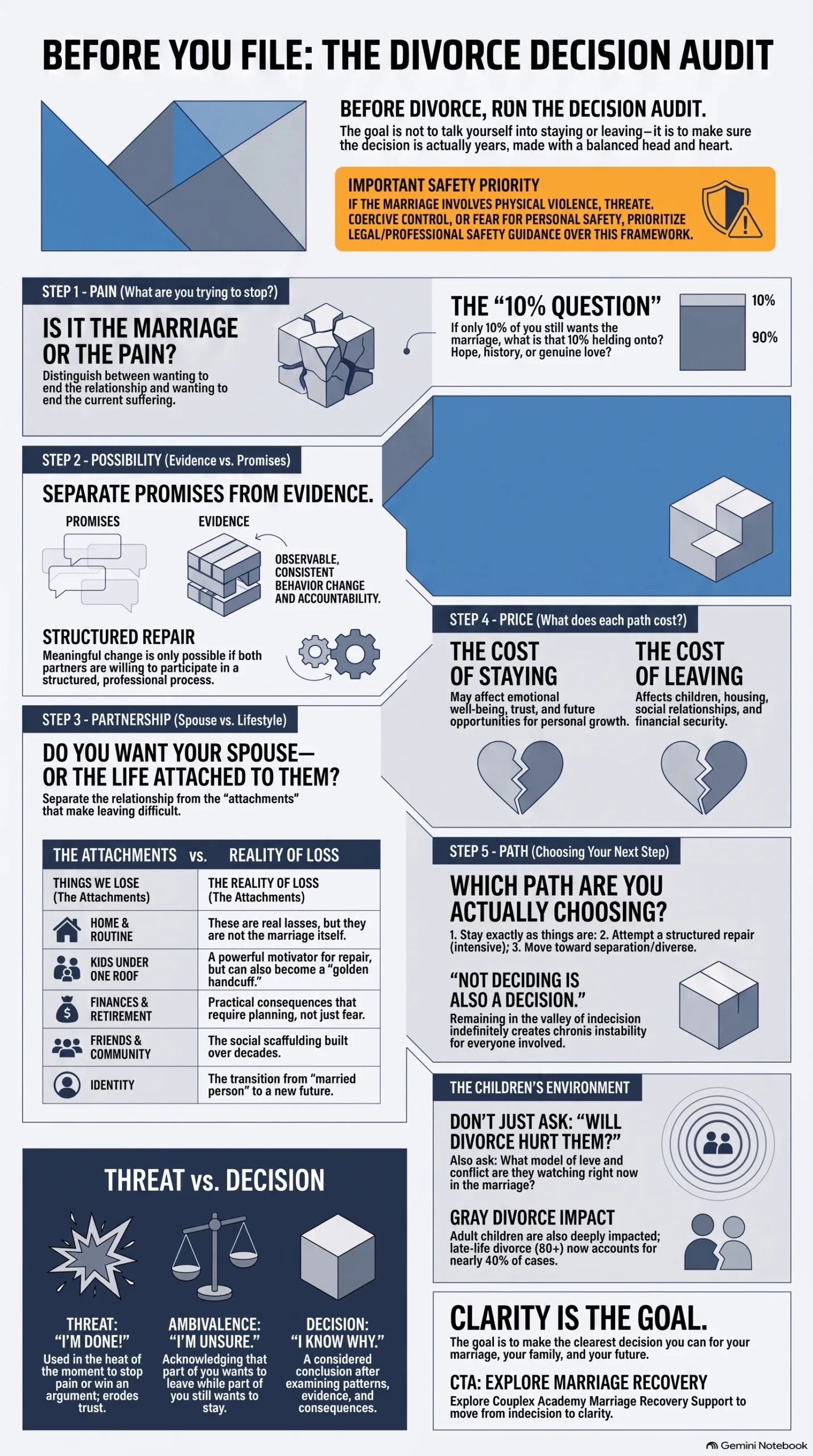
Five Things to Consider Before You File
These aren’t arguments for staying. They’re questions that make the decision — whichever way it goes — more deliberate and more yours.
1. Is Divorce a Decision — or Has It Become a Threat?
There’s a difference between “I am considering ending this marriage” and “I say divorce whenever we fight.” Chronically threatening divorce without following through trains your spouse that your words don’t carry weight — and it gradually depletes their willingness to invest. It also keeps you in a loop where the threat is doing emotional work that an actual decision would resolve.
Ask yourself: “If I stopped using the word divorce during arguments, would I still want a divorce when the argument was over?”
2. Are the Children a Reason to Work on the Marriage — or a Reason to Avoid the Decision?
Staying for the children can mean two very different things: a genuine motivation to do the hard work and actually rebuild something worth staying for, or a shield that lets you avoid making a decision while the relationship quietly destroys everyone in it. Research on children and divorce consistently finds that the environment surrounding a divorce matters far more than the legal fact of it — high, chronic conflict in an intact home harms children more than a well-handled cooperative split.
Ask yourself: “Am I working on this marriage, or just staying frozen in it?”
3. Is There Still 10% Worth Saving?
If even 10% of the relationship is something you’d genuinely want to preserve — not out of fear, not out of obligation, but out of actual love or respect for who this person has been to you — that matters. It isn’t a reason to stay in a relationship that’s unsafe or irreparably broken. But it is a reason to make sure you’ve given a real, structured attempt before making the decision permanent. What would it take to grow that 10%?
Ask yourself: “What would have to be true for me to want to stay?”
4. Are You Ending the Relationship — or Running From Your Own Attachments?
Some marriages end because both people are genuinely incompatible and the relationship ran its course. Others unravel because one or both people are avoiding something difficult about themselves — and the marriage becomes the explanation rather than the place where that gets worked on. Leaving a marriage doesn’t automatically mean leaving what drove the difficulty there. Whatever patterns drove crisis here tend to travel.
Ask yourself: “If I left and started over, what would I do differently — and what do I know for certain I’d repeat?”
5. What Does Staying — or Leaving — Mean for the Years You Have Left?
Divorce rates among people over 50 have quintupled since 1990. Adults who have spent decades in a marriage that stopped working are increasingly choosing to leave — not out of impulsivity, but out of a clear-eyed recognition that the remaining years are too valuable to spend in an empty shell. If you’re in this demographic, your considerations are real and don’t need to be apologized for. The question is whether the decision is coming from clarity about your future or from a current moment of pain that might look different in a year.
Ask yourself: “What does the life I want actually look like — and what path gets me there?”
“At the end of the day, the best way to love your child is to love your spouse… your children have a front row seat to your relationship and they will play out in adulthood what they were exposed to in childhood.”
— Danielle & Hasani Pettiford, Marriage Intervention
What the Data Actually Shows
Some context worth having before you make a permanent decision — for current divorce rates and broader context, the data tells a more nuanced story than the conventional wisdom suggests.
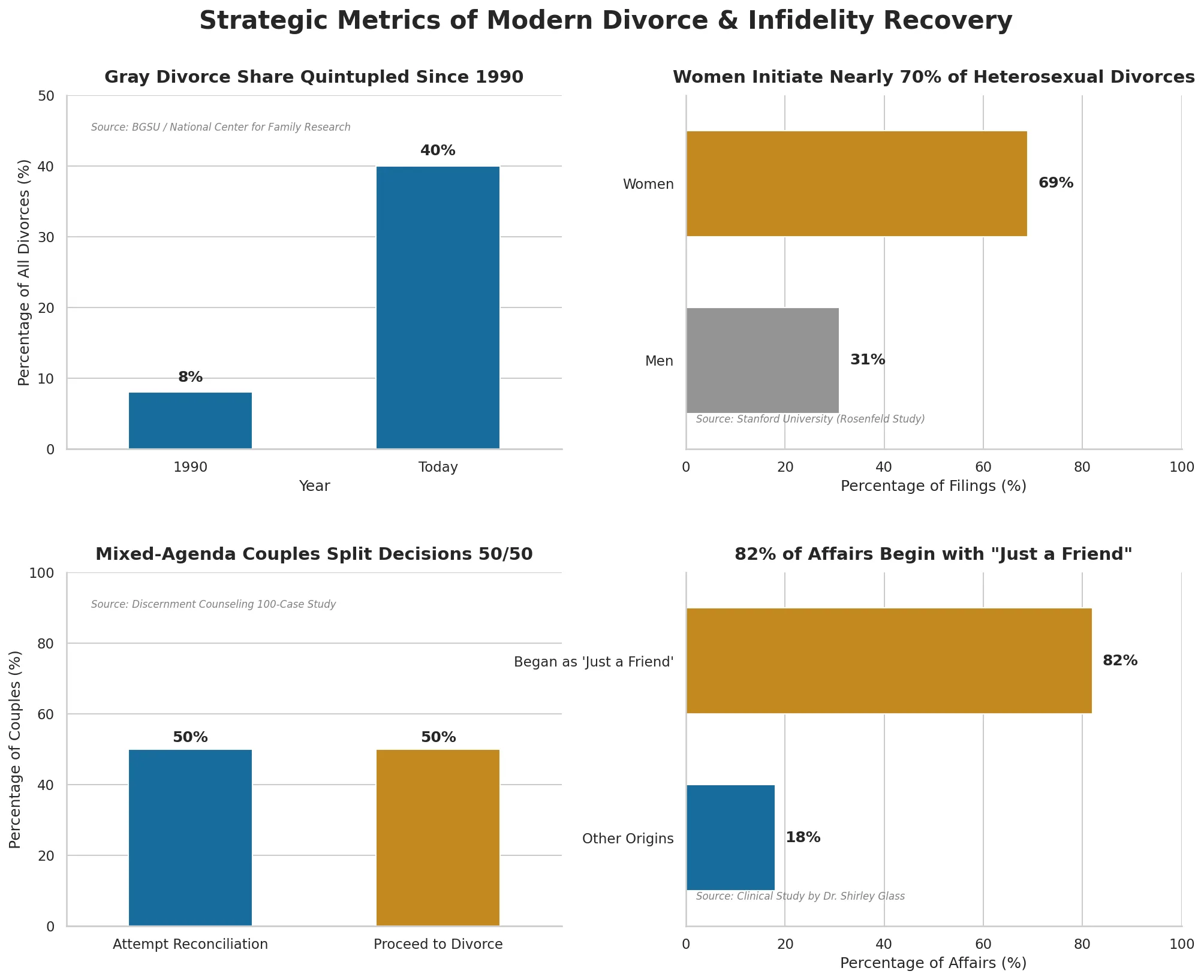
Sources: BGSU / National Center for Family Research; Stanford University (Rosenfeld Study); Discernment Counseling 100-case study; Dr. Shirley Glass clinical data.
Divorce & Infidelity: Key Research Benchmarks
| Metric | Finding | What It Means |
|---|---|---|
| Gray divorce (50+) | 8% of divorces in 1990 → ~40% today | Late-life divorce has quintupled. Adults in long marriages are increasingly choosing to leave rather than resign themselves to empty-shell marriages. |
| Who files | Women initiate ~69% of heterosexual divorces (Rosenfeld / Stanford) | Filings that appear sudden to husbands often follow years of unaddressed erosion. The decision point is rarely the moment it becomes visible. |
| Mixed-agenda couples | 50% chose reconciliation after structured discernment | You don’t have to know the answer before starting a structured process. Half of couples at the brink who go through it choose to try. |
| Affairs and friendship | 82% began as “just friends” (Dr. Shirley Glass) | Betrayal almost never starts as an affair. It starts as a boundary that nobody set. This is relevant context for understanding how infidelity relationships can still carry genuine attachment alongside the betrayal. |
| Lifetime divorce rate | Current estimates: 40–45% of first marriages (down from earlier projections) | The “50% of marriages end in divorce” figure is outdated. The actual picture is more nuanced — and more hopeful — than the conventional wisdom. |
The Question Most People Don’t Ask Before Filing
Most couples who file for divorce have never put their relationship through a concentrated, professional repair process. They’ve had difficult conversations, maybe a few sessions of something that didn’t help, and years of deterioration. That’s not the same thing as trying.
Research on discernment counseling with mixed-agenda couples — one partner wanting to repair the marriage, one leaning toward leaving — found that roughly half chose to attempt structured reconciliation after going through the process. That doesn’t mean the outcome was predetermined. It means a structured process gives both people something they don’t have alone: clarity about what they actually want, from a place of less reactivity.
Hasani describes couples stopping divorce proceedings days before court dates after going through an intensive — not because someone convinced them, but because they finally had a real, guided conversation rather than another unstructured fight.
“When it comes to getting help… you can never start too early, but it can be a point where you start too late.”
— Hasani Pettiford, Marriage Intervention
The practical question worth asking before you file: have we actually given a concentrated, structured recovery process a genuine chance — or have we only let the passage of time exhaust us? Those are two different things, and they lead to two different decisions.
What You Owe Yourself Before You Make This Permanent
Regardless of which direction you’re leaning, you owe yourself a few specific things before you file.
An honest inventory of behavior, not words. Look at what your spouse has actually done over the last six months. Not what they’ve promised, not how they’ve explained themselves — what they’ve done. That data is more reliable than anything said in an argument or a tearful moment of remorse.
An honest look at the financial and legal realities. This isn’t meant to scare you out of leaving. It’s meant to make sure you’re making a fully informed decision about what the transition actually requires — not a decision based on a version of the future that hasn’t been reality-tested yet.
Understanding what drove infidelity, if that’s relevant to your situation. If the marriage is ending because of an affair, it’s worth understanding how someone can love you and still betray your trust — not to excuse it, but to make a clear-eyed decision about what happened rather than a reactive one.
A genuine attempt at structured support. That means individual support for each of you, and if reconciliation is even a possibility, something for both of you together — a process, not just a conversation.
If You’ve Decided to Try One More Time
A real attempt doesn’t look like more of the same kitchen-table arguments. It requires specific, verifiable behavioral commitments — not promises about how things will feel, but concrete changes in what happens. What will change structurally? What are the boundaries? What’s the timeline for evaluating whether this is actually different? What happens if those commitments aren’t kept?
Research on partners who choose to stay after infidelity finds that the ones who navigate it successfully had specific behavioral green flags from the unfaithful partner: sincere accountability, active trust-building, and renegotiated boundaries. Not more words. Our private marriage intensives are structured specifically for this stage — the “last real attempt” that looks fundamentally different from anything that’s been tried before.
If You’ve Decided the Marriage Is Over
You don’t have to rewrite your history or make your spouse into a monster to justify your exit. You don’t have to be certain you’ll never second-guess it. You just have to be as clear as possible that you’re making this decision from an honest assessment of the relationship and your future — not from a reaction to the worst moment you’ve ever lived.
Danielle validates what many people in long marriages are afraid to say out loud: sometimes choosing to walk away — to preserve the years you have left and to stop modeling a broken relationship for your children — is a clear-headed, legitimate choice.
Ending well means prioritizing co-parenting integrity if children are involved, approaching financial questions fairly, and making the transition in a way you’ll be able to look back on without regret about how it was done — even if the decision itself was the right one.
“He pauses… and then says, ‘Well, I just never thought that she would ever go.’ … ‘I never thought that she would leave. And now that she’s left, I now realize what I’ve done, and now I’m in regret.'”
— Hasani Pettiford, Marriage Intervention
That story matters for both people in a marriage approaching this decision. The person who is quietly retreating while the other comfortably assumes they’ll stay. And the person who has been threatening to leave for years without ever making the decision — until one day their spouse does it for them. Both paths become real. The question is which one you’re choosing deliberately.
Loading Viewer...
FAQ
How do I know if I actually want a divorce or just want the pain to stop?
One test: if a structured, guaranteed path existed to remove the current pain from the relationship, would you still want to leave? If the answer is yes without hesitation, you may genuinely be done. If you hesitate, you may want out of the pain rather than out of the marriage. Slowing down long enough to tell the difference is the whole point of a structured discernment process.
Should I stay in a marriage for the children?
The research on this is clear: the environment surrounding a divorce matters far more to children than the legal fact of it. A cooperative, respectful co-parenting split is less harmful than sustained high-conflict cohabitation. “Staying for the kids” is only meaningful if you’re actually working on the marriage — not if you’re staying frozen in chronic misery that your children experience every day.
How long should I try before deciding to divorce after infidelity?
There’s no fixed timeline, and anyone who gives you one is guessing. What matters more than time is whether the conditions necessary for recovery are actually in place: honest disclosure, accountability, structural changes, and consistent trustworthy behavior. A year of waiting without those conditions is different from six months of genuine structured work.
Is it too late to try to save the marriage?
It depends on what “trying” has actually looked like so far. Most couples who feel like they’ve exhausted their options have been through painful, unstructured attempts — not a concentrated, professionally guided process. Research on discernment counseling finds that half of couples who are genuinely on the brink, with one foot out the door, choose structured reconciliation when they go through a real process. But as Hasani says: you can never start too early, and there is a point where starting too late becomes real.